
Programmatic Advertising in 2026: AI-Driven Bidding, Targeting & Creative Optimisation
Learn programmatic advertising in 2026 with AI bidding, targeting, and creative optimisation to reduce waste and boost ROI.
 By Divyesh Savaliya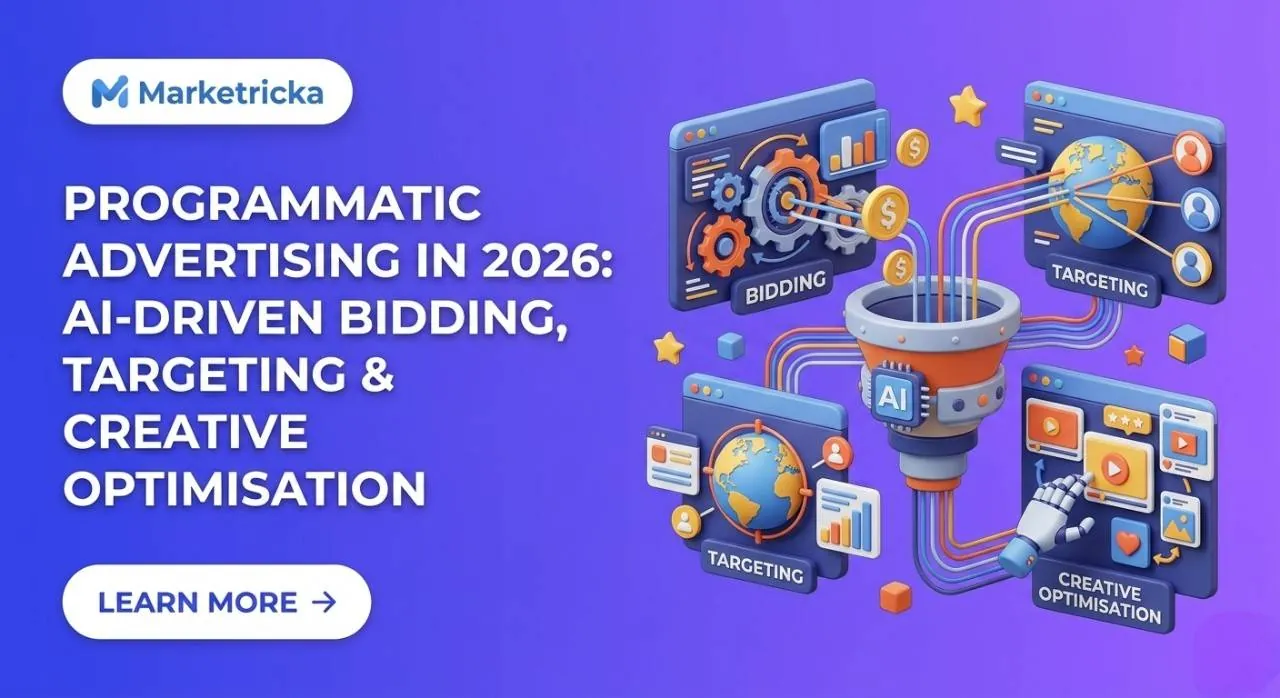
Let's start with a number that should make every marketer uncomfortable: studies consistently show that up to 26 cents of every programmatic dollar is wasted on fraudulent, non-viewable, or completely irrelevant impressions.
Think about what that means for your budget. If you're spending $50,000 a month on ads, around $13,000 of that might be going to waste—not reaching real people, but disappearing into bots, invisible pixels, and pages that nobody ever opens.
And yet, the global programmatic advertising market just hit $110 billion in 2026, on course for $328 billion by 2035. That's not because it doesn't work. It's because, when it's done right, programmatic is the single most efficient way to get your message in front of the right person at the right moment — at a scale no human-managed media buy could ever match.
Source: Global Growth Insights — Programmatic Advertising Market Report 2026
The difference between wasting money and getting a great return on investment comes down to three things: how you bid, who you target and what ads you run. AI has changed all three. This guide is going to show you, as a marketer, exactly how to use that to your advantage.
No complicated tech talk. No confusing terms. What you need to know to make smarter decisions with your ad budget this year.
And if you want the wider picture of how AI is reshaping marketing decisions — not just advertising — our piece on AI Agents in Marketing: How Autonomous AI is Replacing Manual Workflows in 2026 gives you the full context.
What Programmatic Advertising Really Means for Marketers in 2026
Advertising is a way to buy ads automatically. Of calling a publisher, negotiating a price and booking an ad spot, everything happens on its own. Your ad joins an auction, wins or loses based on your bid and who you want to reach and gets shown to someone. All in a split second.
You decide what you want to achieve. You choose who you want to reach. You set a budget. The system takes care of the rest.
That's what programmatic advertising is. Most marketers get it wrong. They think it's a button you press and forget about. They set a campaign to wait for a report at the end of the month and wonder why the results are just okay.
Programmatic advertising works best when you treat it like a living campaign. You need to give it information, clear goals and check on it often. The computer does the work. You still need to be the planner.
The Three Ways Programmatic Inventory Is Bought
Open Auction (RTB): This is the common way. Your ad competes with all buyers in real time. It can reach a lot of people and costs less on average. You have less control over where your ad appears. This is good for finding customers and raising awareness.
Private Marketplace (PMP): This is an invitation- auction. Top publishers offer their ad space to select advertisers. You pay more per ad. Get better placements and safer branding. This is ideal for campaigns where the context matters.
Programmatic Direct: This is a fixed price for guaranteed ad space. It's like an ad buy but with programmatic targeting. Use this when you've found ad spaces that work well for your brand.
A smart programmatic strategy, in 2026, uses all three methods. You allocate your budget based on the stage of the sales funnel, your campaign goals and the type of audience you're targeting.
Understanding how your ad strategy fits into your overall marketing funnel is crucial. Our guide on Marketing Automation Mastery 2026 walks through how automated systems, including programmatic, can work together across your entire customer journey.
AI Bidding: How to Stop Overpaying for Every Ad Impression
The truth is, when you do bidding, you are basically guessing. You pick a number that you think is right. You use it for a whole group of people. Then you hope that the platform does something with it. To be fair, this used to be the only way to do things.
AI bidding is a story. When using a fixed price for every ad, the system looks at each ad opportunity one by one. It decides in time how much it is worth to you based on what you want to achieve with your campaign.
Think of it like this: manual bidding is like offering the salary to every person who applies for a job, no matter how good they are. AI bidding is like negotiating a salary with each person, based on how good they are for the specific job. One way is fair. The other way is smart.
What Changes When You Let AI Bid For You
The difference in results is clear. Campaigns that use AI to bid see 10 to 30% people doing what they want compared to campaigns that are managed by hand. The number of people who click on ads also goes up by around 28 % on average. The return on investment or ROI is 17 % higher or more across all types of campaigns.
Source: SQ Magazine — Programmatic Advertising Statistics 2026
This happens because AI can process a lot of information quickly in a way that no human team can. Every time AI bids on an ad, it takes into account what the user has done recently, what device they are using, what time of day it is, what page they are on, how similar auctions have worked in the past and how likely they are to do what you want. A human can only look at one thing at a time. AI looks at hundreds of things.
The Bidding Strategy That Matches Your Marketing Objective
Brand awareness campaign? Use impression-based bidding focused on viewability. You want eyeballs on quality placements, not just raw impressions.
Lead generation? Target CPA bidding. Tell the system what a lead is worth to you and let it find the audience most likely to convert at that cost.
E-commerce? Target ROAS. Feed it your conversion values, and it will prioritise the impressions most likely to generate profitable purchases.
Retargeting past visitors? Use time-decay segments. People who visited yesterday are worth more than people who visited 30 days ago. Your bidding should reflect that.
High-value accounts (B2B)? Value-based bidding. Bid higher for impressions from people who match your ideal customer profile, not just anyone who clicked your site once.
One important caveat: AI bidding needs enough conversion data to work well. Most platforms require a minimum of 50–100 conversions per month before the algorithm can optimise effectively. If your conversion volume is low, start with a broader goal (like landing page visits) and work your way toward tighter objectives as data builds.
AI fraud detection saves programmatic advertisers approximately $6.5 billion annually in wasted spend
Source: WiFi Talents — Programmatic Advertising Industry Statistics
Smarter bidding is one part of the ROI equation. AI Marketing Analytics: Track ROI Like a Pro covers how to build the measurement foundation that makes AI bidding decisions visible and accountable.
Targeting Without Cookies: How Smart Marketers Are Replacing Third-Party Data
If you've been running programmatic campaigns that depend heavily on third-party audience data, this section is the one you need to read most carefully. Because that data source is going away, and the marketers who haven't built their targeting strategy around what comes next are going to feel it.
Third-party cookies — the little trackers that followed users around the web and let advertisers build audience profiles are being phased out across the major browsers. Safari and Firefox already block them. Chrome, which commands the majority of browser market share, is completing its own phase-out. The behavioural targeting infrastructure that programmatic advertising has relied on for a decade is being dismantled.
88% of marketers now say first-party data is critical for programmatic success. The good news is: the brands that have already built their targeting strategy around data they own are actually performing better, not worse, than they did in the cookie era.
Source: WiFi Talents — Programmatic Advertising Industry Statistics
First-Party Data: Your Biggest Competitive Advantage Right Now
First-party data is everything you know about your audience from direct interactions — your email list, your website behaviour data, your CRM, your purchase history, and your app users. This is data your customers gave you, that lives in your systems, that no privacy regulation can take away from you.
The marketers winning at programmatic targeting right now have done one thing: they've connected their customer data to their ad platforms. Your email list, uploaded and matched. Your CRM segments, mapped to ad audiences. Your website visitors, segmented by behaviour and intent.
Once that's done, you can run lookalike modelling — the platform's AI finds new users who behave similarly to your best existing customers. It's the most powerful prospecting signal in programmatic, and it gets better the richer your first-party data is.
Building strong first-party data also connects directly to your personalisation strategy. Our breakdown of Hyper-Personalization at Scale: How AI Delivers 1-to-1 Marketing Without a 100-Person Team explains how the same data that powers your personalisation also powers your best programmatic targeting.
Contextual Targeting: Back in a Much Smarter Form
Contextual targeting — placing ads based on the content of the page rather than the profile of the user was considered old-fashioned during the cookie era. Now it's making a very serious comeback, and modern AI-powered contextual targeting is nothing like the keyword-matching of the early 2000s.
Today's contextual AI reads the full meaning of a page — its topic, its tone, its sentiment, its relevance to your brand. A financial services company can target content about retirement planning, not just pages with the word 'retirement' in them. A fashion brand can target style-conscious, aspirational editorial environments, not just pages tagged 'fashion.' The match between ad and content context improves relevance without needing any personal data at all.
Contextual targeting investment is expected to double by 2027 as advertisers shift away from behavioural cookie strategies. The brands getting ahead of this curve now are building contextual audience logic that will be a genuine competitive advantage when the cookie transition completes.
Source: SQ Magazine — Programmatic Advertising Statistics 2026
Retail Media: The Intent Signal Cookie Tracking Never Had
If there's one targeting development every marketer should be paying attention to in 2026, it's retail media networks. Amazon, Walmart, Target, and major grocery chains are selling ad inventory powered by actual purchase data — what people have bought, what categories they browse, what price points they shop at.
That's not a probabilistic audience profile built from browsing history. That's real buying intent, from people actively shopping. The signal quality is extraordinary. And because it's built on retailer first-party data — purchase data explicitly shared with the retailer — it's entirely cookieless and fully privacy-compliant.
Commerce media ad spend in the US has surged to nearly $59 billion, with retail media projected to account for around 20% of total US digital ad spend by 2029. If you sell a product or service that people research before buying, you should be testing retail media right now.
Source: eMarketer — Programmatic Advertising
The broader shift in how people discover brands, including through AI search tools, is something every marketer needs to understand. Our piece on How ChatGPT Trends Are Transforming Brand Discovery & Online Visibility connects the dots between programmatic targeting and how AI is changing the top of the funnel.
Creative That Actually Works: How AI Optimises Ads While You Sleep
You can have the perfect bid strategy. You can have the most precise audience targeting in the industry. And a bad ad will still tank your campaign.
Creative quality is the most underinvested variable in most programmatic campaigns. Teams spend weeks obsessing over audience segments and bidding strategy, then approve two or three ad variants and call it done. Meanwhile, the data consistently shows that the creative quality of the actual ad drives between 50 and 75% of campaign performance variation.
AI is fixing this. And the results are significant.
Dynamic Creative: One Brief, Thousands of Variations
The traditional approach to ad creative requires your team to manually brief, produce, and approve every variation. If you want five different headlines, three different images, and two different CTAs — that's 30 combinations, each requiring design time, review cycles, and campaign setup. Most teams manage five to ten variants. The high performers are running hundreds.
Dynamic Creative Optimisation (DCO) automates this. You provide the components — headlines, images, body copy, CTAs, offers, and the system assembles them into combinations automatically. More importantly, it tests those combinations in real time and shifts spend toward what's working, without waiting for a human to review a performance report and make manual changes.
This is not a small-scale improvement. Two out of three enterprise B2C marketing leaders believe AI-driven creative testing will improve both efficiency and ROI, and more than half say it will drive measurable revenue growth on top of brand impact.
Source: MarTech — Performance Marketing Is Being Rewritten by AI
What Marketers Actually Need to Do (Creative Edition)
AI creative optimisation doesn't eliminate the need for a good creative strategy. It makes a good creative strategy go further. Here's what you're responsible for:
Brief for modularity: Write briefs that produce components, not complete ads. 'Give us five headlines that each emphasise a different benefit' produces more testable creative than 'give us a finished ad.'
Test one variable at a time: The AI will test combinations, but your insight comes from isolating what's driving performance. 'Which headline angle works best for this audience?' is a learnable question. 'Was it the headline or the image?' is harder if you change both at once.
Brief for your audience segments, not just your brand: A first-time visitor and a high-value returning customer should see different creative angles. Brief them separately. The AI will serve the right one, but you need to create both.
Never stop testing: Creative fatigue is real. Audiences see the same ads, engagement drops, and CPMs rise. The brands sustaining performance are running fresh creative variations on a regular cycle, not waiting for performance to collapse before making changes.
Personalised Creative at Scale: The 2026 Standard
The leap beyond dynamic creative optimisation is generative creative optimisation, where AI doesn't just assemble your components; it generates new headline variations, new copy angles, and new creative hypotheses based on performance data. Generative AI is expected to cut programmatic creative production costs by 25% while simultaneously increasing the volume of testable variations brands can run. Brands already using AI creative tools report CTR improvements of 25–35% compared to static creative campaigns.
Source: WiFi Talents — Programmatic Advertising Industry Statistics
New Channels, Real Results: Where to Run Programmatic Ads in 2026
If your programmatic strategy is limited to display banners and social retargeting, you're missing the most interesting and least saturated inventory available right now.
Connected TV: The Premium Channel Going Programmatic
Streaming is now the default. Netflix, Disney+, Peacock, Max — they're all running ad-supported tiers. And those ad slots are increasingly available programmatically. CTV programmatic spend in the US is set to exceed $30 billion in 2026, with conversion rates 25% higher than traditional linear TV.
Source: SQ Magazine — Programmatic Advertising Statistics 2026
What makes CTV programmatic interesting for marketers isn't just the reach. It's the attention. People watching a streaming show aren't scrolling past your ad — they're sitting in front of a screen. The completion rates, the brand recall, and the ability to retarget CTV viewers across other devices make this one of the highest-quality inventory types available.
The practical note: measurement is still maturing. Attribution for CTV is more complex than web display. But the brand impact data is strong, and for upper-funnel awareness campaigns, few channels come close.
Digital Out-of-Home: Your Brand in the Physical World, Programmatically
Programmatic DOOH means digital billboards, transit screens, airport displays, and retail screens — bought through the same platforms you use for digital, with the same audience and geo-targeting logic applied. You can now buy a prime billboard placement in a specific city, at a specific time of day, targeted to a specific catchment area, through your DSP.
For local marketers, event-based campaigns, and brand awareness in specific geographies, this is genuinely underutilised. The automation makes it scalable. The physical world reach makes it different.
Programmatic Audio: Reaching Audiences Where Screens Can't
Podcast advertising. Streaming radio. Spotify. These audiences are unreachable through display and social — they're not looking at a screen. Programmatic audio lets you serve dynamically personalised ads into these listening environments at scale, with the same demographic and behavioural targeting you'd apply to digital.
For B2B marketers in particular, business podcasts represent a concentrated, high-intent audience that's actively seeking professional insights. It's a harder-to-reach audience with lower saturation and premium attention — a combination that rarely exists in digital advertising.
How you show up across all of these channels connects to how customers find and perceive your brand. Our breakdown of Google AI Mode: How It's Changing Search & SEO in 2025 covers the parallel shift happening in search and why brand visibility across channels matters more than ever.
Your 2026 Programmatic Game Plan: What to Do This Quarter
Strategy is only useful when it connects to action. Here's what actually moving the needle on your programmatic performance looks like this quarter.
This Month: Sort Your Data House
Before anything else, get your first-party data connected to your ad platforms. Export your email list and upload it. Connect your CRM audiences. Ensure your website has proper conversion tracking firing across all goal events — not just purchases, but form fills, page depth, time on site, and content downloads.
If your analytics and ad platforms aren't connected, your AI bidding is flying blind. Fix this first. Everything else depends on it.
Our article on AI Marketing Analytics: Track ROI Like a Pro is the companion read for this step — it covers exactly how to build the measurement infrastructure that makes all your AI decisions work better.
Next Month: Restructure Your Campaign Objectives
Look at every active campaign and ask: what is the AI actually optimising toward? If the answer is 'clicks' but you actually care about qualified leads, you've got a misalignment that's costing you money. Rebuild your campaign structure around your real business goals.
Awareness stage: Optimise for viewable impressions and completed video views, not clicks
Consideration stage: Optimise for engaged page visits and content consumption, not just landing page loads
Conversion stage: Optimise for actual conversion events — leads, purchases, bookings with offline conversion data imported where possible
Retention stage: Suppress recent purchasers from acquisition campaigns and create a separate retargeting flow with loyalty-oriented creative.
This Quarter: Build Your Creative Testing Engine
Create a simple creative testing calendar. Commit to refreshing your worst-performing creative variants every four weeks. Brief your creative team or your AI tools to produce modular assets: five headline options, three image options, two CTA options per campaign. Let the platform optimise across combinations. Review what wins. Document the learning. Apply it to the next brief.
This single habit, consistent creative testing, produces more performance improvement over six months than any bidding tweak or audience refinement.
If scaling your content and creative production is the constraint, our guide on AI Agents in Marketing: How Autonomous AI is Replacing Manual Workflows in 2026 covers how AI can take pressure off your team across the creative production pipeline, not just ads.
Ongoing: Review, Don't Just Report
The most expensive mistake in programmatic is treating it like a vending machine — put money in, expect results to come out, blame the machine when they don't.
Build a review cadence into your calendar. Weekly: budget pacing, creative performance, and any anomalies. Monthly: audience performance, channel mix, attribution review. Quarterly: full strategy audit — is what you're optimising toward still aligned with what you actually need?
The marketers who avoid the common pitfalls here are the ones who stay honest about where AI needs human oversight. Our AI Challenges in Marketing: 7 Critical Mistakes Costing Businesses ROI in 2025 is a useful reality check — written exactly for this stage of implementation.
Final Thoughts: Programmatic Belongs in Every Marketer's Toolkit
Programmatic advertising in 2026 isn't a specialist discipline. It's not something you outsource to a media agency and ignore. It's a core marketing skill — like email, like SEO, like content — that every marketer who manages budget needs to understand and own.
The AI handles the auction. The AI handles the bid. The AI tests the creative. But you decide what you're optimising for. You decide who your audience is. You decide what your brand stands for in the creative. You set the guardrails. You do the reviews.
That's the marketing job in 2026: being a smart, intentional director of AI systems that do the execution at a scale you never could alone.
The programmatic market is heading toward $328 billion by 2035. The inventory is getting more competitive. The targeting is getting more sophisticated. And the gap between marketers who do this thoughtfully and those who just hit 'go' is widening every quarter.
Source: Global Growth Insights — Programmatic Advertising Market Report
The good news? The fundamentals are accessible. Clean data. Clear objectives. Modular creative. Regular reviews. That's the framework. Stack AI on top of it, and you have a programmatic strategy that can genuinely compete.
For more practical, marketer-first guides on AI, digital advertising, and growth strategy, explore the Marketricka blog — built for people who want to do marketing better, not just talk about it.