
Marketing Automation Mastery: Complete Guide for 2026
Learn how marketing automation drives growth with smart workflows, lead nurturing, personalization, and sales alignment.
 By Divyesh Savaliya
Marketing automation is not magic. It doesn’t fix broken strategies. It doesn’t invent demand. And it definitely doesn’t replace thinking.
What it does is scale intent. It takes your best ideas, your most thoughtful customer journeys, your strongest messaging, your smartest timing, and repeats them reliably, tirelessly, across thousands or millions of interactions.
Used well, marketing automation becomes the quiet engine behind predictable growth. Used poorly, it becomes noise. This guide is about mastering it. Not just setting up workflows. Not just buying tools. But building a system that respects your customers’ time, your team’s energy, and your business goals.
Let’s begin.
What Is Marketing Automation?
Marketing automation is the practice of using software to execute, manage, and measure marketing activities automatically across channels. But that definition is too small. Real marketing automation is an operational philosophy.
It means:
Triggering communications based on behavior
Personalizing content dynamically
Routing qualified leads to sales
Nurturing prospects over time
Measuring everything
Instead of blasting messages, automation listens first.
Someone downloads a guide? They enter a nurture flow.
Someone views pricing twice? They get a product email.
Someone stops engaging? They receive a reactivation campaign.
Today’s platforms increasingly combine automation with AI to predict outcomes, optimizing send times, and identifying high-intent users automatically. This evolution moves automation from rigid rules toward adaptive systems.
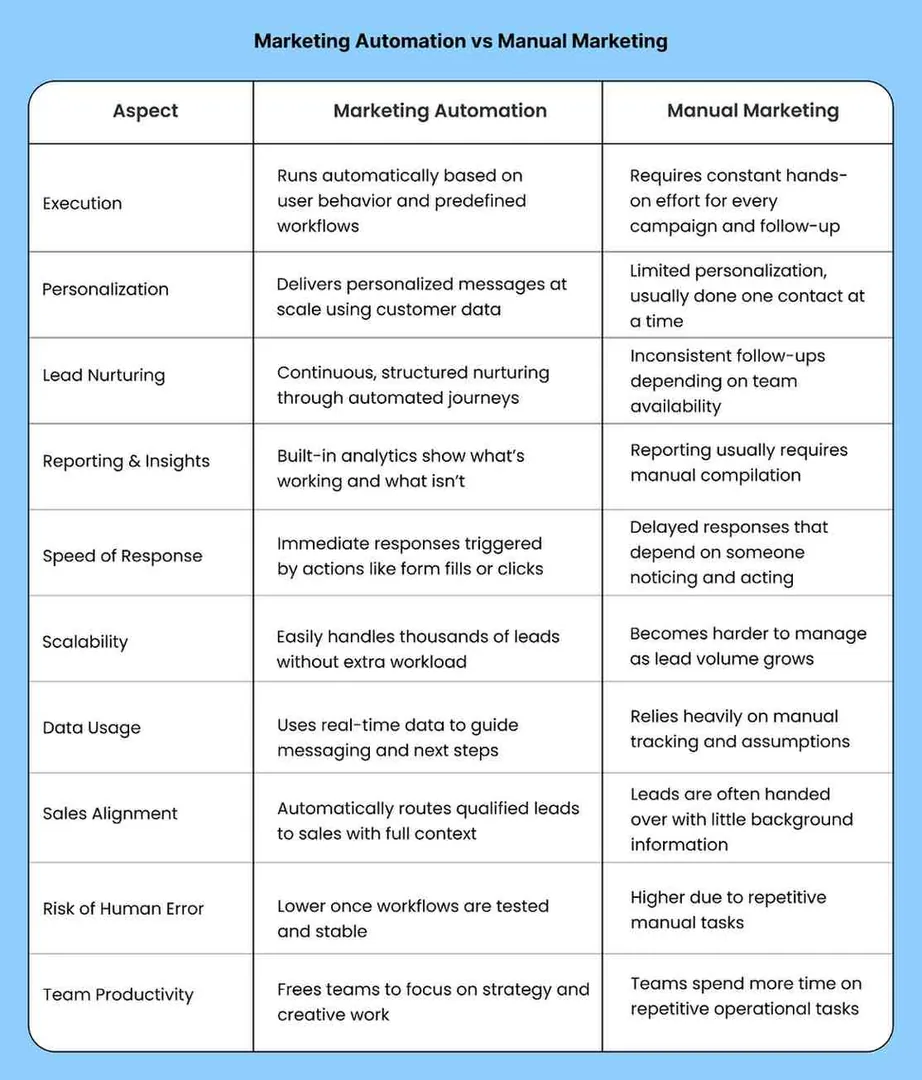
Marketing Automation vs Manual Marketing
Core Components of Marketing Automation
Every serious marketing automation setup relies on the same building blocks. So here are the core and critical components of marketing automation.
1. Data collection
Everything starts with data. Page visits. Email opens. Form submissions. Purchases. App activity. All of it flows into a single customer record. If your data is scattered, automation struggles. Clean inputs matter more than fancy features.
2. Segmentation
Segmentation groups people based on behavior, interests, or where they are in the buying process. New leads. Returning visitors. Active customers. This is how messages stay relevant instead of turning into noise.
3. Lead scoring
Lead scoring assigns value to actions. Reading a blog might be one point. Requesting a demo might be fifty. Over time, this creates a simple way to spot sales-ready prospects without guessing.
4. Workflow automation
This is the engine. Workflows send emails, trigger SMS messages, update CRM fields, notify sales teams, and move people through journeys automatically.
5. Reporting
If you can’t measure it, you can’t improve it. Good platforms show engagement, conversions, pipeline contribution, and revenue, so you know what’s working and what isn’t.
Benefits of Marketing Automation
Marketing automation isn’t about doing more marketing. It’s about doing better marketing with the same team.
When companies adopt automation thoughtfully, they usually notice changes in places they didn’t expect. It’s not just campaign speed or email volume. It shows up in how sales conversations feel. It shows up in how customers move through the funnel. It shows up in fewer dropped leads and clearer decision-making.
Here’s what actually improves.
1. Your team gets time back and uses it on work that matters
Most marketing teams spend a surprising amount of time on tasks that don’t need human creativity: sending follow-ups, updating spreadsheets, tagging contacts, exporting lists, and nudging sales. Marketing automation takes those chores off the table.
Once workflows are in place, leads flow automatically into nurture campaigns. Emails go out based on behavior. CRM records update themselves. Sales alerts trigger when prospects show buying signals.
The result isn’t just efficiency. It's the focus. Your team stops babysitting processes and starts working on messaging, campaigns, customer research, and strategy. That shift alone changes how marketing feels day to day.
2. Lead nurturing becomes consistent instead of accidental
Without automation, lead nurturing depends on memory. Someone has to remember to follow up. Someone has to notice that a prospect downloaded something. Someone has to decide when it’s time to reach out. That doesn’t scale.
Marketing automation creates steady, predictable lead nurturing. Every new lead enters a journey. Every prospect receives content over time. Every interaction adds context.
This matters because most buyers aren’t ready when they first engage. They’re researching. Comparing. Waiting for budget approval. Automation keeps your brand present during that quiet period, sending useful content instead of sales pressure.
Over time, this builds familiarity and trust, and when buyers are ready, they already know who you are.
3. Personalization becomes practical at scale
Personalized marketing sounds great until you try to do it manually. Automation makes it manageable. Emails can change based on industry, job role, or previous activity. Website content can shift depending on whether someone is new or returning. Product recommendations can reflect browsing behavior.
This is where customer journey automation earns its keep. Instead of everyone seeing the same message, people see what’s relevant to them. A first-time visitor gets educational content. A returning prospect sees pricing details. An existing customer receives onboarding tips.
It feels human, even though it’s automated. And customers notice.
4. Sales gets warmer conversations, not cold handoffs
One of the quiet wins of marketing automation is what it does for sales teams. Instead of receiving raw leads with no background, sales gets prospects with a history attached to what pages they visited, what emails they opened, and what content they downloaded.
Lead scoring helps prioritize outreach. High-intent prospects rise to the top. Casual browsers stay in nurture campaigns until they show a stronger interest. This changes sales conversations. Reps don’t have to guess what someone cares about. They already know. It shortens sales cycles and reduces frustration on both sides.
5. Marketing decisions stop relying on gut feeling
Marketing automation brings visibility. You can see which campaigns drive conversions. Which emails lead to demos. Which landing pages lose people. Which channels bring qualified leads.
This replaces opinion with evidence. Instead of arguing over ideas, teams look at performance. Instead of guessing what works, they test and measure. Over time, this builds a feedback loop where every campaign improves the next one. That’s how marketing becomes predictable instead of reactive.
Getting Started: Implementation Roadmap for Marketing Automation
This is where most marketing automation projects quietly fail.
Not because the platform is wrong. Not because the features are missing. They fail because teams rush. They treat automation like a software rollout instead of a change in how marketing actually operates.
A good implementation doesn’t feel dramatic. There’s no big launch day. It feels gradual. A few workflows go live. A few reports start making sense. Sales notice better leads. Marketing stops chasing follow-ups.
That’s what progress looks like.
Here’s how to get there.
1. Start with what you already have (and what’s broken)
Before you even open a marketing automation tool, take a slow walk through your current process. Where do leads enter the system? Through forms? Ads? Referrals? Events?
Then follow one lead from start to finish. What happens after they submit a form? Who owns the follow-up? How long does it take? Where does communication drop off?
Most teams discover the same things:
Leads sitting untouched for days.
Spreadsheets are being emailed back and forth.
Sales reps are unsure which prospects matter.
Marketing sends campaigns without knowing what happens next.
These are not small problems. They’re signals. Automation works best when it fixes specific pain points, not abstract goals. Write everything down. Those broken spots become your first automation opportunities.
2. Clean your data before you automate anything
This step feels boring. It’s also the most important. Marketing automation runs entirely on data. If your contact records are messy, everything downstream breaks. Duplicate contacts receive multiple emails. Missing fields make segmentation useless. Old records distort reporting.
Spend real time here.
Merge duplicates.
Standardize job titles and industries.
Decide which fields actually matter.
Remove contacts that shouldn’t be marketed to.
It’s tempting to skip this because it doesn’t feel productive. But clean data is what turns automation into precision instead of chaos. Think of it like laying plumbing before installing appliances.
3. Decide what “success” looks like in plain terms
Avoid technical goals like “build workflows” or “launch campaigns.” Those aren’t outcomes. Ask harder questions:
Do you want more qualified demo requests?
Are you trying to shorten sales cycles?
Is retention the problem?
Are leads coming in but not converting?
Pick one or two priorities. Tie every workflow back to them. Otherwise, you’ll end up with beautifully built automations that don’t move revenue, and nobody will know why. This step forces discipline.
4. Choose your platform based on how your team actually works
Yes, platforms like HubSpot, Salesforce, and Adobe Experience Cloud offer powerful marketing automation features. But features don’t matter if your team avoids the tool.
Watch how your marketers work. Are they technical? Are they visual? Do they live in spreadsheets? Do they hate complex dashboards? Choose software that fits those habits.
Look for:
Simple workflow builders
CRM integration that doesn’t require engineering help
Reporting that answers business questions, not just technical ones
Interfaces people don’t dread opening
5. Build one or two core workflows first
Every team wants to automate everything immediately. This can’t be possible in this case. Start with workflows that solve obvious problems: A welcome sequence for new leads. A nurture campaign for prospects who aren’t ready to buy. A sales alert when someone shows strong buying signals.
These flows teach your team how automation behaves. They reveal data issues. They surface timing problems. They also build confidence. Once those basics work, everything else becomes easier.
6. Test like you don’t trust yourself (because you shouldn’t)
Automation magnifies mistakes. An incorrect email goes to thousands of people. A broken condition sends prospects down the wrong journey. A missing merge field turns personalization into embarrassment. So test obsessively.
Submit your own forms.
Click your own emails.
Pretend you’re a customer moving through the journey.
Check:
Is the timing right?
Do emails feel natural?
Are sales notifications firing properly?
Does personalization actually work?
This is just one case scenario. There are thousands of possibilities where automation can create blunders if not tested thoroughly.
7. Bring sales into the process early
Marketing automation doesn’t belong to marketing alone. Sales should help define lead scoring rules. They should explain which signals matter. They should agree on when a lead becomes sales-ready. Show sales how journeys work. Share reports. Ask for feedback. If sales don’t trust automation, they’ll ignore it. And then you’ve built a very expensive email machine. Alignment here saves months of friction.
8. Measure, adjust, repeat
Once workflows go live, start paying close attention to what actually happens. Look at which emails get opened, where people drop off, whether leads are converting faster, and if sales conversations feel more productive. Use these signals to refine your journeys. Tweak subject lines. Adjust timing. Add helpful content. Remove steps that don’t move people forward.
Marketing automation improves through steady tuning, not big redesigns. Small changes, made consistently, add up over time.
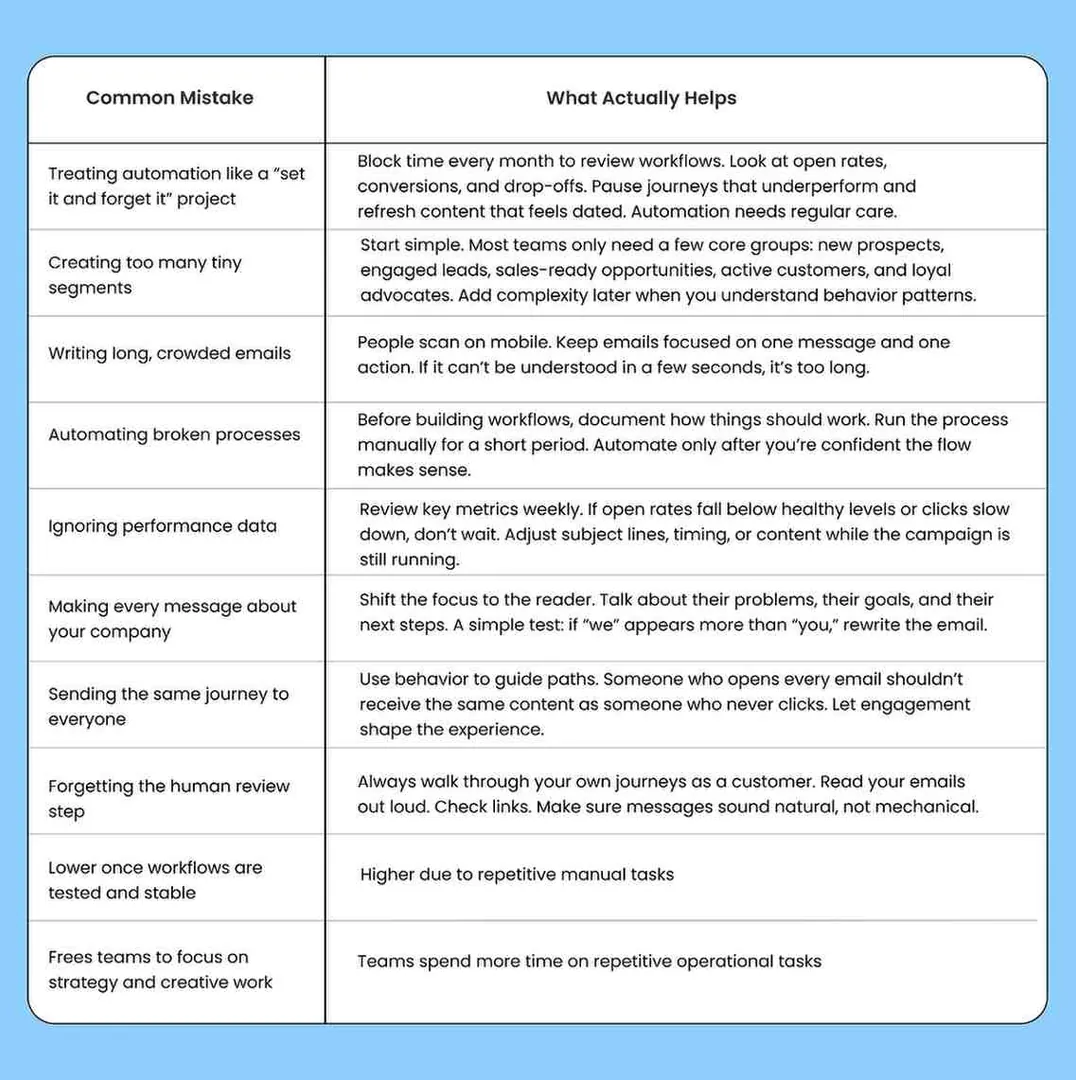
Marketing Automation Mistakes to Avoid (and What to Do Instead)
Want to Get Started with Marketing Automation? Here’s What to Do Next
Marketricka is a sales and AI automation marketing services provider with in-house experts who help businesses design practical automation strategies, build customer journeys, and optimize workflows based on real performance data. Whether you’re getting started or refining existing systems, the team focuses on creating marketing automation that supports revenue growth and long-term engagement.