
AI Marketing Analytics: Track ROI Like a Pro
Track ROI smarter with AI marketing analytics. Gain clear insights, predictive data, and optimize campaigns with confidence.
 By Divyesh Savaliya
Most marketing teams say they’re “data-driven,” but when the reports build up, dashboards grow messy, and every platform tells a different story, it becomes clear that having data and using data are two completely different things. In fact, studies show that nearly 63% of marketing data goes unused because teams either don’t have time to analyze it or aren’t sure what to do with it. This is exactly where AI marketing analytics changes the game. Instead of spending hours digging through numbers, AI reads the data for you, identifies patterns you may not even notice, and highlights opportunities that directly impact revenue.
The beauty of AI analytics is that it doesn’t just pull reports; it gives you clarity. It shows which campaigns are actually working, which channels are silently draining money, and what kind of improvements can increase ROI in the next 30 days. And if you’ve already been exploring AI in marketing for personalization or content automation, this is the natural next step. AI marketing analytics becomes the layer that measures all your efforts with far more accuracy than traditional dashboards ever could.
What is AI Marketing Analytics?
AI marketing analytics is simply a smarter, more predictive way to understand your marketing performance. Instead of depending on manual spreadsheets or basic KPIs, AI uses machine learning, predictive models, and behavioral analysis to break down what’s really happening in your campaigns. Think of it as moving from “We spent this much, and here’s the outcome” to “Here’s why it performed this way, here’s what will happen next month, and here’s where your next revenue opportunity lies.”According to industry research, AI contributions in the marketing field will exceed 107 billion by 2028.
How AI Marketing Analytics Benefits Your Business
Let’s start from the basics, how AI marketing analytics is a way to bring a lot to your business, and here is the list.
A clearer picture of what genuinely impacts your marketing ROI
Every marketing team has numbers coming in from multiple tools, but the real challenge is understanding which of those numbers actually matter. AI marketing analytics helps cut through unnecessary noise by tying your efforts back to revenue in a way that feels logical and easy to act on. You’re no longer making decisions just because a dashboard looks good; you’re deciding based on what truly influences your bottom line.More confidence in where you put your budget and why
One of the biggest frustrations for growing brands is not knowing whether a channel deserves more spend or should be scaled back. AI brings a sense of clarity by showing the hidden performance patterns behind each platform. It becomes much easier to shift budgets when you can see, with evidence, which channels consistently attract high-quality customers and which ones aren’t pulling their weight over time.More accurate attribution that reflects the entire customer journey
It is common for traditional analytics to overvalue the final touchpoint in a conversion. AI offers a more balanced view by tracking how customers move across several interactions before they decide. When you understand the real influence of each step in the journey, your strategy becomes more complete. You respect the value of early and mid-stage touchpoints instead of focusing only on the last action.
Decisions that feel easier because the data is finally clear
When information is organized, interpreted, and presented in a straightforward way, marketing decisions stop feeling heavy. AI handles the complexity behind the scenes and brings forward the insights that matter. This reduces confusion, speeds up decision-making, and gives the entire team more clarity about what should happen next.
AI Marketing Analytics vs Traditional Marketing Analytics
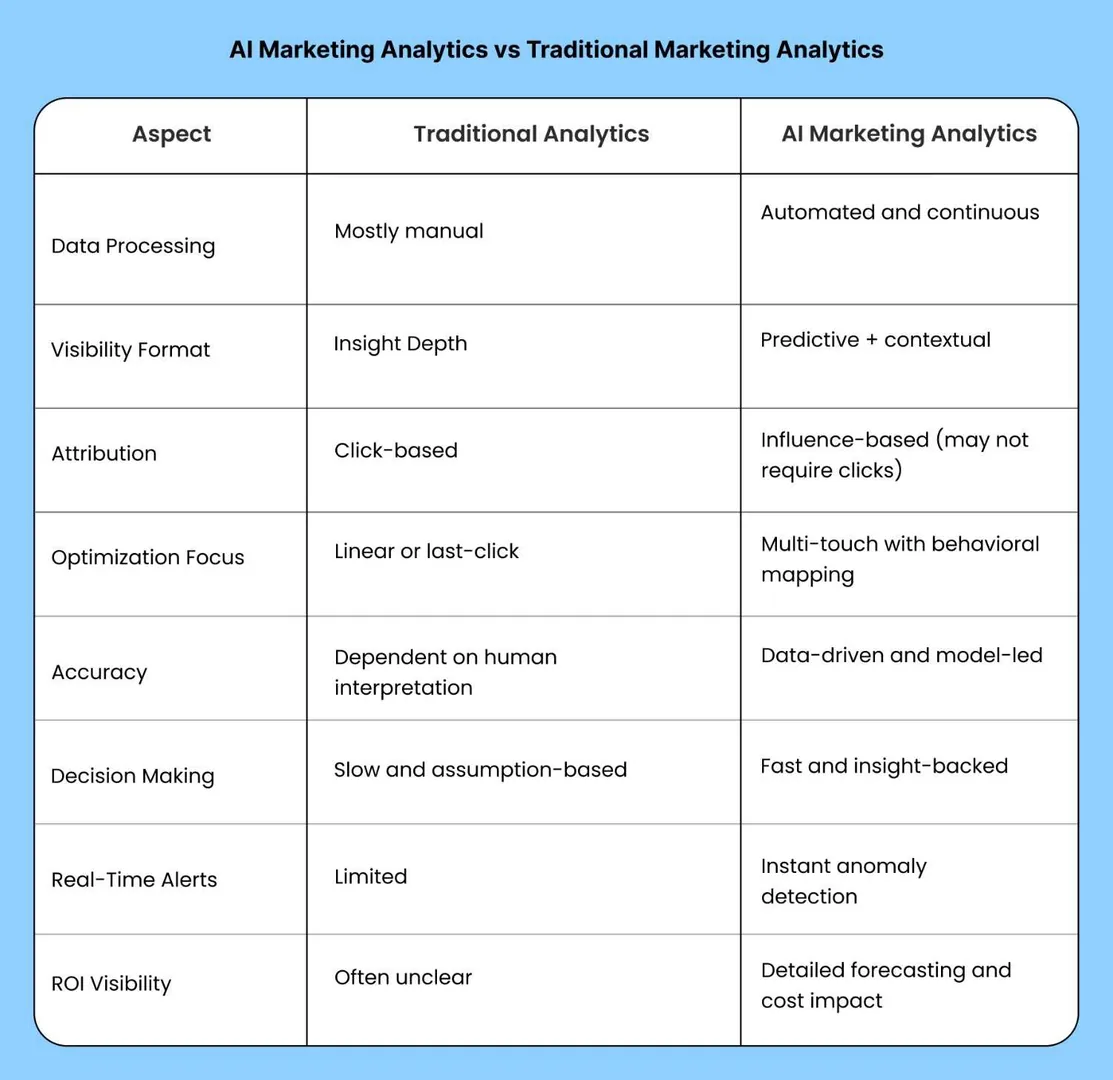
Traditional analytics tools depend heavily on manual interpretation. You receive data in charts, and your team must analyze trends and decide what’s relevant. AI-driven analytics, however, interprets the data for you.
Here’s a clear comparison:
Best Practices for Measuring ROI Through AI Marketing Analytics
Measuring ROI through AI marketing analytics becomes far more meaningful when you approach it with intention rather than treating it as another reporting task. The goal is to build a system that helps your team understand performance in a practical and clear way. AI brings intelligence, but the clarity comes from how you structure your measurement approach. These best practices help you create a measurement framework that feels organised, insightful, and genuinely useful for the decisions you make every day.
Define ROI metrics that reflect your real business outcomes:
The volume of available data often pulls teams in many directions. Before reviewing any dashboard, choose the indicators that truly represent progress for your organisation. These may include customer acquisition cost, lifetime value, conversion efficiency, revenue influence, or the contribution of each interaction. When everyone agrees on what matters, your AI marketing analytics system becomes far easier to interpret and far more aligned with your goals.
Bring all your marketing and sales data into one connected environment:
AI delivers its strongest insights when it can see the complete picture. This requires unifying your data from advertising platforms, CRM systems, email tools, website analytics, and sales reports. When information flows together cleanly, AI is able to identify patterns that are not visible when each platform is reviewed separately. This unified view reduces confusion and strengthens the accuracy of your ROI assessment.
Review the customer journey rather than isolated touchpoints:
People need more than one contact point to make a conversion. AI marketing analytics provides insights about how prospects progress from awareness to decision-making. The evaluation of performance requires a complete journey assessment because it shows channel impact and customer decision points, and conversion factors. This perspective provides a more honest understanding of ROI across campaigns.
Use predictive insights to stay ahead of performance shifts:;;;
Traditional reporting focuses on what happened. AI provides you with information about upcoming events that will probably occur in the future. The review of predictive signals enables you to forecast performance declines while recognizing new opportunities that will emerge, and you need to modify your campaigns before results start to drop. The proactive approach safeguards your return on investment while enabling your team to take educated actions without having to wait until problems become serious.
Treat optimisation as a continuous process rather than an occasional effort:
The process of developing effective marketing systems requires constant improvement through evaluation. Your team needs to establish a routine that lets them explore AI results because AI identifies specific changes that produce measurable benefits over extended periods. The data-supported incremental advances that your team develops will enhance all campaign elements without needing to execute big changes.
Evaluate ROI in a wider context that includes operational impact:
The return from AI marketing analytics extends beyond revenue generation. The benefits include better reporting accuracy and reduced workload for staff and improved team collaboration, and more precise predictions. The operational benefits and financial results provide you with a complete understanding of how AI improves your marketing operations.
How to Implement AI Marketing Analytics in Your Business
1. Start by looking at the data you already collect
Before you bring AI into the picture, get familiar with the numbers you track today. Open your tools. See what is being recorded, what you actually use, and what has been sitting untouched for months. You may find a few surprises. This quick check helps you understand what needs fixing and what can stay.
2. Pick a tool your team will not avoid
Choose something simple. A tool that connects easily to your CRM, ad platforms, and website tracking without making your team feel confused or stuck. If people avoid it, it will never help you. Go with something that feels clean and easy to navigate.
3. Connect your platforms so your data stops fighting with itself
When everything is scattered, nothing makes sense. Link your tools so your numbers live in one place. Once the data flows together, patterns start showing up on their own, and your reports finally begin to tell a consistent story.
4. Create dashboards that show the real numbers you care about
Do not crowd your screen with 20 charts. Pick the few numbers that actually tell you how your marketing is doing. Keep the dashboard simple enough that you can understand it at a glance. A clean view always leads to calmer, sharper decisions.
5. Check your AI suggestions once a week
You do not need to babysit the tool. A quick weekly check is enough. Look at what changed. See which campaigns need a little help. Adjust the things that make sense. These small tweaks keep your marketing under control without overwhelming you.
6. Make small changes and watch how they play out
There is no need for big, dramatic shifts. Start with small updates. Change the target group. Adjust a creative. Move a little budget. These small moves teach you more about your system than large resets. Over time, they build a much stronger and predictable setup.
How Marketricka Helps You Build a Winning AI Marketing Analytics Framework
Marketricka helps you make sense of your data without drowning in dashboards. We set up the right tools, connect everything properly, and show you the numbers that genuinely matter for your growth. With our team, AI analytics feels less like a technical project and more like a system you can trust every day.