
AI Agents in Marketing: How Autonomous AI is Replacing Manual Workflows in 2026
Discover how AI agents automate marketing workflows in 2026, boosting ROI, cutting costs, and replacing manual tasks.
 By Divyesh Savaliya
Let me be real with you — most marketing teams are still running on manual workflows that were designed for 2018. Spreadsheets. Copy-pasted reports. Someone spends hours every Monday pulling campaign data from five different platforms.
That era is ending fast.
According to MarketsandMarkets, the global AI agents market is set to grow from USD 7.84 billion in 2025 to USD 52.62 billion by 2030 — at a CAGR of 46.3%. That's not a trend. That's a transformation.
Industry research from KPMG shows that roughly 33% of organisations have already deployed at least some AI agents — triple the adoption rate seen just two quarters earlier (11%). And companies using AI-driven marketing platforms are reporting a 20% increase in sales conversions, 30% lower customer acquisition costs, and 25% higher retention rates.
Source: KPMG — Q2 2025 AI Pulse Survey
Source: SuperAGI — 2025 AI Marketing Trends
If you're a marketer or a business owner wondering what all this "agentic AI" hype actually means for your campaigns, budgets, and team, this guide is for you. No fluff, just the real picture.
What Are AI Marketing Agents? (And Why Should You Care?)
Think of an AI marketing agent as a very capable digital team member that never sleeps, never misses a data point, and never gets tired of running the same optimisation task at 3 AM.
More technically, AI marketing agents are autonomous or semi-autonomous systems that execute specific marketing and analytics tasks with minimal human intervention. They're powered by machine learning, natural language processing (NLP), and advanced automation frameworks. They don't just sit there generating reports — they collect data, spot patterns, make decisions, and take action across your platforms.
But here's where most people get confused — not all AI in marketing is the same.
There are three types you need to know:
Generative AI
This is your ChatGPT, Jasper, and content-writing tools. Great for producing ad copy, social posts, and email drafts at scale. But it still needs human direction on when and how to deploy that output.
Predictive AI
Uses data and machine learning to forecast outcomes — think churn prediction, lead scoring, and demand forecasting. It tells you what will likely happen, but doesn't act on its own.
Agentic AI
This is the big shift. Agentic AI can plan, execute, and adjust actions in real time — autonomously. It can pull data, analyse it, reallocate your ad budget, and send you an alert — all without a single human touchpoint. This is what's truly replacing manual workflows.
The distinction matters because when someone says "we're using AI in marketing," they could mean any of the three. In 2026, the brands pulling ahead are the ones moving from generative AI to agentic AI.
If you're already navigating the pitfalls of AI adoption, our piece on AI Challenges in Marketing: 7 Critical Mistakes Costing Businesses ROI is a must-read before you scale.
Types of AI Agents Transforming Marketing Workflows in 2026
Not all AI agents do the same thing. In marketing, agents are emerging across several distinct categories, and each one is chipping away at a different slice of manual work.
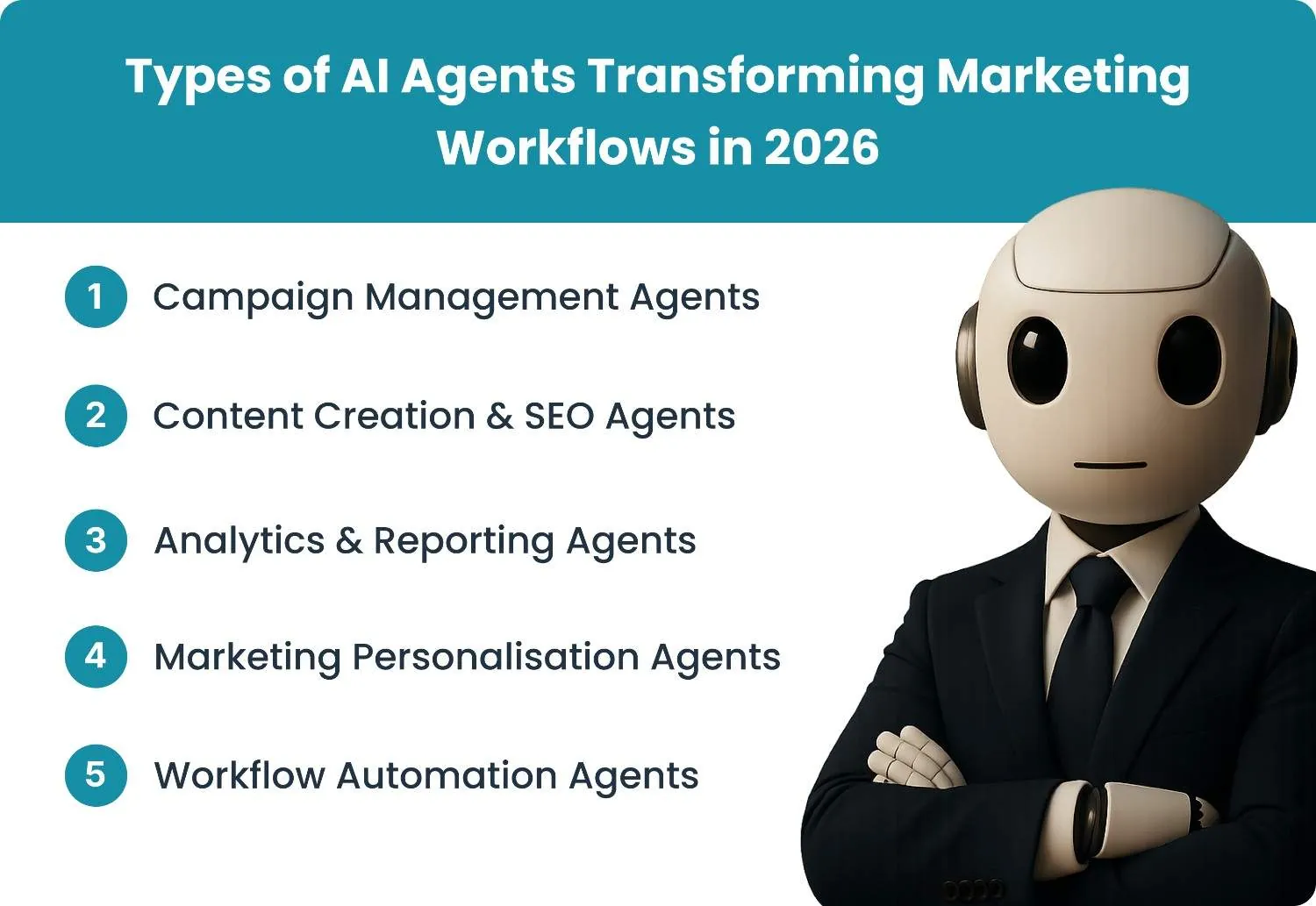
1. Campaign Management Agents
These agents monitor your live campaigns across Google Ads, Meta, LinkedIn, and more — automatically adjusting bids, pausing underperforming ad sets, and reallocating budget toward what's working. Instead of you checking dashboards every morning, the agent does it continuously.
What they replace: Manual bid adjustments, daily campaign checks, weekly performance reviews.
2. Content Creation & SEO Agents
These agents handle keyword research, content gap analysis, first-draft generation, and on-page optimisation recommendations. Platforms like Jasper and Copy.ai have evolved to produce content that aligns with your brand voice consistently.
What they replace: Hours spent on manual keyword research, content briefs, and SEO audits.
3. Analytics & Reporting Agents
One of the most impactful categories. Analytics agents pull data from multiple platforms, unify it, detect anomalies — like a sudden CPC spike or conversion drop — and produce plain-English reports. According to Improvado's case study with Chacka Marketing, one agency saw a 90% reduction in manual reporting time after deploying AI-powered analytics.
Source: Improvado — Chacka Marketing Case Study
4. Marketing Personalisation Agents
These agents analyse individual customer behaviour and dynamically personalise email content, website experiences, and ad messaging at scale. Salesforce's Agentforce and ActiveCampaign use agent-powered workflows to deliver the right message to the right person at the right time automatically. You can learn more about how Salesforce frames this shift in their Agentic Marketing overview.
What they replace: Static segmentation, one-size-fits-all email blasts, generic ad creative.
5. Workflow Automation Agents
Tools like Zapier and Relevance AI let you build multi-step automated workflows across your entire marketing stack — no code needed. When a lead fills a form, the agent can enrich their data, score them, assign them to a sales rep, trigger a nurture sequence, and log everything in your CRM — all in seconds.
What they replace: Manual hand-offs between tools, copy-paste data entry, missed follow-ups.
For a practical walkthrough on automating your sales process end-to-end, see our guide on the Automated Sales Process: Crafting Pitches that Convert.
Real-World Use Cases: Where AI Agents Are Replacing Manual Work
Let's get concrete. Here's where AI agents are actually delivering results right now — not in a lab, but inside real marketing teams.
Cross-Channel Performance Analysis
Before AI agents, getting a unified view across Google Ads, Meta, LinkedIn, email, and organic required a data analyst, a few hours, and a lot of copy-pasting. Now, an AI agent pulls all of that data, normalises it, and surfaces insights in minutes. Teams are moving from weekly reporting cycles to real-time decision-making.
Anomaly Detection & Budget Protection
AI agents constantly monitor live data streams and flag unusual patterns — a sudden 40% spike in CPC, a conversion rate drop from a specific segment, or a tracking pixel that's stopped firing. Teams get instant alerts with context, not just a raw number — so they can act before a small issue becomes a major budget bleed.
Predictive Lead Scoring
Instead of manually reviewing lead quality or using basic demographic filters, AI agents analyse dozens of behavioural signals — page visits, email opens, content downloads, time on site — to predict which leads are most likely to convert. Salesforce Einstein and HubSpot's AI tools do this in real time, ensuring sales teams spend their time on the right prospects.
Automated Executive Reporting
Marketing leaders used to spend hours preparing board-level reports. AI agents now generate tailored performance summaries automatically, on schedule or on demand. Function Growth, using Improvado's AI-powered reports, saw a 30% increase in team productivity because their team stopped drowning in manual data tasks.
Personalised Email Campaigns at Scale
Platforms like Klaviyo and ActiveCampaign now use AI agents to personalise email content, subject lines, send times, and product recommendations at the individual level — automatically. The result? Better open rates, higher conversions, and less time manually building segments.
The rise of AI search is also changing how people discover brands in the first place. Our article on How ChatGPT Trends Are Transforming Brand Discovery & Online Visibility explains what this means for your top-of-funnel strategy.
How to Choose the Right AI Marketing Agent for Your Business
With so many tools claiming to be "AI-powered," it's easy to get overwhelmed. Here's how to cut through the noise and find what actually fits your business.
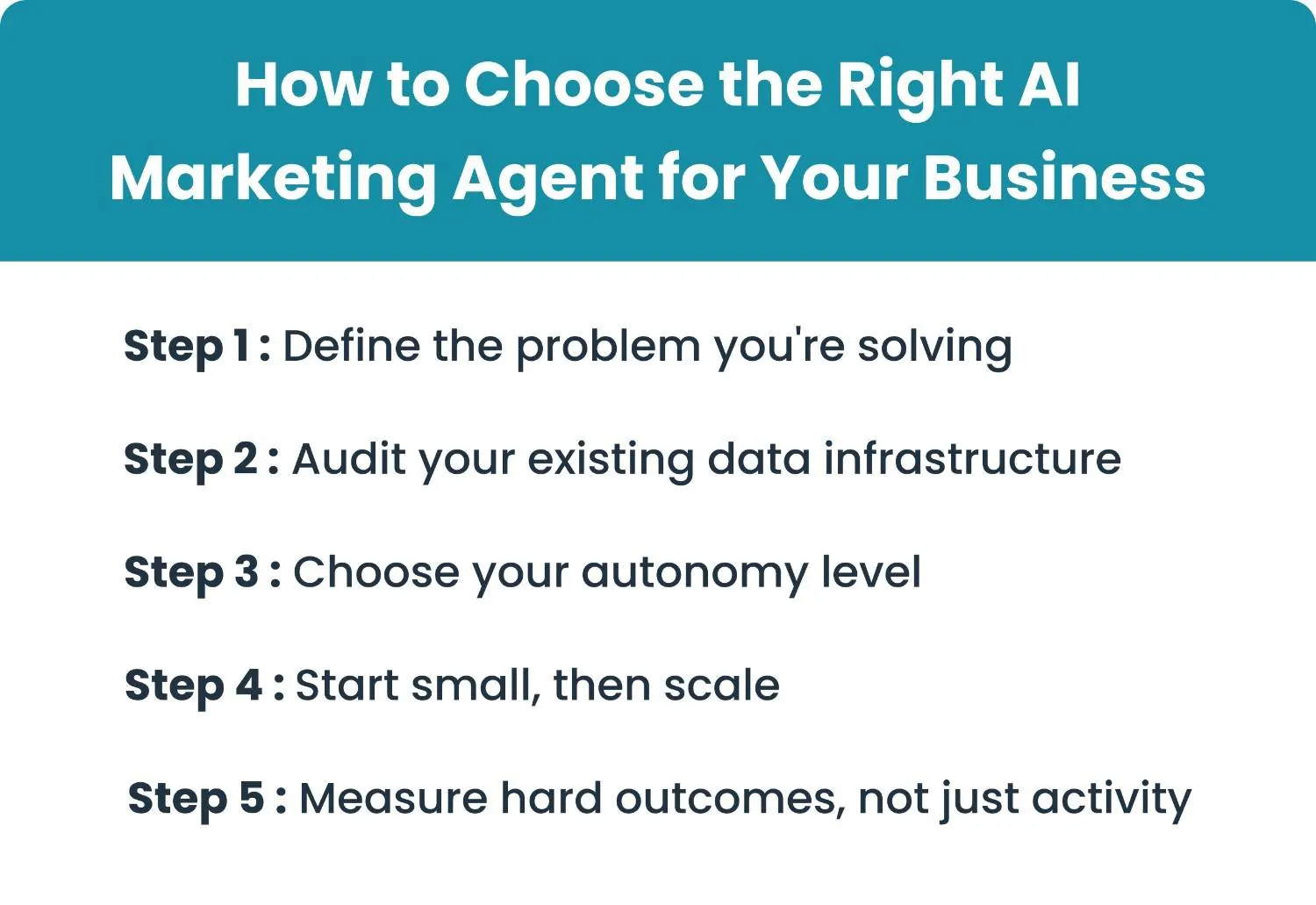
Step 1: Define the problem you're solving
Don't start with the tool. Start with the pain. Is it that your team spends too much time on reporting? Are your campaigns not being optimised fast enough? Is that personalisation non-existent? Every AI agent shines in a specific area — matching the agent to the problem is everything.
Step 2: Audit your existing data infrastructure
AI agents are only as good as the data they run on. Before deploying any agent, check your data pipelines for gaps in freshness, standardisation, and coverage. If your CRM and ad platform data aren't talking to each other, the agent will produce garbage outputs.
Step 3: Choose your autonomy level
There are three types to consider — insight-only agents (give you recommendations), semi-autonomous agents (require human approval before acting), and fully autonomous agents (execute changes directly). Your choice should depend on your governance standards, risk appetite, and data quality.
Step 4: Start small, then scale
The worst thing you can do is deploy an AI agent across your entire marketing stack on day one. Pick one channel or one use case. Validate that the agent's recommendations align with human judgment. Build trust in the system before expanding its remit.
Step 5: Measure hard outcomes, not just activity
It's tempting to measure success by "hours saved" or "reports automated." Those matter, but tie every agent deployment to a business outcome — cost-per-lead reduction, conversion rate lift, ROAS improvement. That's how you justify the budget and scale the investment.
Here's a quick tool-matching framework based on business size and need:
• Small business/freelancers: Zapier + Jasper + Surfer SEO — low cost, high automation for content and workflows
• Growing teams: HubSpot AI + ActiveCampaign + Google Ads Smart Bidding — solid for lead gen and email personalisation
• Mid-market: Salesforce Agentforce + Relevance AI — powerful CRM integration and custom agent building
• Enterprise/agency: Improvado + Adobe Sensei + Salesforce Einstein — full-stack analytics, governance, and personalisation at scale
Search visibility is shifting too — not just how you run campaigns, but how customers find you. Read our Google AI Mode: How It's Changing Search & SEO in 2025 to understand how to stay visible as search evolves.
Will AI Agents Replace Marketers? (The Real Answer)
This is the question everyone's thinking, but not everyone's asking out loud. Let's not dance around it.
AI agents are not going to replace marketers wholesale. But they will absolutely replace marketers who refuse to adapt.
Gartner predicts that at least 15% of day-to-day work decisions will be made autonomously through agentic AI by 2028, up from essentially 0% in 2024. And 33% of enterprise software applications will include agentic AI by 2028, up from less than 1% today.
Source: Gartner Press Release — June 2025
What this means in practice: The repetitive, data-heavy, manually-intensive parts of marketing — bid management, reporting, list segmentation, A/B test analysis — are going to be increasingly handled by agents. Not because AI is smarter than marketers, but because it's faster and never makes careless errors at 11 PM.
What it doesn't mean: AI agents can't build a brand strategy. They can't navigate client politics. They can't create a campaign idea that genuinely moves people. They can't build trust with a customer the way a thoughtful human can.
The marketers who will thrive in 2026 and beyond are the ones who learn to work with agents — directing them, interpreting their outputs, catching their mistakes, and using the time they free up for high-value, human work.
New roles are already emerging: AI Campaign Strategists who architect human-AI workflows, Data Interpreters who translate agent outputs into business decisions, and Creative Directors who maintain brand integrity across AI-generated content.
By 2028: 15% of daily business decisions made autonomously by AI (Gartner)
Understanding where AI falls short is just as important as knowing where it excels. Our article on AI Challenges in Marketing: 7 Critical Mistakes Costing Businesses ROI covers the risks you need to manage as you scale agentic workflows.
Final Thoughts: Your Move in 2026
Here's the honest summary: AI agents in marketing are no longer a future concept. They're live, they're delivering measurable results, and the gap between teams using them and teams not using them is widening every quarter.
The good news? You don't have to boil the ocean. Pick one workflow that's eating your team's time — reporting, bid management, lead scoring, email personalisation — and find an agent that solves it. Test it properly. Measure the outcomes. Then expand.
The companies that will dominate their markets in the next three to five years won't necessarily be the ones with the biggest teams or the biggest budgets. They'll be the ones that figured out how to pair human creativity and strategy with the relentless efficiency of autonomous AI.
That's the real opportunity sitting in front of every marketer reading this right now.