
Hyper-Personalization at Scale: How AI Delivers 1-to-1 Marketing Without a 100-Person Team
Learn how AI enables 1-to-1 marketing at scale using real-time data, predictive analytics, and dynamic content without large teams.
 By Divyesh Savaliya
Here's something that should bother every marketer: we have more data on our customers than any generation in history — and most of us are still sending the same email to 50,000 people.
We know their names. We know what pages they visited. We know what they added to their cart and then abandoned at 11 PM on a Tuesday. And yet, the message they receive the next morning is the same generic blast everyone else got.
That's the personalisation gap. And in 2026, it's becoming expensive.
80% of consumers are more likely to purchase from a brand that offers personalised experiences, according to Epsilon research. And McKinsey data shows that companies who do personalisation well generate 40% more revenue from those activities than average players.
The good news? You no longer need a 100-person team or a $10 million tech stack to do this. AI has changed the equation completely. What used to require armies of analysts, developers, and content creators can now be done with the right tools, the right data, and a clear strategy.
This guide breaks down exactly how — with real examples, a practical framework, and no buzzword overload.
And if you want to understand the broader AI shift happening in marketing right now, start with our guide on AI Agents in Marketing: How Autonomous AI is Replacing Manual Workflows in 2026 — it gives useful context for everything we cover here.
What Hyper-Personalization Actually Means in 2026
Let's clear something up first because the word 'personalisation' has been diluted to the point where putting someone's first name in a subject line gets called "personalised marketing."
That's not hyper-personalisation. That's mail merge.
Real hyper-personalisation is the use of AI, real-time behavioural data, and predictive analytics to tailor every touchpoint — emails, ads, website content, product recommendations, even the timing of your messages — to each customer's behaviour, context, and predicted needs.
Think about what Netflix does. It doesn't just recommend shows based on genre. It changes the thumbnail image you see based on which actors you've previously engaged with. A drama fan sees one image. A comedy fan sees a completely different image for the same title. The recommendation and the creative are both personalised, in real time, at scale.
That's the standard hyper-personalisation being held to in 2026.
The Three Levels of Personalisation
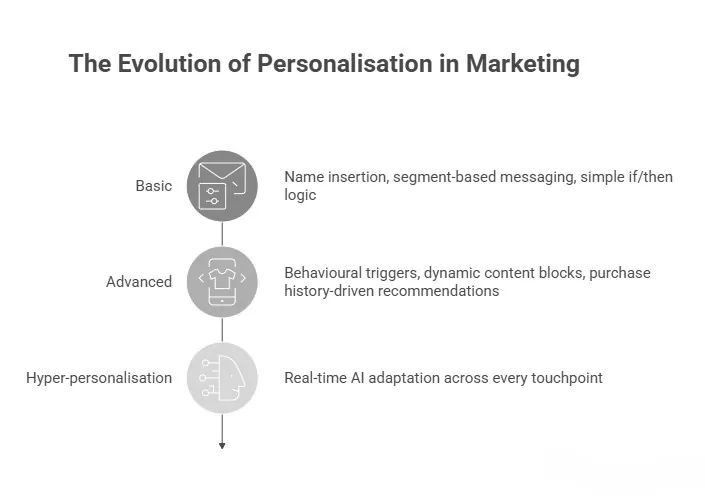
• Basic: Name insertion, segment-based messaging, simple if/then logic ("if customer bought X, show Y")
• Advanced: Behavioural triggers, dynamic content blocks, purchase history-driven recommendations
• Hyper-personalisation: Real-time AI adaptation across every touchpoint — the message, the creative, the timing, and the channel — all tailored to the individual based on live signals and predictive modelling
The shift from advanced to hyper-personalisation is powered by one thing: AI that can process signals faster than any human team.
As search and discovery evolve too, it's worth reading our piece on How ChatGPT Trends Are Transforming Brand Discovery & Online Visibility because how customers find you is changing just as fast as how you speak to them.
How AI Makes 1-to-1 Marketing Possible at Scale
Here's the core challenge hyper-personalisation has always faced: the maths doesn't work for humans.
If you have 100,000 customers and you want to send each one a genuinely personalised message at the right time through the right channel — that's 100,000 decisions. No team can make those decisions in real time, every day, across every campaign. AI can.
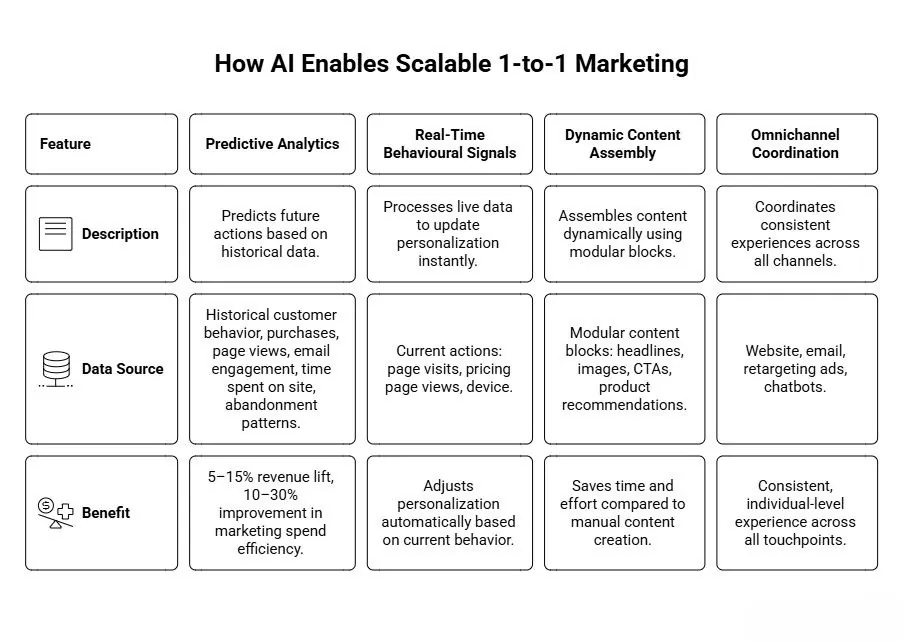
Here's how the technology actually works:
Predictive Analytics
AI models are trained on historical customer behaviour, purchases, page views, email engagement, time spent on site, and abandonment patterns to predict future actions before they happen. Not guessing. Statistical prediction based on patterns identified across millions of data points.
According to Salesforce's State of the Connected Customer report, 62% of senior executives identify AI and machine learning for hyper-personalisation as a top priority over the next 12–24 months. Why? Because the ROI is real: AI-driven personalisation delivers 5–15% revenue lift and 10–30% improvement in marketing spend efficiency.
Source: Salesforce — State of the Connected Customer
Source: Adobe — Digital Trends Report
Real-Time Behavioural Signals
Predictive models are powerful, but they work best when combined with live data. What is this person doing right now? Which page did they just visit? How many times have they looked at the pricing page in the last 48 hours? What device are they on?
AI systems process these real-time signals and update their personalisation decisions instantly. Someone who was in the 'casual browser' segment at 9 AM can shift into 'high-intent buyer' by 11 AM — and the system adjusts automatically. The email they receive at 2 PM reflects who they are right now, not who they were last week.
Dynamic Content Assembly
One of the most powerful applications of AI in personalisation is the ability to assemble content dynamically. Rather than having a human build 50 versions of an email, the AI uses a set of modular content blocks — headlines, images, CTAs, product recommendations — and assembles the right combination for each individual automatically.
This is where AI connects directly to your automated marketing workflows — the personalisation logic sits inside the pipeline, not as a one-off manual task.
Omnichannel Coordination
True hyper-personalisation isn't just about one channel. It's about a consistent, individual-level experience whether the customer is on your website, receiving an email, seeing a retargeting ad, or interacting with a chatbot. AI coordinates these touchpoints — ensuring the message the customer sees on Instagram reflects what they did on your site yesterday, and the email they receive tomorrow is aware of both.
80% of consumers are more likely to buy from brands that offer personalised experiences
Real-World Brands Winning With AI Hyper-Personalization
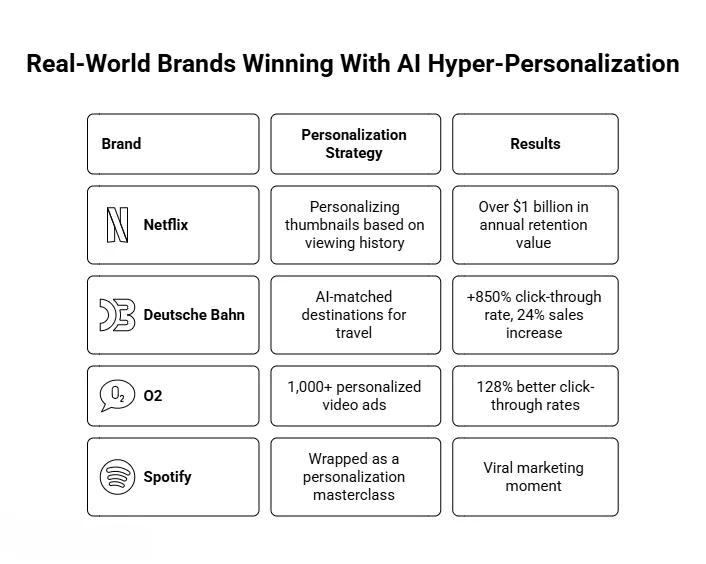
Theory is useful. Proof is better. Here are brands that have moved beyond segmentation into genuine 1-to-1 personalisation — and the results they got.
Netflix: Personalising the Thumbnail, Not Just the Recommendation
Netflix doesn't just recommend what to watch — it personalises which image you see for each title. Machine learning analyses a user's viewing history to determine which actors, genres, or visual themes resonate most. Two users can see completely different thumbnails for the same show depending on their individual preferences.
The result: significantly higher click-through rates on content, and Netflix has attributed over $1 billion in annual retention value to its recommendation and personalisation engine.
Source: Netflix Research — Recommendations
Deutsche Bahn: +850% Click-Through With AI-Matched Destinations
German railway company Deutsche Bahn ran a campaign called 'No Need to Fly' — targeting travellers planning expensive international trips and showing them visually similar destinations within Germany instead.
Using an AI algorithm, they identified the international destinations users were searching for, matched them with lookalike German locations, and delivered geo-targeted ads comparing train prices to flight costs in real time.
The outcome: +850% click-through rate and a 24% increase in sales revenue. Same budget. Same team. Completely different results driven by personalisation logic that no human could have executed manually at that scale.
O2: 1,000+ Personalised Video Ads That Outperformed Generic by 128%
UK telecom provider O2 used customer data — contract status, device usage, and location to generate over 1,000 versions of the same video ad, each tailored to the viewer's current lifecycle stage.
A customer with an expiring contract saw a renewal offer. A recent upgrader saw an accessories ad. The personalised versions performed 128% better in click-through rates compared to the generic version of the same ad.
Spotify: Wrapped as a Personalisation Masterclass
Spotify Wrapped is arguably the most successful annual personalisation campaign in marketing. By surfacing each user's unique listening data in a shareable, visual format, Spotify turned individual data into a deeply personal experience and a viral marketing moment simultaneously.
The campaign drives massive re-engagement every December and generates enormous organic reach because the personalisation is so specific that it feels like a gift rather than a marketing message. That's the gold standard: personalisation so good that people want to share it.
Understanding how AI is reshaping search and discovery is part of the same story. Our piece on Google AI Mode: How It's Changing Search & SEO in 2025 shows how personalisation extends into how customers find brands in the first place.
How to Build Your Own AI Personalization Strategy (Step-by-Step)
Here's the practical framework. You don't need to do everything at once — but you do need to do things in the right order.
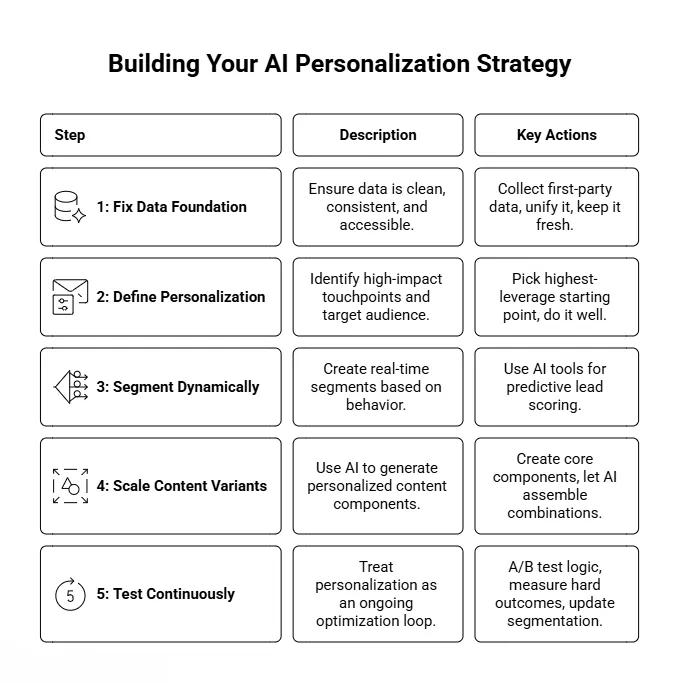
Step 1: Fix Your Data Foundation First
Everything in hyper-personalisation is downstream of data quality. Before you build any personalisation logic, you need to know: What data do you have? Where does it live? Is it clean, consistent, and accessible?
The most common mistake teams make is trying to personalise with fragmented, siloed data — where your CRM, your email platform, your website analytics, and your ad platforms all contain different pieces of the picture but none of them talks to each other. The AI can only personalise based on what it can see.
• Collect first-party data: Website behaviour, purchase history, email engagement, form submissions, support interactions
• Unify it: Connect your CRM, email platform, website analytics, and ad data into a single customer view
• Keep it fresh: Stale data produces stale personalisation — real-time signals matter
Step 2: Define What You're Personalising (And For Whom)
You can't personalise everything at once. Start by identifying the one or two high-impact touchpoints where personalisation will make the biggest difference for your business.
For most teams, this is email because it's the channel with the most data, the most control, and the clearest ability to measure outcomes. For e-commerce businesses, it's often on-site product recommendations. For B2B companies, it might be the content shown to a prospect based on their industry or company size.
Pick the highest-leverage starting point and do it well before expanding.
Step 3: Segment Dynamically, Not Statically
Traditional segmentation groups people into fixed buckets — 'enterprise customers,' 'SMB prospects,' 'free trial users' — that might update monthly if you're lucky.
Hyper-personalisation requires segments that update in real time. Someone who was a 'passive browser' yesterday can become a 'high-intent buyer' today based on their behaviour. Your personalisation logic needs to reflect that shift immediately — not at the next campaign send.
AI tools like HubSpot's predictive lead scoring, Klaviyo's dynamic segments, and Salesforce Einstein all enable this real-time segmentation. Businesses using AI for dynamic segmentation report an average 20–30% uplift in campaign effectiveness.
Source: Gartner — Marketing Personalisation Research
Step 4: Use AI to Scale Content Variants
One of the biggest blockers to personalisation is content production. If personalisation requires a different email for every segment, a different landing page for every audience, and a different ad creative for every context, most teams hit a wall quickly.
AI solves this through modular content generation. Instead of producing every variation manually, you create a set of core content components — headlines, body copy options, images, CTAs — and let AI assemble the right combination for each individual based on their profile and behaviour.
Step 5: Test Continuously — Personalisation Is Never 'Done'
Hyper-personalisation is not a campaign. It's a system. The brands that win are the ones that treat it as an always-on optimisation loop — constantly testing which personalisation approaches drive better outcomes, feeding those learnings back into the model, and iterating.
• A/B test personalisation logic vs. control groups (no personalisation)
• Measure hard outcomes: conversion rate, revenue per user, retention — not just open rates
• Review and update your segmentation logic as customer behaviour evolves
• Let the AI learn models get better over time with more data, but only if you let them run
The Privacy Problem: Where Personalization Goes Wrong
We'd be doing you a disservice if we wrote a guide on hyper-personalisation without talking about the part that can blow up in your face.
Personalisation walks a very fine line. Done right, it feels helpful — like the brand genuinely understands you. Done wrong, it feels surveillance-y and invasive. The difference matters more than most marketers realise.
The Creepiness Threshold
There's a psychological threshold where personalisation shifts from 'this brand gets me' to 'how do they know that?' Crossing it doesn't just fail to convert — it actively damages trust. And trust, once lost, is expensive to rebuild.
The factors that push personalisation across that line include: using data the customer doesn't remember giving you, being too specific about sensitive information, following people too aggressively across channels with the same message, and making predictions about personal circumstances the customer didn't disclose.
Build on First-Party Data — Not Third-Party
With GDPR, CCPA, and the ongoing deprecation of third-party cookies, brands that built their personalisation stack on third-party data tracking are in serious trouble. The brands building sustainably in 2026 are doing so on first-party data — information collected directly from their own customers with explicit consent.
This means: be transparent about what you collect and why. Provide genuine value in exchange for data. Give customers control over their preferences. Build direct relationships rather than depending on intermediary data brokers.
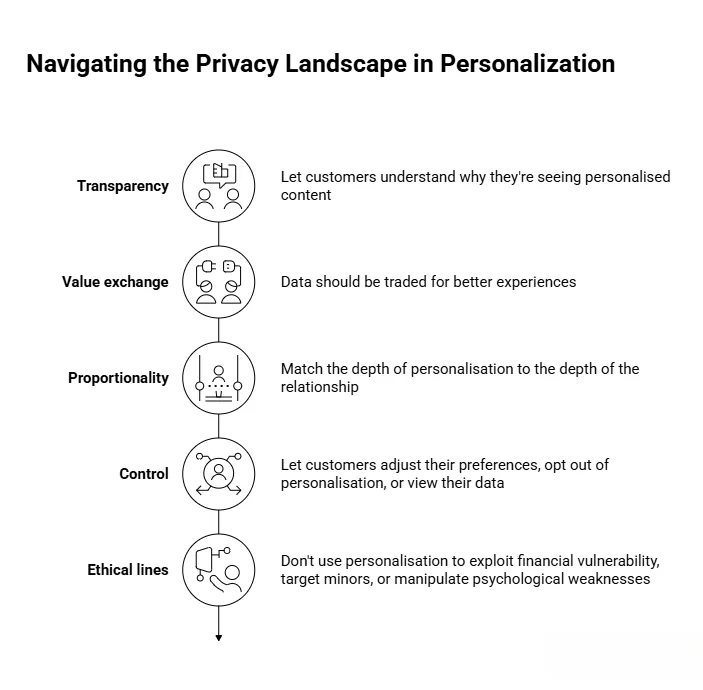
Personalisation Principles to Live By
• Transparency: Let customers understand why they're seeing personalised content — it builds trust, not suspicion.
• Value exchange: Data should be traded for better experiences, not extracted silently.
• Proportionality: Match the depth of personalisation to the depth of the relationship — don't get too specific too fast.
• Control: Let customers adjust their preferences, opt out of personalisation, or view their data.
• Ethical lines: Don't use personalisation to exploit financial vulnerability, target minors, or manipulate psychological weaknesses.
The brands navigating AI adoption most carefully are the ones asking hard questions about where automation helps and where it creates risk. Our article on AI Challenges in Marketing: 7 Critical Mistakes Costing Businesses ROI in 2025 covers these tensions directly.
Final Thoughts: Personalisation Is Now Table Stakes
Here's the blunt version: in 2026, generic marketing is a choice, not a constraint.
The technology to personalise at scale exists and is accessible to teams of every size. The data to power it is sitting in your CRM, your email platform, and your website analytics right now. The only question is whether you're going to use it or keep sending the same email to everyone.
The AI marketing market is projected to grow from $57.99 billion in 2025 to $240.58 billion by 2030 — a compound growth rate that reflects not hype, but real enterprise investment in personalisation infrastructure.
Source: MarketsandMarkets — AI Marketing Market Report
The brands winning right now aren't the biggest or the best-funded. They're the ones that figured out how to combine first-party data, AI-powered personalisation logic, and smart content strategy to make every customer feel like the campaign was built specifically for them.
That's the bar. It's achievable. And the gap between brands that hit it and those that don't is only going to widen from here.
For more practical AI marketing strategies, explore the Marketricka blog — we publish no-fluff guides on AI, automation, and growth for modern marketing teams.