
Omnichannel Marketing Strategy 2026: How to Build a Seamless Customer Journey with AI
Learn how to build a seamless customer journey using AI-powered omnichannel marketing strategies for better engagement and growth.
 By Divyesh Savaliya
Picture the path your ideal customer takes before buying from you. They see your Instagram ad on Tuesday but ignore it. A few days later, on Thursday, they search for your brand on Google and read one of your blog posts. After that, they sign up for your email list. They receive three emails but don’t open any of them. Two weeks pass. Then, they see a retargeted ad, click on it, land on your homepage, and leave. The next morning, they return directly to your site and finally make a purchase.
Now, consider your marketing funnel. It typically has three stages: Awareness, Consideration, and Decision. These stages are often presented as simple boxes connected by a straight line, moving from stranger to customer.
But in reality, these two ideas don’t truly align.
The modern customer journey is not linear. It happens across multiple devices and is highly personal. Brands that understand this and design their marketing around the actual customer journey rather than an idealized funnel are the ones gaining a competitive edge.
The numbers are striking. Brands with strong omnichannel customer engagement retain 89% of their customers — compared to just 33% for brands with weak cross-channel strategies. Companies running effective omnichannel strategies see 179% faster revenue growth than those operating in disconnected channels. And customers who engage across three or more channels generate 287% higher purchase rates than single-channel shoppers.
Source: Capital One Shopping — Omnichannel Statistics 2026
AI is what makes the seamless, connected journey possible without a 50-person team managing every touchpoint manually. This guide walks you through exactly how, from strategy to execution to measurement.
Before diving in: if you haven't read our piece on AI Agents in Marketing: How Autonomous AI is Replacing Manual Workflows in 2026, it gives the wider context for how AI is reshaping the entire marketing operation, of which omnichannel is one of the most important applications.
Omnichannel vs Multichannel: The Difference That Changes Everything
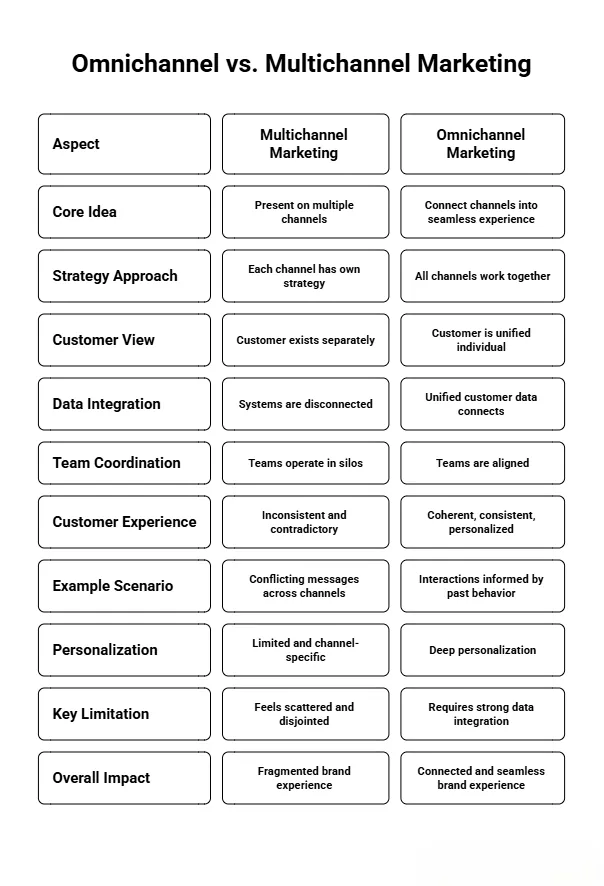
This distinction matters because 73% of consumers actively use multiple channels during a single purchase journey, and 91% expect to pick up exactly where they left off when switching channels. When your channels don't share that context, you're not meeting that expectation, and customers notice.
Source: WiFi Talents — Omnichannel Marketing Statistics 2026
How AI Makes Omnichannel Marketing Actually Work at Scale
Omnichannel marketing has always sounded simple in theory—but in practice, it’s extremely difficult to execute.
Why? Because it’s not a strategy problem. It’s an infrastructure and execution problem.
To do it properly, brands need to:
Unify data from multiple channels
Track individual customer journeys in real time
Personalize messages across every touchpoint
Traditionally, this required enterprise-level teams, complex systems, and large budgets.
How AI Changes the Game
AI doesn’t solve everything, but it significantly reduces the complexity.
What once required massive resources is now accessible to marketing teams of almost any size.
AI primarily solves the execution problem, making omnichannel marketing practical and scalable.
What AI Actually Does in an Omnichannel System
1. Unifies Customer Identity Across Channels
AI connects data from different platforms and devices to identify the same customer everywhere.
It combines:
Website behavior
Email interactions
Social engagement
Purchase history
Result: A single, unified customer profile—the foundation of effective omnichannel marketing.
2. Decides the Next Best Action in Real Time
Instead of depending on fixed automation flows, AI makes dynamic decisions.
It determines:
What message to send
Which channel to use
When to deliver it
Result: All based on the customer’s most recent behavior and current stage in the journey.
3. Personalizes Content at the Individual Level
AI tailors messaging for each customer segment or even each individual.
For example:
A first-time visitor sees introductory messaging
A returning user sees product-focused content
A lapsed customer gets re-engagement offers
Result: Same product, different presentation—automatically optimized for intent.
4. Learns and Improves Continuously
AI systems get smarter over time.
As more customers interact:
It identifies what works and what doesn’t
Refines targeting and messaging
Improves outcomes without manual updates
Result: Continuous optimization without constant human intervention.
The result is measurable: companies using AI for omnichannel personalisation report 91% higher year-over-year customer retention and 287% higher lifetime customer value compared to brands without integrated AI-driven journeys.
Source: Atechnocrat — Omnichannel E-Commerce Marketing with AI Automation in 2026
This connects directly to what we covered in our guide on Hyper-Personalization at Scale: How AI Delivers 1-to-1 Marketing Without a 100-Person Team — the personalisation engine that powers great omnichannel experiences is the same one that powers 1-to-1 messaging.
Mapping the Modern Customer Journey: Touchpoints, Gaps & Moments That Matter
You can't improve a journey you haven't mapped. And you can't map a journey if you're only looking at the data from one channel at a time.
The average customer now interacts with a brand across six touchpoints before making a purchase. B2B buyers use an average of ten channels throughout their journey — and 42% use more than eleven. Each of those touchpoints is a moment where your brand can either build trust or lose it.
Source: Martal — Omnichannel Statistics for B2B Sales 2026
The Three Journey Stages That Matter Most to Marketers
Discovery & Awareness: The customer finds out you exist. This could be a Google search, a social post, a word-of-mouth recommendation, a podcast ad, or a retargeted display impression. At this stage, your job is simple: be findable, be credible, leave them curious. The mistake most brands make here is treating every awareness touchpoint as a conversion opportunity. It isn't.
Consideration & Evaluation: The customer is actively deciding whether you're the right choice. They're reading reviews, comparing options, revisiting your site multiple times, maybe watching demo videos or reading case studies. This is your highest-value window. The brands that win here are the ones who show up with the right information at the right moment — not the ones who hit them with 'BUY NOW' banners on every channel.
Conversion & Post-Purchase: The sale is just the beginning. A customer who buys once and never comes back is a cost. A customer who buys repeatedly, upgrades, and refers others is a business. The omnichannel journey doesn't end at checkout — the most valuable part starts there.
Where Journeys Break: The Four Common Gaps
The channel gap: The customer's behaviour on one channel doesn't inform what they see on another. They get emails about a product they already bought. They see ads for content they've already read.
The timing gap: Your follow-up is too slow or too fast. A lead fills a form and hears nothing for three days. Or they get five emails in 48 hours and unsubscribe.
The message gap: Your email tone is warm and conversational. Your retargeting ads are cold and transactional. Your website is corporate. The customer doesn't feel like they're dealing with the same brand.
The data gap: Your customer service team has no visibility into what marketing has sent. Your sales team doesn't know which content the lead consumed. Each team is flying blind.
Fixing the data gap starts before you build any omnichannel flows. Our article on Zero-Party Data Strategy: How to Collect Customer Intent Without Cookies or Guesswork is the most important pre-read before mapping your own customer journey because the quality of your data determines the quality of every decision the AI makes downstream.
The Data Foundation Every Omnichannel Strategy Needs Before Anything Else
Every omnichannel strategy conversation eventually circles back to the same constraint: data. Specifically, data that is unified, clean, and accessible across all your channels. Without this, AI can't personalise. Automation can't adapt. And your 'omnichannel' strategy is just multichannel with better intentions.
Companies with unified customer data see a 2.5x increase in marketing ROI from omnichannel efforts compared to those with disconnected systems. Yet 54% of companies say they have limited visibility into the cross-channel customer journey, which means more than half of marketing teams are making channel decisions with an incomplete picture.
Source: WiFi Talents — Omnichannel Marketing Statistics 2026
The Three Data Layers You Need to Connect
Behavioural data: What did they do? Pages visited, content consumed, emails opened, ads clicked, time on site, products viewed, cart activity. This is the real-time signal layer — it tells you where someone is in their journey right now.
Transactional data: What have they bought? How much? How often? Which categories? This tells you who your best customers actually are and lets you build lookalike audiences, predict lifetime value, and personalise retention messaging.
Declared / zero-party data: What did they tell you directly? Preferences submitted in quizzes, surveys, preference centres, and explicit opt-ins. This is the most powerful data layer because it represents intent without inference — the customer told you what they want.
That third layer, declared intent data, is what separates brands with truly personalised journeys from those just using behavioural signals. Our deep dive on Zero-Party Data Strategy: How to Collect Customer Intent Without Cookies or Guesswork explains exactly how to collect it ethically and activate it across your omnichannel stack.
The CRM is usually the connective tissue that holds this data together. If yours isn't doing this work, our guide on CRM Automation Strategies for Maximum Efficiency covers how to turn your CRM from a contact database into a genuine intelligence layer for your customer journey.
Channel-by-Channel: How to Connect Email, Social, SMS, CRM & Ads Into One Journey
This is where strategy becomes execution. Here's how each channel fits into a connected omnichannel journey — and what AI does specifically in each one.
Email: Your Highest-ROI Relationship Channel
Email is still the backbone of most omnichannel journeys because it's the channel you own, it reaches people in their inbox rather than competing in a social feed, and it scales exceptionally well with AI personalisation.
AI-powered email systems can generate 450% higher click-through rates compared to generic broadcasts through intelligent personalisation of content, send timing, subject lines, and product recommendations. The key shift: stop thinking of email as a broadcast channel and start thinking of it as a behaviour-triggered response system.
Source: Atechnocrat — Omnichannel E-Commerce Marketing with AI Automation in 2026
If you're rethinking your email platform to support these kinds of behaviour-triggered, AI-personalised flows, our breakdown of Mailchimp Alternatives: Better Email Platforms for 2026 covers which platforms handle omnichannel email automation best.
Social Media: Discovery, Remarketing & Community
Social is where most customer journeys begin and where remarketing reconnects with people who've already shown interest. The omnichannel role of social is awareness and re-engagement, not necessarily direct conversion.
The key to making social work within an omnichannel strategy is suppression and sequencing. Suppress recent purchasers from acquisition campaigns. Sequence your retargeting creative based on where someone is in their journey — someone who visited your pricing page should see different social ads than someone who only visited your homepage once. AI handles this sequencing automatically when your ad platform and CRM are connected.
Understanding how customers discover brands through AI-powered search and social is changing the top of this funnel rapidly. Our piece on How ChatGPT Trends Are Transforming Brand Discovery & Online Visibility covers what this means for your social strategy specifically.
SMS: High-Attention, Use It Sparingly
SMS has a 98% open rate — which is both its superpower and its greatest responsibility. Nobody wants a brand in their text messages unless the message is genuinely worth receiving.
Source: WiFi Talents — Omnichannel Marketing Statistics 2026
In an omnichannel journey, SMS works best for high-urgency, high-relevance moments: order confirmations, appointment reminders, flash sale alerts for customers who've opted in, and cart abandonment nudges timed to the last session. Use it for moments that genuinely require immediacy. Not for newsletters. Not for general promotions.
CRM: The Intelligence Layer That Connects Everything
Your CRM isn't a channel — it's the central nervous system of your omnichannel strategy. Every customer action across every channel should write back to the CRM, and every channel decision should be informed by what the CRM knows.
When a customer emails support, the CRM logs it and pauses the promotional email sequence. When they buy, the CRM triggers the onboarding journey and suppresses the acquisition ad spend. When they've been inactive for 60 days, the CRM triggers a re-engagement flow across email and paid social simultaneously.
If your CRM isn't doing this kind of cross-channel coordination, it's just a contact list. Our guide on CRM Automation Strategies for Maximum Efficiency shows how to close this gap and why CRM automation is one of the highest-ROI investments in your omnichannel stack.
How to Measure Omnichannel Marketing
Omnichannel measurement is genuinely hard. When a customer sees an Instagram ad, reads a blog, opens an email, and then buys through a direct visit — who gets credit? Last-click attribution gives it all to the direct visit. First-click attribution gives it all to Instagram. Both are wrong.
But imperfect measurement is still far better than no measurement. Here's the practical approach for 2026.
Metrics That Actually Matter
Customer retention rate by channel combination: Customers who engage across three or more channels have dramatically higher retention than single-channel customers.
Revenue per customer by journey stage: Not just conversion rate — total revenue per customer who entered from each journey path. A lower-converting journey that produces higher-LTV customers may be more valuable than a higher-converting one.
Journey completion rate: What percentage of customers who enter your omnichannel journey actually complete it? Where do they drop off? That's your optimisation roadmap.
Cross-channel engagement rate: What percentage of your audience engages on two or more channels? Actively move customers toward multi-channel engagement — it's one of the highest-leverage retention strategies available.
Marketing automation ROI: Are your automated flows generating measurable revenue? Track revenue attributed to automated journeys vs. broadcast sends separately.
For a deeper framework on measuring your marketing automation and omnichannel ROI properly, our article on Marketing Automation ROI: How to Track & Improve is the companion piece — it covers the attribution models, the metrics that matter, and how to build a measurement system that gives you honest visibility.
Your 2026 Omnichannel Action Plan
Strategy without a starting point is just good intentions. Here's how to build momentum without boiling the ocean.
This Month: Map One Journey End-to-End
Pick your most important customer journey — the one from first contact to first purchase for your core product or service. Map every touchpoint that actually exists right now: every ad, every email, every page, every notification. Not how you think it should work. How it actually works.
Then identify the two or three biggest gaps where the experience breaks? Where does context get lost between channels? Where is the timing off? Those gaps are your first three priorities.
Next Month: Connect Your Data Sources
Identify your three most important data sources — probably your email platform, your CRM, and your website analytics. Connect them. Make sure customer events on your website (page views, cart additions, purchases) are flowing into your CRM and informing your email triggers. This single integration step enables more personalisation than any amount of creative work.
If you need a clear view of what 'good' data connectivity looks like for AI-driven marketing, our guide on Zero-Party Data Strategy: How to Collect Customer Intent Without Cookies or Guesswork gives you a practical framework for building first-party data infrastructure that supports real omnichannel personalisation.
This Quarter: Build Your First AI-Powered Journey Automation
Start with the highest-impact, lowest-complexity automation: a behaviour-triggered email sequence. When someone visits your pricing page three times without converting, trigger an email. When someone downloads a piece of content, trigger a nurture sequence based on the topic. When someone hasn't engaged in 60 days, trigger a re-engagement flow.
These are not complex builds. But they represent the shift from broadcast marketing to journey marketing, and that shift is where the biggest performance gains live.
The mistake most teams make at this stage is covered in detail in our AI Challenges in Marketing: 7 Critical Mistakes Costing Businesses ROI in 2025 — it's worth reading before you scale any AI-powered journey automation, because the pitfalls are predictable and avoidable.
Final Thoughts
Here's the simplest way to explain omnichannel marketing: your customer should never feel like they're dealing with different brands when they switch channels.
The email should know what the ad said. The SMS should know what the email is about. The support agent should know what the customer bought. The retargeting ad should know the customer has already converted and show them something else entirely.
That consistency is not just a nice-to-have. It's a revenue driver. Companies with strong omnichannel engagement see 9.5% annual revenue growth versus 3.4% for weak omnichannel brands. Omnichannel customers spend 16% more per order and shop 1.7 times more frequently than single-channel customers.
Source: Capital One Shopping — Omnichannel Statistics 2026
Source: Demand Experts — Omnichannel Marketing Stats That Prove ROI
AI makes this consistency achievable without a massive team. The data foundation, the CRM automation, the personalized email sequences, the connected ad suppression — all of it can be built and managed by a lean team if the infrastructure is right.
Start with one journey. Connect your data. Automate the highest-impact triggers. Measure honestly. Iterate. That's the omnichannel playbook for 2026, and the brands building it now will have a compounding advantage over every competitor that's still running disconnected channels.
Explore more practical marketing guides at the Marketricka blog — written for marketers who want to do the work, not just read about it.