
Mailchimp Alternatives: Better Email Platforms for 2026
Discover top Mailchimp alternatives for 2026. Compare pricing, automation, and features to find the best email platform.
 By Divyesh Savaliya
Mailchimp was the starting point for email marketing for small businesses and creators. It was easy to get started with. Had a lot of features. Mailchimp was also free up to a point, which made it accessible to people who were new to email marketing. Mailchimp deserves credit for making email marketing available to a lot of people.
Things have changed a lot. Mailchimp's pricing has changed over the years. It has become more expensive for businesses with big lists. This is especially true after they got rid of the tier for multiple lists and started charging based on the number of contacts. The automation features that Mailchimp used to have are not as good as what other platforms offer now. Mailchimp also tried to become a marketing suite, but this has made the platform more complicated without making it better at its main job.
This means that there is a market for alternatives to Mailchimp. Businesses are looking for platforms that can meet their needs better than Mailchimp. This guide will cover the options for different use cases in 2026. We will give assessments of which platforms are best for which businesses.
Why Businesses Are Looking for Mailchimp Alternatives in 2026
Before we look at platforms, it is worth talking about why people are leaving Mailchimp. The main reason is pricing. Mailchimp charges for all contacts, even if they have unsubscribed. This means that costs can add up quickly even if those contacts are not actively engaging with the business. For example, if a business has a list of 20,000 contacts and 6,000 of them have unsubscribed, the business still has to pay for all 20,000 contacts.
Another reason businesses are leaving Mailchimp is that its automation features are limited. Mailchimp's automation builder is good for sequences, but it is not good for complex workflows. Businesses that want to build customer journeys based on purchase history and engagement behavior often find that Mailchimp is not up to the task.
Ecommerce businesses also find that Mailchimp does not meet their needs. Mailchimp has ecommerce integrations. It was not built with ecommerce in mind. Platforms like Klaviyo were built for ecommerce and have features like abandoned cart sequences and predictive product recommendations.
Klaviyo: The Best Mailchimp Alternative for Ecommerce
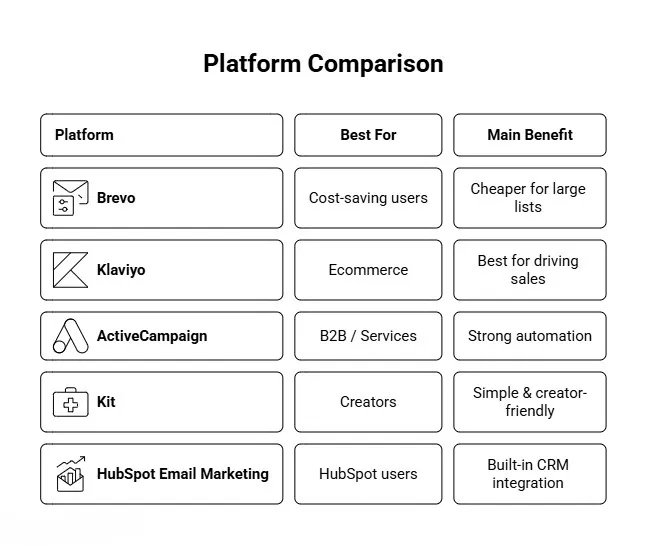
If you run an ecommerce business, Klaviyo is an alternative to Mailchimp. Klaviyo was built for ecommerce and has features that are tailored to the needs of online stores. The segmentation capabilities are very good. You can build audiences based on predicted next order date, predicted lifetime value, and other behavioral signals.
The flow builder is also very good. Can handle complex conditional logic. Klaviyo has use cases like abandoned cart sequences and post-purchase upsell flows. The pricing model is based on profiles, which means that you only pay for contacts who are actively engaging with your business.
Best for:
DTC brands and Ecommerce stores where email drives direct revenue
Shopify, WooCommerce, and BigCommerce merchants who want deep platform integration
Teams that have outgrown Mailchimp's segmentation and automation logic
ActiveCampaign: The Best Alternative for Complex Automation
For service businesses, B2B teams, and agencies, ActiveCampaign is an alternative to Mailchimp. The automation builder is very powerful. Can handle complex workflows with conditional branches and goal tracking. The built-in CRM is also very good. Can help businesses manage longer sales cycles.
ActiveCampaign is best for businesses that need automation and CRM features. The deliverability is consistently strong. The reporting gives enough depth to diagnose campaign performance.
Best for:
Service businesses, agencies, and B2B teams with complex nurture sequences
Organizations that want email marketing and CRM in a platform
Teams that have hit Mailchimp's automation ceiling and need multi-branch conditional workflow logic
Brevo: The Most Cost-Effective Mailchimp Alternative
Brevo is a great alternative to Mailchimp for businesses that are cost-conscious. The pricing model is based on the number of emails sent per month rather than the number of contacts stored. This means that businesses that have lists but do not email frequently can save a lot of money.
Brevo covers email marketing, SMS, WhatsApp campaigns, transactional email, and a basic CRM. The automation builder is capable. Can handle simple workflows. The transactional email infrastructure is also very good. Can handle order confirmations, password resets, and account notifications.
Best for:
Businesses with lists but lower send frequency
SMBs that want email, SMS, and transactional email under one roof without enterprise pricing
Teams migrating from Mailchimp primarily to reduce cost while maintaining comparable feature access
Kit (Formerly ConvertKit): The Best Alternative for Creators and Solopreneurs
Kit is a great alternative to Mailchimp for creators and solopreneurs. It was built for individual creators and has features that are tailored to their needs. The subscriber tagging system is intuitive and flexible, and the landing page and form builder are strong.
Kit is best for newsletter operators, bloggers, podcasters, and individual content creators. It is not the fit for ecommerce operations or businesses running complex marketing automation.
Best for:
Newsletter operators, bloggers, podcasters, and individual content creators
Course creators and Digital product sellers with audience-first business models
Solopreneurs who want simplicity and deliverability without enterprise complexity
HubSpot Email: The Best Alternative When Email Is Part of a Broader Stack
HubSpot Email is a great alternative to Mailchimp when email is part of a broader stack. HubSpot is expensive as an email platform, but it makes sense when it is part of a broader investment in HubSpot's CRM, sales, and service tools.
For businesses on HubSpot, migrating email marketing to the same platform is often a straightforward efficiency gain. Contact data, deal history, support interactions, and email engagement live in one place.
Best for:
B2B companies using or planning to adopt HubSpot CRM and Sales Hub
Teams that want email attribution connected to pipeline data without third-party integrations
Organizations where unified contact data across marketing, sales, and service justifies the platform investment
How to Choose the Right Mailchimp Alternative for Your Business
The best Mailchimp alternative depends on what Mailchimp was failing to give you and what kind of business you are running. There is no winner across the platforms covered here.
If the primary driver is cost, Brevos send-volume pricing model is certainly cheaper for lists above 5,000 contacts. If you are an ecommerce business, Klaviyo is an alternative. If you are a service business or B2B team, ActiveCampaign is an alternative. If you are a creator or solopreneur, Kit is an alternative. If you are already on HubSpot, HubSpot Email is an alternative.
If your main goal is to make money from ecommerce then Klaviyo is the way to go. It is made for this purpose. The cost is higher. It pays off in ways that other email platforms do not.
If you want something that can handle tasks like automation, then ActiveCampaign is a good choice. It can do a lot of things. Is affordable for medium-sized businesses.
If you are someone who creates things or sends out newsletters, then Kit is an option. It was made with people like you in mind, unlike Mailchimp, which is more for businesses.
One thing you should try is testing out two platforms at the same time with a small group of people on your list. This will give you an idea of which one is right for you. You can see how easy it is to use, how the automation works, and how helpful the support team is. This will tell you more than reading about the features.
Comparison Table of Mailchimp Alternatives
What to Expect When Switching from Mailchimp
Switching to a platform is a lot of work, so it is good to know what to expect. The technical part of switching, like moving your contacts and templates, is not hard. It takes time. The harder part is making sure your emails get delivered.
When you switch to a platform, you have to start over with getting a good reputation for sending emails. Any good alternative to Mailchimp will help you through this process, which is like a warm-up period. If you skip this step, you might have problems with your emails getting delivered.
It is also an idea to clean up your list before you switch. Remove any emails that bounce back, take off people who have not been active in a while, and make sure the people who have not been engaging are still okay with getting emails. If you start with a list, it will be better for you in the long run.
Final Thoughts
Mailchimp is not a choice. If you are just starting with email marketing and do not have a lot of people on your list, it might still be the way to go. The free version is good, and the templates are nice. It is easy to use.
There are a lot of other good options out there now. If you take the time to look at them, you might find one that's a better fit for you and your business. You might even find one that costs the same or less than Mailchimp.