Marketing Data Stack Audit: Complete 2026 Guide to Improve Pipeline & Data Quality
Audit your marketing data stack to uncover data quality issues, broken integrations, attribution gaps, and underused tools. Learn a proven framework to improve reporting, pipeline visibility, and marketing performance.
 By Divyesh Savaliya
Marketing teams have never had access to more data, tools, or automation than they do today. Yet many still struggle to answer a simple question:
Can we trust our marketing data?
According to Gartner's 2025 Marketing Technology Survey, organizations use only 49% of the martech capabilities they pay for. At the same time, the average marketing team manages a growing mix of CRM platforms, marketing automation software, analytics tools, advertising platforms, customer data solutions, and AI-powered applications. As each new technology is added, the risk of disconnected data, duplicate records, inconsistent attribution, and inaccurate reporting increases.
The result isn't just operational complexity, it directly affects pipeline generation, budget allocation, customer experience, and executive decision-making.
A marketing data stack audit helps uncover these hidden issues before they become costly business problems. By reviewing how data is collected, integrated, governed, and activated across your technology ecosystem, you can improve reporting accuracy, strengthen marketing attribution, optimize campaign performance, and build a more reliable foundation for AI-powered marketing.
If you're building a long-term data-driven marketing strategy, a structured audit should be one of the priorities, not an afterthought.
What Is a Marketing Data Stack Audit?
A marketing data stack audit is the process of evaluating every platform, integration, workflow, and dataset that supports your marketing operations. The goal is to ensure that customer data flows accurately between systems, reporting reflects reality, and every technology investment contributes measurable business value.
Unlike a basic martech stack audit, which often focuses on software inventory and licensing, a marketing data stack audit examines how information moves across your ecosystem from website interactions and advertising platforms to CRM systems, marketing automation, analytics, and revenue reporting.
A comprehensive audit typically evaluates:
Marketing technology usage
CRM and marketing automation integrations
Customer data quality
Attribution accuracy
Campaign measurement
First-party and zero-party data collection
Marketing analytics
Reporting consistency
AI readiness
Compliance with privacy regulations
Ultimately, the objective isn't simply to remove unused tools. It's to create a connected marketing ecosystem where every decision is based on trustworthy, actionable data.
Why Marketing Data Stack Audits Matter More in 2026
Marketing technology is evolving faster than most organizations can manage. AI-powered automation, predictive analytics, customer data platforms, and privacy-first measurement have fundamentally changed how marketing teams operate.
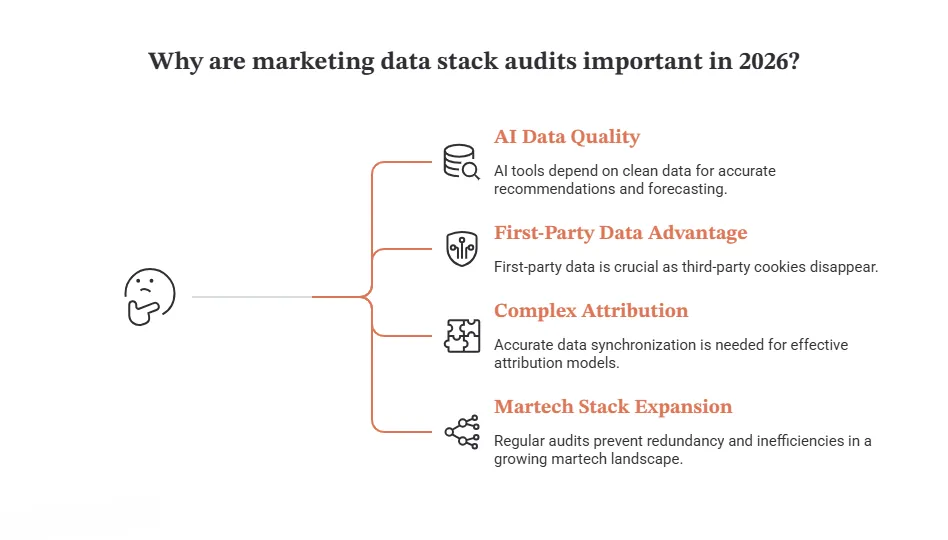
Several industry shifts make regular marketing data stack audits more important than ever:
AI Is Only as Good as Your Data
Generative AI, predictive lead scoring, and intelligent automation depend on clean, structured, and connected datasets. Poor data quality leads to inaccurate recommendations, ineffective personalization, and unreliable forecasting.
First-Party Data Has Become a Competitive Advantage
As third-party cookies continue to disappear and privacy regulations evolve, organizations increasingly depend on first-party and zero-party data. An audit helps verify that this data is collected, stored, and activated effectively across your marketing ecosystem.
Marketing Attribution Is Becoming More Complex
Modern customer journeys span multiple devices, channels, and touchpoints. Without accurate data synchronization, attribution models often over-credit or under-credit marketing efforts, leading to poor budget decisions.
Martech Stacks Continue to Expand
Chiefmartec's 2025 Marketing Technology Landscape now lists more than 15,000 marketing solutions, giving businesses more options than ever but also increasing the risk of redundant tools, disconnected systems, and operational inefficiencies.
Organizations that regularly evaluate their marketing data infrastructure are better positioned to improve reporting accuracy, optimize marketing investments, and deliver more consistent customer experiences.
Expert Insight
One of the biggest misconceptions in modern marketing is that adding another AI tool will solve performance issues. In reality, AI amplifies the quality of the data it receives. Organizations with clean, well-governed marketing data typically see greater returns from automation than those investing in additional software without fixing underlying data problems first.
What Is Included in a Marketing Data Stack Audit?
A successful marketing data stack audit goes beyond listing the tools your team uses. Its purpose is to evaluate how every platform, integration, and dataset contributes to marketing performance, customer insights, and revenue generation.
Many organizations assume their marketing technology stack is functioning correctly because campaigns continue to run. In reality, hidden issues such as incomplete CRM records, broken integrations, inconsistent campaign parameters, or duplicate customer profiles can quietly reduce reporting accuracy and impact business decisions.
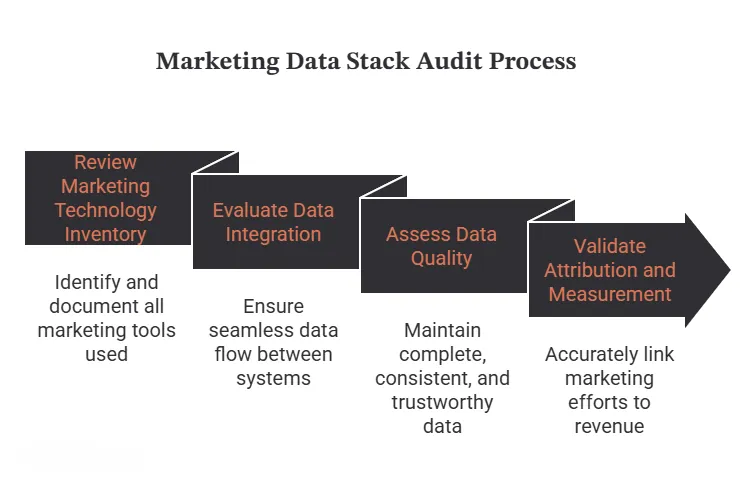
An effective audit evaluates four interconnected areas:
Audit Area | Primary Questions | Business Outcome |
|---|---|---|
Tool Inventory | Are all tools still providing value? | Reduced software costs and stack complexity |
Data Integration | Does information move accurately between systems? | Reliable customer data and automation |
Data Quality | Is the data complete, consistent, and trustworthy? | Better segmentation and personalization |
Attribution & Measurement | Can marketing efforts be linked to revenue? | Smarter budget allocation and ROI measurement |
Rather than treating these as separate exercises, high-performing marketing teams review them together because weaknesses in one area often create problems across the rest of the stack.
1. Review Your Marketing Technology Inventory
The first step in a marketing stack assessment is understanding exactly what technologies your organization uses and why they exist.
Over time, most businesses accumulate new software without retiring older solutions. Different departments purchase their own tools, teams adopt new AI platforms, and overlapping capabilities gradually increase costs while reducing operational clarity.
Instead of creating a simple inventory spreadsheet, document the following for every platform:
Primary business purpose
Annual licensing cost
Department owner
Active users
Connected systems
Data collected
Business processes supported
Reporting dependencies
This exercise often reveals duplicate functionality across marketing automation platforms, analytics software, customer data platforms (CDPs), social media tools, or reporting dashboards.
For example, it's common to find multiple tools tracking website performance, generating campaign reports, or managing customer segmentation independently. Consolidating these overlapping functions can reduce costs while improving reporting consistency.
Best Practice
Instead of asking: "Do we still use this tool?"
Ask: "What business outcome would become impossible if we removed this tool today?"
If the answer isn't clear, the platform deserves closer evaluation.
2. Evaluate Data Integration and Workflow Reliability
Technology delivers value only when information flows seamlessly between systems.
This is where many marketing data stack audits uncover their biggest issues.
Every customer interaction, whether it's a form submission, ad click, webinar registration, or product demo request, should travel accurately through your marketing ecosystem.
Typical data flow:
Website → CRM → Marketing Automation Platform → Customer Data Platform → Analytics → BI Dashboard
When even one integration fails, the consequences extend beyond reporting.
For example:
Sales teams receive incomplete lead information.
Marketing automation workflows trigger at the wrong time.
Customer segments become inaccurate.
AI models generate unreliable recommendations.
Revenue attribution becomes inconsistent.
Common integration issues include:
CRM fields failing to synchronize
API connection failures
Missing UTM parameters
Duplicate customer identifiers
Delayed synchronization
Inconsistent naming conventions
Manual spreadsheet imports
Missing event tracking
Broken webhook automations
Rather than checking integrations only when something breaks, organizations should establish ongoing monitoring for critical customer data flows.
Expert Tip
Marketing teams often blame dashboards when campaign performance appears inconsistent. However, the root cause is usually upstream. Broken integrations, missing tracking parameters, or inconsistent CRM fields often create reporting discrepancies long before they appear in executive dashboards.
3. Assess Marketing Data Quality and Governance
Even the most advanced marketing technology cannot compensate for poor data quality.
Clean, standardized data enables:
Accurate audience segmentation
Reliable personalization
Better predictive analytics
Stronger AI recommendations
Consistent attribution
Improved customer experiences
Conversely, poor-quality data leads to:
Duplicate customer profiles
Incorrect lead scoring
Inaccurate campaign reporting
Personalization errors
Wasted advertising spend
Reduced sales productivity
During your audit, evaluate:
Customer Records
Duplicate contacts
Missing email addresses
Incomplete company information
Outdated job titles
Invalid phone numbers
Campaign Data
Missing UTM parameters
Inconsistent naming conventions
Incorrect campaign sources
Broken conversion tracking
CRM Data
Lifecycle stage consistency
Lead source accuracy
Opportunity mapping
Revenue attribution fields
Governance Standards
Data ownership
Naming conventions
Retention policies
Access permissions
Privacy compliance
As organizations increasingly depend on AI-powered marketing, maintaining high-quality first-party data becomes even more important. Clean data improves personalization, forecasting, and customer journey orchestration while supporting compliance with evolving privacy regulations.
4. Validate Marketing Attribution and Performance Measurement
Marketing attribution influences some of the most important decisions in an organization, from budget allocation to campaign optimization.
If attribution is inaccurate, every downstream decision becomes less reliable.
A marketing data stack audit should examine whether attribution models accurately reflect today's customer journeys, which often involve multiple touchpoints across paid media, organic search, email, webinars, social platforms, and sales interactions.
Questions worth asking include:
Can every qualified lead be traced back to its source?
Are attribution windows consistent across platforms?
Do CRM and analytics reports match?
Are offline conversions included?
Is multi-touch attribution configured correctly?
Can revenue be connected to marketing activities?
Many organizations still depend heavily on last-touch attribution because it's simple to implement. However, longer B2B buying cycles typically involve numerous interactions before a purchase decision is made.
Evaluating alternative attribution models, such as position-based, linear, time-decay, or data-driven attribution, can provide a more balanced understanding of marketing performance.
Organizations focused on improving reporting maturity should also review how marketing analytics, customer journey analytics, and revenue intelligence platforms work together to provide a unified view of pipeline performance.
How to Audit Your Marketing Data Stack: A Step-by-Step Framework
Knowing what to evaluate is only half the process. The real value comes from following a structured framework that uncovers hidden inefficiencies, strengthens data quality, and aligns your marketing technology with measurable business outcomes.
Whether you're managing a lean marketing team or an enterprise technology ecosystem, the audit process should focus on improving visibility, reducing operational complexity, and enabling more confident decision-making.
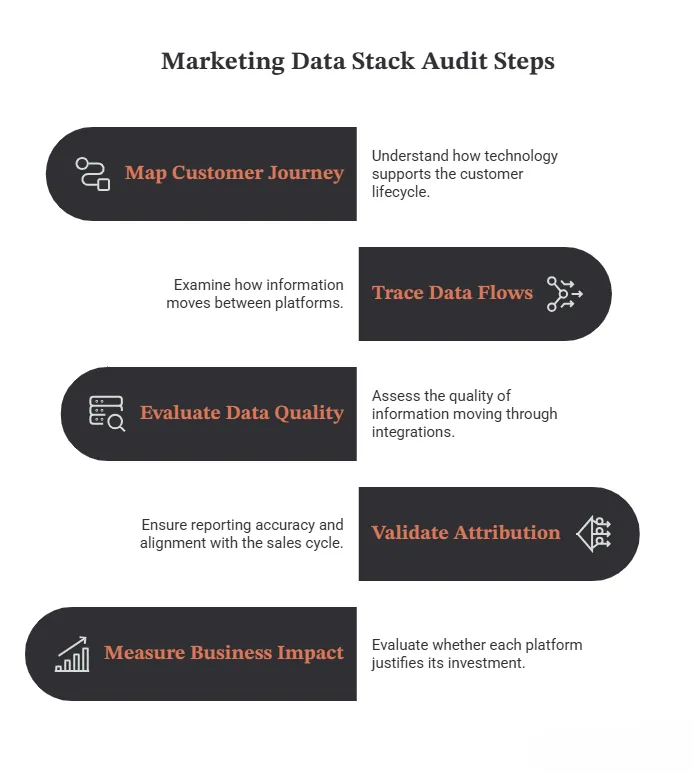
Follow these five steps to perform a comprehensive marketing data stack audit.
Step 1: Map Your Marketing Stack to the Customer Journey
Before reviewing individual platforms, understand how your technology supports the entire customer lifecycle.
Many organizations purchase software to solve immediate challenges, but over time, those tools become disconnected from the actual buyer journey.
Create a visual map covering each major stage:
Buyer Journey Stage | Typical Marketing Activities | Supporting Technology |
|---|---|---|
Awareness | Organic search, paid advertising, and social media | SEO tools, Google Analytics, ad platforms |
Consideration | Content downloads, webinars, and email nurturing | Marketing automation, CRM, and webinar platforms |
Decision | Product demos, sales meetings, proposals | CRM, Revenue Intelligence, Sales Enablement |
Retention | Customer onboarding, email campaigns, surveys | Customer Success Platform, CDP, Marketing Automation |
Advocacy | Reviews, referrals, and community engagement | Loyalty platforms, Social Listening Tools |
This exercise helps identify:
Missing data collection points
Overlapping technologies
Manual workflows
Customer journey gaps
Inconsistent reporting
For example, you may discover that website engagement data flows into Google Analytics but never reaches your CRM, making it impossible to connect anonymous visitors with pipeline creation.
Pro Tip:
Instead of asking: "Which tools do we own?"
Ask: "Which systems influence customer decisions at each stage of the buying journey?"
This mindset shifts the audit from software management to revenue optimization.
Step 2: Trace Every Critical Data Flow
Once the customer journey is mapped, examine how information moves between platforms.
A marketing stack only performs as well as its integrations.
Start by identifying the three most business-critical data flows.
For most B2B organizations, these include:
Website → CRM
CRM → Marketing Automation Platform
Advertising Platforms → Analytics → CRM
CRM → Business Intelligence Dashboard
Product Usage Data → Customer Success Platform
Now validate each connection.
Ask questions such as:
Is every field syncing correctly?
How often does synchronization occur?
Are duplicate records being created?
Are important values overwritten?
Are API failures monitored?
Does every campaign parameter transfer correctly?
Document findings in a simple audit table.
Source System | Destination | Data Type | Sync Status | Action Required |
|---|---|---|---|---|
Website | CRM | Form submissions | Healthy | None |
CRM | Marketing Automation | Lifecycle stages | Delayed | Review integration |
Google Ads | CRM | Lead source | Missing | Update tracking |
This approach makes hidden integration problems immediately visible and simplifies prioritization.
Common Integration Problems
During marketing stack audits, organizations frequently discover:
CRM fields no longer sync after platform updates
Inconsistent campaign naming conventions
Missing UTM parameters
Duplicate customer IDs
Manual spreadsheet imports replacing automated workflows
Offline conversions never reaching reporting dashboards
Broken webhook automations
Inconsistent currency or revenue values
Each of these issues reduces reporting accuracy and limits the effectiveness of marketing automation and AI-powered decision-making.
Step 3: Evaluate Data Quality and Governance
Once integrations are validated, assess the quality of the information moving through them.
Poor-quality data creates a ripple effect across every marketing initiative, from segmentation and personalization to attribution and forecasting.
Focus on four key areas.
Customer Data
Review:
Duplicate contacts
Invalid email addresses
Missing demographic information
Incomplete company profiles
Outdated records
Campaign Data
Review:
Campaign naming consistency
Source attribution
UTM tagging
Conversion events
Channel classification
CRM Data
Review:
Lifecycle stages
Opportunity mapping
Lead ownership
Account hierarchy
Revenue fields
Governance
Evaluate whether your organization has documented standards for:
Data ownership
Field naming conventions
Permission management
Data retention policies
Privacy compliance
Regular data cleansing
Strong governance improves reporting accuracy while creating a reliable foundation for AI-powered marketing initiatives.
Expert Insight
Many organizations schedule a major database cleanup once a year.
High-performing marketing teams treat data quality as an ongoing operational process rather than a one-time project.
Quarterly audits combined with automated validation rules typically deliver far better long-term results than annual cleanups.
Step 4: Validate Marketing Attribution and Reporting Accuracy
Reliable reporting depends on accurate attribution.
Unfortunately, attribution is often where disconnected marketing stacks become most visible.
Rather than relying solely on dashboard metrics, manually validate a sample of recent closed opportunities.
Compare:
CRM opportunity history
Website interactions
Email engagement
Paid advertising clicks
Webinar attendance
Sales activities
Now compare that customer journey with what your attribution platform reports.
Many organizations discover that:
Last-touch attribution receives excessive credit.
Organic content appears undervalued.
Email nurturing disappears from reporting.
Offline interactions are excluded entirely.
These inconsistencies influence future budget allocation, campaign optimization, and executive reporting.
Modern marketing teams should evaluate whether their attribution model aligns with their sales cycle and customer journey complexity.
Comparison: Attribution Models
Model | Best For | Limitations |
|---|---|---|
First Touch | Brand awareness analysis | Ignores later interactions |
Last Touch | Simple reporting | Overvalues the final interaction |
Linear | Multi-channel campaigns | Equal weighting isn't always realistic |
Time Decay | Long B2B sales cycles | Complex to implement |
Data-Driven | Large datasets | Requires reliable historical data |
Selecting the right attribution model depends on business goals, not simply platform defaults.
Step 5: Measure Technology Utilization and Business Impact
The final step is evaluating whether every platform justifies its investment.
This goes beyond software usage.
Instead, measure business value.
For every marketing technology platform, answer these questions:
How many team members actively use it?
Which business process depends on it?
Does it reduce manual work?
Does it improve customer experience?
Does it contribute to measurable pipeline growth?
Can its value be demonstrated using KPIs?
Create a simple evaluation matrix.
Evaluation Criteria | Score (1–5) |
|---|---|
Business Value | |
User Adoption | |
Integration Quality | |
Reporting Accuracy | |
Operational Efficiency | |
Total Cost of Ownership |
Platforms scoring consistently low across multiple categories should be reviewed for consolidation or replacement.
Remember, reducing software costs should never be the primary objective.
The goal is to create a marketing technology ecosystem that supports reliable data, efficient workflows, and sustainable business growth.
What to Do After Completing Your Marketing Data Stack Audit
A marketing data stack audit only creates value if it leads to measurable improvements. The goal isn't to produce another report, it's to strengthen your marketing operations, improve reporting accuracy, and build a technology ecosystem that supports sustainable pipeline growth.
Rather than trying to solve every issue at once, prioritize findings based on business impact, implementation effort, and potential return on investment.
One of the biggest mistakes organizations make is treating every issue with equal urgency. A broken CRM integration affecting lead routing deserves immediate attention, while replacing a reporting dashboard can often wait.
Prioritize Your Findings Using an Impact-Effort Matrix
Categorizing audit findings helps marketing, RevOps, and IT teams focus on improvements that deliver the greatest business value first.
Priority | Typical Issues | Business Impact | Recommended Timeline |
|---|---|---|---|
Critical | Broken CRM integrations, missing lead source data, failed automation workflows, and inaccurate attribution | Direct impact on revenue and pipeline visibility | Immediately |
High | Duplicate customer records, inconsistent campaign tracking, poor data governance, and reporting discrepancies | Affects decision-making and personalization | Within 30 days |
Medium | Underutilized software, overlapping platform capabilities, and outdated dashboards | Improves operational efficiency | Quarterly roadmap |
Strategic | CDP implementation, data warehouse modernization, AI readiness, and architecture redesign | Long-term scalability and competitive advantage | 6–12 months |
This structured approach prevents teams from spending months optimizing low-impact problems while mission-critical issues continue affecting revenue.
Focus on Business Outcomes, Not Just Technical Fixes
When presenting audit findings to leadership, avoid technical language whenever possible.
Instead of saying: "Several CRM fields aren't synchronizing correctly."
Frame the business impact: "Sales representatives are missing important lead qualification data, reducing follow-up accuracy and affecting conversion rates."
Similarly,
Instead of: "Campaign attribution contains duplicate conversion events."
Say: "Marketing investment decisions are being made using incomplete performance data, making budget allocation less reliable."
Executive stakeholders respond more positively when improvements are connected to measurable business outcomes rather than system maintenance.
Quick Wins That Deliver Immediate Value
Not every recommendation requires a major technology investment. Many organizations improve marketing performance by fixing relatively small issues that have accumulated over time.
Consider prioritizing these high-impact improvements:
Standardize campaign naming conventions across all marketing channels.
Remove duplicate customer and company records.
Review and validate UTM parameters for active campaigns.
Repair broken CRM and marketing automation integrations.
Archive inactive workflows and outdated automation rules.
Eliminate unused or redundant marketing tools.
Define consistent lifecycle stage definitions across marketing and sales.
Create a recurring process for data quality monitoring.
These improvements often increase reporting accuracy and reduce manual work without requiring additional software purchases.
Don't Let AI Amplify Poor Data
Many organizations are investing heavily in AI-powered marketing tools, predictive analytics, and autonomous workflows. However, AI systems depend entirely on the quality of the data they receive.
If customer profiles are incomplete, attribution models are inaccurate, or integrations are unreliable, AI-generated recommendations become less trustworthy.
Before introducing new AI capabilities, verify that your marketing data foundation is reliable.
Expert Insight
Organizations frequently ask which AI platform they should adopt next. In many cases, the better investment is improving data quality first. Reliable customer data enables existing AI tools to deliver significantly more accurate recommendations, personalization, and forecasting.
Common Marketing Data Stack Audit Mistakes to Avoid
Even experienced marketing teams can overlook issues that reduce the effectiveness of their audit.
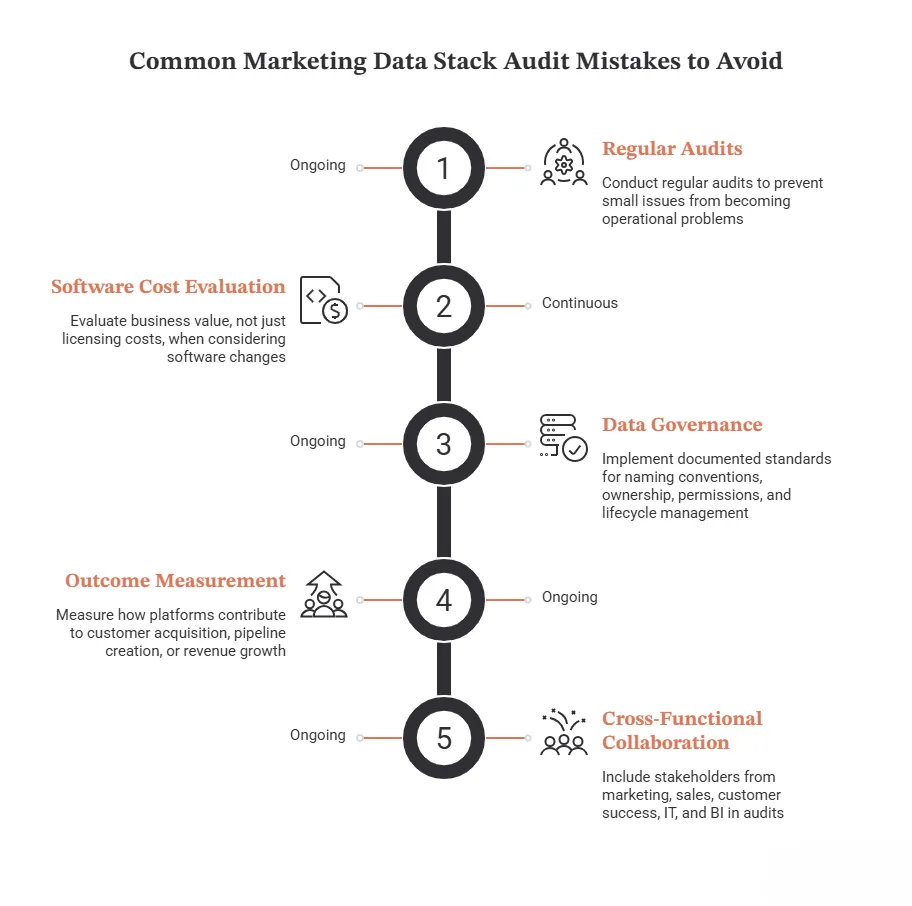
Avoid these common mistakes:
1. Treating the Audit as a One-Time Project
Marketing technology evolves constantly. New platforms, integrations, and campaign structures are introduced throughout the year.
Regular audits help prevent small issues from becoming larger operational problems.
2. Focusing Only on Software Costs
Reducing software spend is valuable, but eliminating the wrong platform can disrupt reporting, customer journeys, or automation workflows.
Evaluate business value, not just licensing costs.
3. Ignoring Data Governance
Technology alone cannot maintain data quality.
Without documented standards for naming conventions, ownership, permissions, and lifecycle management, reporting inconsistencies eventually return.
4. Measuring Activity Instead of Outcomes
High platform usage doesn't necessarily indicate business value.
Instead of asking, "How often is this tool used?"
Ask, "How does this platform contribute to customer acquisition, pipeline creation, or revenue growth?"
5. Forgetting Cross-Functional Stakeholders
A marketing data stack affects multiple teams, including:
Marketing Operations
Revenue Operations (RevOps)
Sales
Customer Success
Business Intelligence
IT
Data Engineering
Including these stakeholders during the audit helps identify issues that individual teams may not notice independently.
How Often Should You Audit Your Marketing Data Stack?
The right audit frequency depends on how quickly your marketing technology evolves.
Organizations that regularly introduce new tools, campaigns, or integrations should review their stack more frequently than businesses with relatively stable systems.
A practical review schedule looks like this:
Audit Activity | Recommended Frequency |
|---|---|
Data quality checks | Monthly or Quarterly |
CRM and integration validation | Quarterly |
Tool utilization review | Quarterly |
Attribution model validation | Every 6 months |
Customer journey mapping | Every 6–12 months |
Vendor and software review | Annually |
Complete marketing data stack audit | Annually (or after major technology changes) |
Rather than waiting for reporting issues to appear, establish recurring audit cycles that proactively identify risks before they affect campaign performance or revenue reporting.
Final Thoughts
Your marketing data stack is more than a collection of platforms, it is the foundation that supports every campaign, customer interaction, and strategic marketing decision.
When data is fragmented, inaccurate, or poorly governed, even the most sophisticated marketing technologies struggle to deliver meaningful results. Conversely, a well-audited and well-maintained stack enables reliable reporting, stronger personalization, more accurate attribution, and greater confidence in every marketing investment.
A marketing data stack audit isn't simply about identifying technical issues. It's about creating a connected ecosystem where data flows seamlessly, insights are trustworthy, and technology supports measurable business outcomes.
As marketing continues to become more data-driven and AI-powered, organizations that regularly audit and optimize their marketing infrastructure will be better positioned to adapt, innovate, and grow.
If you're developing a broader data-driven marketing strategy, your marketing data stack is the foundation that makes every insight, automation, and AI initiative more effective. Starting with a structured audit today can help prevent costly inefficiencies tomorrow.