The Complete Guide to Data-Driven Marketing: Strategy, Analytics & AI
Learn data-driven marketing strategies, analytics, AI tools, KPIs, and frameworks to improve ROI and customer targeting.
 By Divyesh Savaliya
Marketing without data is guesswork. Yet despite an explosion of analytics platforms, AI tools, and customer data sources, most businesses still run campaigns based on assumptions, past habits, or gut feel. The result? Budget wasted on audiences who won't convert, messages that don't resonate, and attribution models that can't explain what actually drove a sale.
Data-driven marketing changes that equation entirely. It replaces intuition with evidence, replaces broad targeting with precision, and replaces reactive strategy with predictive intelligence. And with AI now embedded across the marketing stack, the capacity to act on data in real time has never been stronger.
This pillar guide covers everything you need to know. From what data-driven marketing actually means, to the frameworks, tools, and AI capabilities that make it work, to a step-by-step process for building your own strategy, this is the resource your marketing team needs to move from data-rich to insight-led.
The Market Reality : Why Data-Driven Marketing Is No Longer Optional
The numbers tell a compelling story. The global digital marketing market is valued at $456.7 billion in 2025 and is projected to reach $1.2 trillion by 2034, growing at a CAGR of 10.99%. At the same time, the marketing analytics market alone is set to grow from $6.2 billion in 2025 to over $29.56 billion by 2034 at a CAGR of 17% (Source).
AI's role in this expansion is central. The AI in marketing sector was valued at $20.44 billion in 2024 and is on track to reach $82.23 billion by 2030, growing at 25% CAGR, according to Grand View Research. In practical terms, 88% of digital marketers now use AI tools in their day-to-day workflow, and 92% of businesses plan to invest in generative AI marketing tools over the next three years (Source).
The adoption gap is already creating a competitive divide. According to Bain research, companies leading in B2B revenue are two to six times more likely to have data science, analytics, and marketing automation functions in-house. The companies treating data-driven marketing as optional are falling behind.
What Is Data-Driven Marketing?
Data-driven marketing is the practice of collecting, analyzing, and applying data about customer behavior, campaign performance, and market trends to guide every marketing decision. Rather than building campaigns around assumptions about what audiences want, data-driven marketers build them around evidence: who your buyers are, what they respond to, when they're ready to act, and through which channels.
At its core, data-driven marketing operates across three levels:
Descriptive — understanding what has already happened (past campaign results, customer behavior patterns, channel performance)
Predictive — forecasting what is likely to happen next (lead scoring, churn probability, demand forecasting)
Prescriptive — recommending specific actions to influence outcomes (next-best-action engines, spend optimization, content personalization)
Modern data-driven marketing also involves connecting data from multiple sources: CRM records, website analytics, advertising platforms, email engagement, social media, and offline sales data. This unified view of the customer is what enables truly personalized, consistent experiences across channels.
Data-Driven Marketing vs. Traditional Marketing
Traditional Marketing | Data-Driven Marketing |
|---|---|
Based on intuition and experience | Based on behavioral and performance data |
Broad audience targeting | Precise segmentation by intent, behavior, demographics |
Campaign results measured post-launch | Real-time tracking with continuous optimization |
Single-channel or siloed approach | Integrated cross-channel view of the customer |
Static messaging for large groups | Dynamic personalization at the individual level |
Budget allocated by assumption | Spend optimized by actual attribution data |
Slow strategy iteration cycles | AI-driven rapid testing and adaptation |
Key Components of a Data-Driven Marketing System
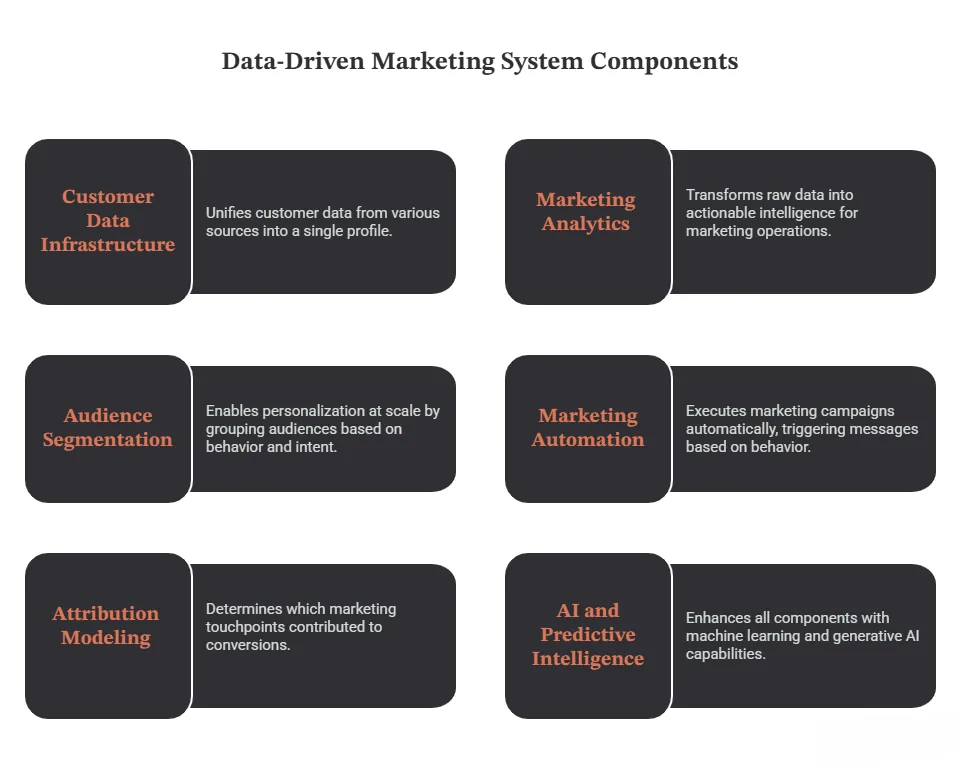
Data-driven marketing isn't a single tool or tactic. It's a system built from interconnected components, each playing a distinct role in turning raw data into marketing outcomes.
1. Customer Data Infrastructure
Everything starts with data collection. The most common sources include:
First-party data: CRM records, website behavior, email engagement, purchase history
Second-party data: Partner-shared audience data
Third-party data: Market research panels, intent data providers, demographic databases
Zero-party data: Preferences customers voluntarily share (surveys, preference centers)
Customer Data Platforms (CDPs) have become the infrastructure backbone of data-driven marketing, unifying these sources into a single, persistent customer profile that updates in real time.
2. Marketing Analytics
Analytics transforms raw data into actionable intelligence. This spans web analytics (Google Analytics 4), campaign analytics, social listening, SEO performance, email metrics, and revenue attribution. The marketing analytics software market is projected to grow from a $15 billion market in 2025 to $45 billion by 2033, reflecting how central analytics has become to marketing operations.
3. Audience Segmentation
Segmentation is what makes personalization at scale possible. Data-driven segmentation goes beyond demographics to include behavioral patterns, purchase intent signals, engagement history, and predictive scoring. Effective segmentation allows a single brand to speak to multiple audiences with messages that feel individual.
4. Marketing Automation
Automation handles the execution layer, triggering the right message to the right audience at the right time without manual intervention. Modern marketing automation platforms (MAPs) combine behavioral triggers, lead nurturing workflows, dynamic content, and AI-powered optimization into a unified execution engine. For more on how automation powers revenue operations, see
How marketing automation connects to your broader revenue strategy at Marketricka's marketing blog.
5. Attribution Modeling
Attribution answers the question: which marketing touchpoints actually drove the conversion? Without proper attribution, marketers either over-credit the last interaction or spread credit so thinly that no actionable insight emerges. Common models include last-touch, first-touch, linear, time-decay, and data-driven attribution, the latter using machine learning to weight each touchpoint by actual contribution.
6. AI and Predictive Intelligence
AI sits across all other components, enhancing every layer of the system. Machine learning models predict which leads are likely to convert, which customers are at risk of churn, and which content will resonate most. Generative AI assists in content creation, ad copy personalization, and campaign ideation. According to Gartner, 73% of marketing teams now use generative AI in some capacity.
Types of Marketing Data and What They Tell You
Data Type | Examples | Primary Use Case |
|---|---|---|
Demographic | Age, job title, company size, location | Initial segmentation & ICP definition |
Behavioral | Pages visited, time on site, clicks, downloads | Intent scoring, personalization |
Transactional | Purchase history, order value, frequency | LTV modeling, retention campaigns |
Engagement | Email opens, CTR, social interactions | Content optimization, nurture scoring |
Firmographic | Industry, revenue band, headcount, tech stack | B2B account targeting & ABM |
Psychographic | Values, interests, pain points, buying motivations | Message framing & creative strategy |
Predictive | Churn probability, propensity to buy | Sales prioritization, retention triggers |
Benefits of Data-Driven Marketing
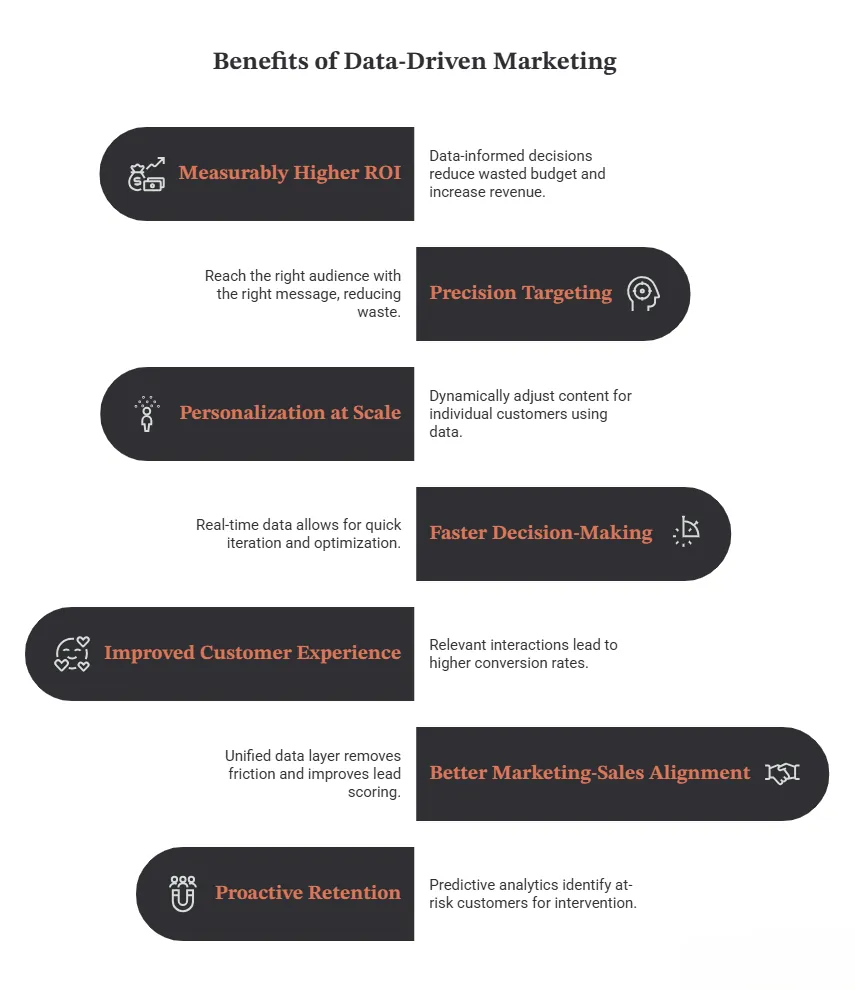
The business case for data-driven marketing is well-documented and growing stronger. Here's what organizations consistently report when they shift to evidence-led decision-making.
Measurably Higher ROI
When every campaign decision is informed by data, budget stops being wasted on audiences and channels that don't convert. Companies that personalize effectively earn 40% more revenue than those that don't. Personalized CTAs outperform generic ones by 202%. And organizations implementing AI-driven marketing report an average 41% revenue increase alongside a 32% reduction in customer acquisition costs.
Precision Targeting and Reduced Waste
Data-driven segmentation enables marketing teams to reach the right people with the right message at the right time. This precision reduces ad spend waste significantly. Companies using AI for customer targeting report a 25% improvement in targeting accuracy. For B2B teams, this translates directly into shorter sales cycles and a higher-quality pipeline.
Personalization at Scale
Personalization is no longer a nice-to-have. 71% of consumers expect personalized interactions from the brands they engage with, and 76% express frustration when that expectation isn't met. Data-driven marketing makes personalization scalable, using behavioral signals and AI to dynamically adjust content, offers, and timing for individual customers without requiring individual manual work.
For deeper context on how AI enables personalization at scale, explore Marketricka's insights on how AI is shaping the future of content strategy.
Faster, Smarter Decision-Making
Access to real-time performance data allows marketing teams to iterate quickly. Instead of waiting until the end of a campaign to understand what worked, teams can test, measure, and optimize in-flight. This agility compounds over time, building institutional knowledge from each campaign cycle into the next.
Improved Customer Experience
Data-driven marketing and customer experience are inseparable. When a brand understands where a customer is in their journey, what they've previously engaged with, and what their next likely need is, every interaction becomes more relevant and less intrusive. Real-time personalization delivers 20% higher conversion rates compared to batch processing approaches.
Better Marketing-Sales Alignment
A unified data layer removes the friction between marketing and sales. When both teams operate from the same customer data, lead scoring becomes more accurate, handoffs happen at the right moment, and revenue attribution reflects the contribution of the full funnel rather than just last-touch conversions.
Proactive Retention and Loyalty
Predictive analytics can identify customers at risk of churning before they leave. Data-driven retention programs, triggered by behavioral signals like reduced engagement or support ticket volume, can intervene at exactly the right moment with the right incentive. Customers who receive preference-based personalization show 33% higher lifetime value than those receiving generic experiences.
Real-World Use Cases of Data-Driven Marketing
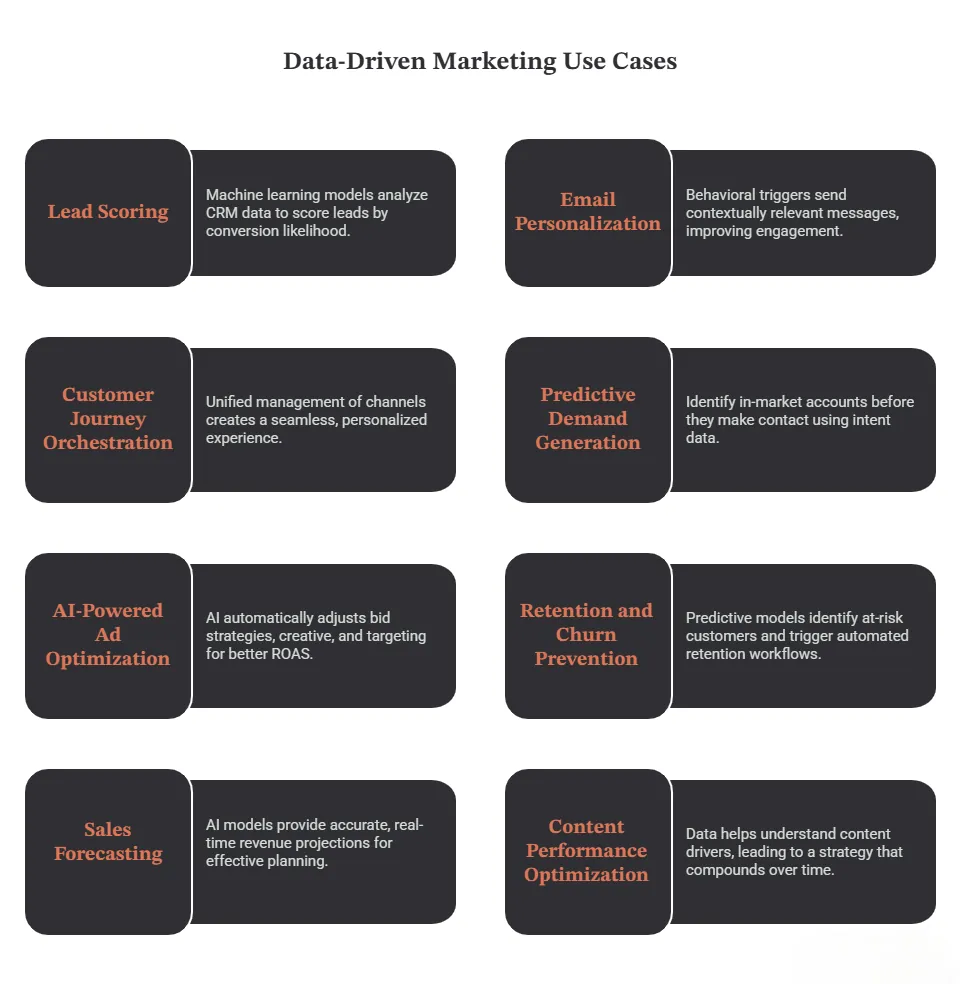
The principles of data-driven marketing apply across industries and functions. Here are the most impactful use cases currently in practice.
Lead Scoring and Pipeline Prioritization (B2B)
Machine learning models analyze historical CRM data to score inbound leads by their likelihood to convert. Signals like job title, company size, content engagement, and page visit patterns feed into a composite score that helps sales teams prioritize outreach. The result is less time spent chasing cold leads and more time focused on accounts with genuine intent.
Email Marketing Personalization
According to a mid-2024 global survey of marketing professionals, email marketing was identified as the area where data-driven marketing delivers the most value, cited by 47% of respondents. Data-driven email programs use behavioral triggers (cart abandonment, content downloads, inactivity) to send contextually relevant messages rather than batch-and-blast campaigns. Segmented email campaigns consistently outperform unsegmented ones across open rate, click rate, and conversion metrics.
Customer Journey Orchestration
Rather than managing email, social, paid, and web as separate channels, data-driven marketers orchestrate them as a unified journey. A prospect who clicks a LinkedIn ad, visits the pricing page, and downloads a case study receives a seamlessly coordinated follow-up sequence across every channel they use, timed and personalized based on their specific behavior.
Marketricka's work on The omnichannel customer journey explores how data connects these touchpoints into a coherent, revenue-driving experience.
Predictive Demand Generation
Demand generation teams are increasingly using predictive intent data to identify in-market accounts before those accounts make contact. Third-party intent signals, combined with first-party behavioral data, allow marketers to activate campaigns precisely when a target account is actively researching solutions. This compresses the early stages of the buying cycle significantly.
AI-Powered Ad Optimization
Paid media teams now use AI to automatically adjust bid strategies, creative rotation, audience targeting, and budget allocation across campaigns. Platforms like Google's Performance Max and Meta's Advantage+ use machine learning to optimize delivery in real time. For marketing teams, the practical benefit is better ROAS without constant manual intervention.
Retention and Churn Prevention
SaaS companies, subscription brands, and e-commerce businesses use predictive churn models to identify at-risk customers early. These models pull signals from login frequency, feature usage, support interactions, and payment behavior to assign a churn probability score. Automated retention workflows then trigger personalized outreach, incentive offers, or success team check-ins before the cancellation decision is made.
Sales Forecasting
AI-driven sales forecasting models give revenue leaders accurate, real-time projections by analyzing pipeline stage data, historical win rates, deal velocity, and market signals. This removes the reliance on manually reported forecasts and gives leadership the visibility needed to plan resources, headcount, and campaigns effectively.
Content Performance Optimization
Content teams use data to understand which formats, topics, and distribution channels drive the most engagement, pipeline, and revenue. This goes beyond pageviews to include scroll depth, content-to-conversion attribution, and topic-level demand analysis. The result is a content strategy that compounds over time, consistently producing assets that drive qualified traffic and real business outcomes.
How to Build a Data-Driven Marketing Strategy: A Step-by-Step Framework
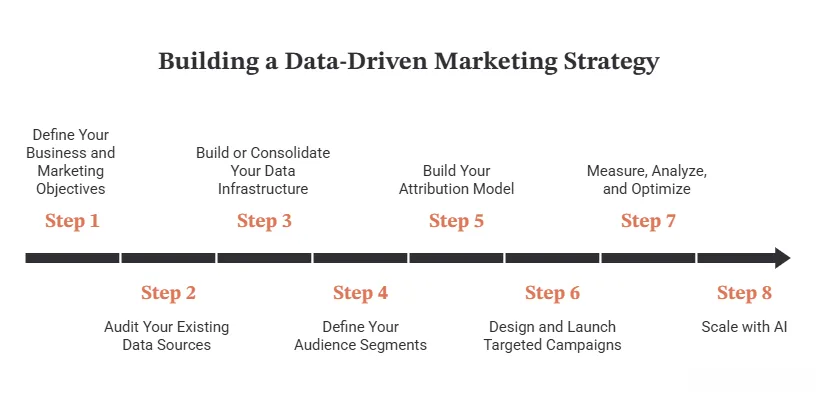
Building a data-driven marketing strategy isn't a one-time project. It's an iterative system you build over time, with each cycle producing better data, sharper insights, and stronger results. Here's how to approach it.
Step 1: Define Your Business and Marketing Objectives
Everything starts with clarity on what success looks like. Before collecting a single data point, establish the business outcomes your marketing is expected to deliver. These might include pipeline generation, customer acquisition cost reduction, retention improvement, or net revenue retention.
From these business objectives, derive specific, measurable marketing goals: the number of qualified leads per quarter, conversion rates by channel, cost per acquisition by segment, or customer lifetime value by cohort. Without these anchors, data collection becomes unfocused, and analytics loses its business context.
Step 2: Audit Your Existing Data Sources
Before building anything new, understand what you already have. Conduct a data audit that maps:
What data you're currently collecting (CRM, website, email, ads, sales)
The quality and completeness of that data (missing fields, inconsistent formats, outdated records)
Where data silos exist between systems
What you need but don't currently have
This audit will shape your technology and infrastructure priorities. Most organizations discover significant gaps in cross-channel data connectivity and attribution at this stage.
Step 3: Build or Consolidate Your Data Infrastructure
If your data lives in disconnected systems, the first infrastructure priority is integration. This typically means connecting your CRM, marketing automation platform, website analytics, and ad platforms through a CDP or a central data warehouse. The goal is a unified customer profile that updates in real time and is accessible across every team that needs it.
Key decisions at this stage include: build vs. buy for your data platform, which identity resolution approach you'll use to match anonymous web visitors to known contacts, and how you'll handle data governance and compliance with privacy regulations.
Step 4: Define Your Audience Segments
With clean, unified data, you can build audience segments that reflect real patterns in customer behavior rather than assumed demographics. Effective B2B segmentation typically combines firmographic data (industry, company size, tech stack), behavioral signals (content engagement, product usage, web visits), and intent data (third-party research signals).
For B2C, behavioral segmentation based on purchase history, engagement patterns, and predictive affinity scores tends to outperform demographic segmentation alone. Test your segments against historical conversion data to validate their predictive accuracy before investing in campaigns.
Step 5: Build Your Attribution Model
Attribution is the connective tissue between marketing activity and revenue outcomes. Choose an attribution model that reflects your actual sales cycle. Short-cycle B2C sales may work well with last-touch or first-touch models. Complex B2B deals with multiple touchpoints over weeks or months, typically require multi-touch or data-driven attribution to accurately reflect how different channels contributed to the win.
Data-driven attribution models use machine learning to assign credit based on actual path-to-purchase data rather than rules. While they require more historical data to train, they consistently produce more accurate and actionable results than rule-based models.
Step 6: Design and Launch Targeted Campaigns
With segments defined and attribution in place, you can design campaigns that speak to specific audiences with specific messages and measure exactly how they perform. Build campaigns around customer intent and journey stage, not just product features. Use behavioral triggers to automate the delivery of relevant content at the right moment, and build A/B testing into every significant campaign element.
Step 7: Measure, Analyze, and Optimize
Data-driven marketing requires a measurement discipline that most organizations underinvest in. Set up dashboards that track not just vanity metrics (impressions, clicks) but business metrics (pipeline contribution, cost per qualified lead, customer acquisition cost, revenue influenced). Establish a regular cadence for reviewing performance data across the team.
Optimization should be continuous, not end-of-campaign. Use real-time data to adjust ad targeting, email timing, content distribution, and budget allocation throughout the campaign lifecycle. The teams that compound their performance fastest are those that treat every campaign as a learning opportunity.
Step 8: Scale with AI
Once your data infrastructure and measurement foundation are solid, AI becomes a force multiplier. However, AI performs only as well as the quality of the data it receives. Before scaling AI initiatives, consider performing a marketing data stack audit to validate your integrations, customer data quality, and attribution models. A clean, connected marketing ecosystem enables AI to generate more reliable insights and recommendations.
Start with the highest-impact, highest-data-availability use cases. Lead scoring and email send-time optimization tend to be the most accessible starting points. As your data matures, more sophisticated applications like real-time content personalization and predictive lifetime value modeling become practical.
How AI Is Transforming Data-Driven Marketing
AI isn't a separate capability you layer on top of data-driven marketing. It's what makes data-driven marketing scalable. Without AI, the volume of data generated by modern marketing channels would overwhelm any human analyst's ability to process and act on it. With AI, patterns hidden in millions of data points become actionable insights in real time.
Predictive Lead Scoring
Traditional lead scoring assigns points to demographic attributes and behavioral actions according to rules set by sales and marketing teams. AI-powered scoring models instead analyze historical won and lost deal data to identify the actual signals most predictive of conversion. These models update automatically as new data comes in, improving accuracy over time without manual recalibration.
Dynamic Content Personalization
AI enables websites, emails, and landing pages to dynamically adapt to each visitor based on their profile, behavioral history, and predicted intent. Rather than showing every prospect the same homepage or email, AI-driven personalization serves content matched to their specific situation. 80% of consumers are more likely to purchase from brands that deliver personalized content, according to Deloitte's 2025 research.
Marketing Spend Optimization
Budget allocation has traditionally been a slow, manual process based on last quarter's performance. AI changes this by continuously rebalancing spend across channels based on real-time conversion data, audience saturation signals, and competitive dynamics. The result is a more efficient use of every dollar in the media budget.
Conversational Intelligence and Chatbots
AI-powered conversational interfaces can qualify leads, answer product questions, book meetings, and gather intent signals at any hour without human involvement. When integrated with CRM and marketing automation platforms, these tools enrich customer profiles with conversational data that informs downstream personalization and sales outreach.
Content Generation and Optimization
Generative AI now assists with drafting ad copy, email subject lines, social content, and blog outlines at scale. While human judgment remains essential for strategy, brand voice, and quality review, AI dramatically reduces the time from brief to first draft. Organizations implementing AI report an average 93% acceleration in content creation processes, according to SurveyMonkey's 2025 marketing survey.
For a detailed view of how this works in practice, Marketricka's content on AI in content strategy walks through specific tools and approaches.
Customer Retention and Lifecycle Marketing
AI excels at identifying the early warning signals of customer disengagement that humans tend to miss. By monitoring behavioral patterns across product usage, support interactions, and communication engagement, AI models can flag at-risk customers for intervention before the decision to leave has been made. For more on how AI supports sales and retention, see Marketricka's resources on data-driven decision-making.
Essential Tools for Data-Driven Marketing
The technology stack for data-driven marketing spans several categories. The right combination depends on your business model, team size, existing systems, and the maturity of your data infrastructure.
Category | Key Tools | Primary Function |
|---|---|---|
Marketing Analytics | Google Analytics 4, Adobe Analytics, Mixpanel | Web behavior, funnel tracking, conversion analysis |
CRM & CDP | Salesforce, HubSpot CRM, Segment, Bloomreach | Unified customer profiles, deal tracking, and data unification |
Marketing Automation | HubSpot, Marketo, Pardot, ActiveCampaign | Email, nurture, behavioral triggers, lead scoring |
SEO & Content Intelligence | Semrush, Ahrefs, Clearscope, Surfer SEO | Keyword research, content optimization, SERP tracking |
Paid Media & Attribution | Google Ads, Meta Ads, Northbeam, Triple Whale | Ad optimization, multi-touch attribution, ROAS tracking |
Business Intelligence | Tableau, Power BI, Looker, Google Looker Studio | Cross-channel dashboards, exec reporting, data visualization |
AI Marketing Platforms | Jasper, Copy.ai, Persado, Drift, 6sense | AI content, intent data, conversational marketing |
Social Analytics | Sprout Social, Brandwatch, Hootsuite Insights | Social listening, engagement tracking, sentiment analysis |
The Most Important Data-Driven Marketing Metrics
Effective data-driven marketing requires tracking the right metrics at the right level of the funnel. Here's a framework organized by what you're trying to measure.
Acquisition Metrics
Customer Acquisition Cost (CAC): Total marketing and sales spend divided by new customers acquired
Cost Per Qualified Lead (CPQL): Total spend divided by leads meeting your ICP criteria
Channel-attributed traffic and conversion rates: Organic, paid, email, social, direct
Marketing-sourced pipeline: Percentage of total pipeline originated by marketing
Engagement and Conversion Metrics
Click-through rate (CTR) by channel and audience segment
Landing page conversion rate
Email open rate, click rate, and conversion rate
Content engagement: scroll depth, time on page, return visits
Lead-to-opportunity conversion rate
Revenue and Retention Metrics
Marketing-influenced revenue: Revenue from deals touched by marketing
Customer Lifetime Value (CLV / LTV)
Net Revenue Retention (NRR): Expansion minus churn as a percentage of prior-period revenue
Return on Ad Spend (ROAS): Revenue generated per dollar of ad spend
Marketing ROI: (Revenue attributable to marketing — Marketing costs) / Marketing costs
Predictive and Health Metrics
Lead score distribution: How well your scoring model predicts pipeline quality
Churn probability by segment
Pipeline velocity: Average deal size x win rate / average sales cycle length
Content-to-pipeline attribution: Which assets influence which deal stages
Common Challenges in Data-Driven Marketing (and How to Overcome Them)
Challenge | How to Address It |
|---|---|
Data silos across CRM, ads, email, and web | Invest in a CDP or data warehouse to create a unified customer view |
Poor data quality and incomplete records | Build data hygiene processes: validation at entry, regular deduplication, enrichment workflows |
Difficulty targeting segmented audiences in real time | Cited by 45% of marketers as the top data-driven challenge (Statista, 2024). Address with behavioral automation triggers and real-time CDPs |
Attribution gaps across long B2B sales cycles | Implement multi-touch data-driven attribution; supplement with revenue operations analytics |
Team lacks analytics skills | Invest in training; use BI tools with self-serve dashboards; hire or partner for data science capability |
Privacy regulations limiting third-party data use | Shift investment to first-party and zero-party data collection; build consent frameworks |
Difficulty proving marketing's contribution to revenue | Establish marketing-influenced pipeline and revenue as core reporting metrics alongside cost metrics |
Data-Driven Marketing and the SEO Connection
Data-driven marketing and SEO are deeply intertwined. Keyword research is a form of demand data, revealing what your target audience is actively searching for. Content performance analytics tell you which topics attract qualified traffic and which convert. Search Console data shows you where your organic presence is strong and where gaps exist.
As AI-powered search and generative engine optimization (GEO) reshape how buyers discover content, data-driven marketers have an advantage: they're already tracking the right signals. Understanding which content formats, query types, and topic clusters drive qualified organic traffic is increasingly the foundation of a competitive SEO strategy.
For teams managing both GEO and traditional SEO, Marketricka's insights on Google Trends alternatives for marketers provide practical tools for tracking emerging search demand in real time.
Data-Driven Marketing in B2B: Specific Considerations
B2B marketing presents unique data challenges and opportunities compared to B2C. Sales cycles are longer, buying committees involve multiple stakeholders, deal values are higher, and the path from first awareness to signed contract is rarely linear.
Account-Based Marketing (ABM) runs on data. Identifying your ideal customer profile, selecting target accounts, and activating personalized campaigns at the account level all require integrated firmographic, intent, and behavioral data.
Lead scoring models need to account for committee-level signals, not just individual behavior. A single contact downloading a case study is a weaker signal than three contacts from the same company engaging with different content assets in the same week.
Revenue attribution in B2B requires both online and offline data. Sales call recordings, event attendance, and direct relationships all influence deals but often go untracked.
Intent data providers like Bombora and G2 Buyer Intent can identify accounts researching your category before they ever visit your website, giving marketing teams a significant head start on outreach timing.
The HubSpot State of Marketing 2025 report confirms that for B2B brands, the top ROI-driving channels are website and blog/SEO, paid social media, and content marketing, all of which depend heavily on data-driven strategy for effective execution.
Building a Data-Driven Marketing Team
The tools and frameworks only deliver results when the team using them operates with a data-first mindset. Building that culture requires both the right talent and the right processes.
Roles That Matter
Marketing Analytics Manager / Data Analyst: Owns reporting, dashboard management, and data interpretation
Marketing Operations Manager: Manages the marketing technology stack, data flows, and process automation
Demand Generation Manager: Applies data to campaign strategy, audience targeting, and funnel optimization
Revenue Operations (RevOps): Aligns marketing, sales, and customer success data under a unified revenue model
Content Strategist with SEO specialization: Uses keyword and performance data to build traffic-driving content programs
Processes That Reinforce Data Culture
Weekly marketing performance reviews using live dashboards, not slide decks
Attribution reporting shared across marketing and sales leadership
Regular A/B testing with documented learnings logged in a shared knowledge base
Quarterly data quality audits
OKRs anchored to measurable marketing outcomes, not activity volume
Future Trends in Data-Driven Marketing
The pace of change in marketing data and AI is accelerating. These are the trends most likely to reshape data-driven marketing over the next two to three years.
Real-time personalization at the individual level: As CDPs and AI become more tightly integrated, the lag between a customer action and a personalized response will compress to seconds. Real-time personalization already delivers 20% higher conversion rates compared to batch processing.
AI agents in marketing: Autonomous AI agents capable of monitoring campaign performance, adjusting targeting, generating creative variants, and escalating anomalies to human review are already in early deployment. By 2026, 40% of enterprise applications are projected to feature task-specific AI agents, up from less than 5% in 2025.
First-party data as a competitive moat: As third-party cookies remain restricted and privacy regulations tighten globally, the richness of a brand's first-party data infrastructure will increasingly determine its competitive advantage in targeting and personalization.
Predictive revenue intelligence: The convergence of marketing analytics, CRM data, and financial planning tools will make it possible to predict pipeline contribution with much greater accuracy, enabling more confident budget allocation and headcount planning.
Generative AI and the speed of content: As generative AI matures, the bottleneck in data-driven content marketing will shift from production to strategy and quality review. The teams that maintain strong creative standards while leveraging AI for velocity will outpace those who do neither.
Conclusion: From Data-Rich to Insight-Led
Data-driven marketing isn't about having more data. It's about having the right systems, the right processes, and the right analytical discipline to turn data into decisions. The organizations that are winning in 2025 and beyond aren't just collecting more information. They're acting on it faster, personalizing more precisely, attributing more accurately, and building the kind of customer intelligence that becomes a genuine competitive asset.
The shift takes time. It requires investment in infrastructure, talent, and organizational culture. But every step toward a more data-driven approach generates compounding returns: better segmentation leads to more efficient spend, which generates better performance data, which improves the next round of targeting and personalization. The flywheel, once in motion, accelerates.
The question isn't whether data-driven marketing is worth building. The evidence makes that case conclusively. The question is how fast you're moving and whether you're building a system that can scale with AI, adapt to changing privacy dynamics, and remain customer-centric as it grows.
Start with clear objectives. Audit what you have. Build toward integration. Measure what matters. And treat every campaign as a learning opportunity, because in data-driven marketing, the data from today is always the strategy for tomorrow.