
Zero-Party Data Strategy: How to Collect Customer Intent Without Cookies or Guesswork
Learn how to collect customer intent with zero-party data. Boost personalization, trust, and ROI without depending on cookies or guesswork.
 By Divyesh Savaliya
For years, digital marketing was based on guessing what customers wanted. You tracked what they clicked, what pages they visited, and how long they stayed on a product page. From that, you made educated guesses about what they wanted. It worked well until privacy regulations, browser changes, and growing consumer concerns started undermining the foundation of the entire system.
The era of third-party cookies is over. Marketers must rethink how they understand customers. First-party data became the replacement, but it still relies on observing behavior and making assumptions. You're still interpreting actions rather than truly knowing intent.
Zero-party data changes that. Of guessing, you directly ask customers about their preferences, and they willingly share them. In this guide, we cover what a zero-party data strategy involves in practice.
What Zero-Party Data Actually Means
Zero-party data is information that a customer intentionally and proactively shares with a brand. It includes:
Preferences that a customer explicitly states (e.g., product interests, style choices)
The intentions they declare (e.g., “I’m planning to buy in the next 30 days”)
Feedback they volunteer (e.g., survey responses, reviews)
Personal context they share (e.g., goals, challenges)
Unlike first-party data (which is observed), zero-party data is declared directly by the customer.
Zero-Party vs First-Party Data
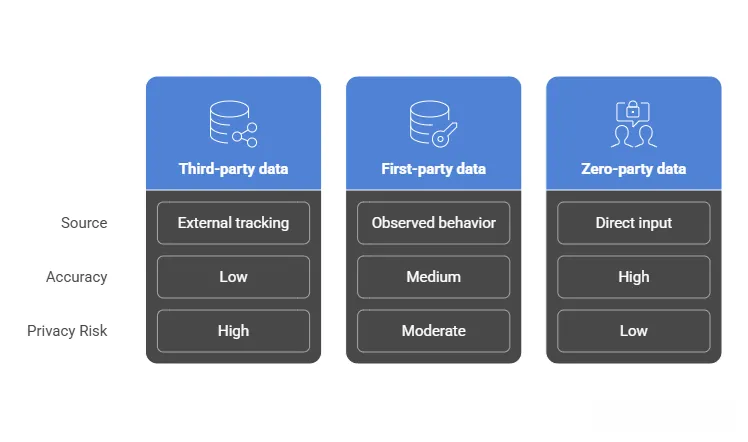
Zero-party data removes guesswork and replaces it with explicit intent.
Why Zero-Party Data Strategy Is Critical in 2026
Three major shifts have made zero-party data a necessity:
1. The End of Third-Party Cookies
Most major browsers have phased out third-party cookies, eliminating traditional tracking methods.
2. Stricter Privacy Regulations
Laws like GDPR and CCPA have increased the cost and risk of collecting user data without transparency.
3. Changing Customer Expectations
Customers are more willing to share data, but only when:
They understand why it’s collected
They receive clear value in return
This creates a new model: value exchange over silent tracking
How to Collect Zero-Party Data (Practical Methods)
The success of a zero-party data strategy depends on how naturally you collect information.
The goal is simple:
Make sharing feel easy, useful, and worth it.
1. Preference Centers
Let users choose what they care about:
Product categories
Content topics
Communication frequency
Example: Email preference dashboards
2. Onboarding Surveys
Ask simple questions during sign-up:
What are you looking for?
What’s your goal?
Keep it short and benefit-driven.
3. Quizzes & Product Finders
Highly effective for eCommerce and D2C brands.
Examples:
“Find your perfect skincare routine.”
“Which laptop suits your needs?”
These convert well because they provide instant value.
4. Post-Purchase Feedback
Capture intent when engagement is highest:
“Why did you choose this product?”
“What problem are you solving?”
5. Progressive Profiling
Instead of asking everything up front:
Ask 1–2 questions over time
Spread data collection across touchpoints
This reduces friction and improves completion rates.
Turning Zero-Party Data into Personalization That Works
Collecting data is only half the strategy. The real value comes from using it effectively and knowing how to track marketing ROI effectively.
1. Email Personalization
Segment users based on stated interests and intent, then activate those insights using email automation workflows that convert.
Stated interests
Purchase intent
Goals
Result: Higher open and conversion rates
2. Website Personalization
Adjust:
Homepage content
Product recommendations
Messaging
Based on user-declared preferences.
3. Product Recommendations
Instead of:
“You viewed this product”
Use:
“Based on your goal, here’s what fits best.”
This feels helpful, not intrusive.
Real-World Examples of Zero-Party Data
eCommerce
A fashion brand uses a style quiz to recommend outfits.
Result: Higher conversions and lower returns.
SaaS
A CRM tool asks users about team size and goals during onboarding.
Result: Personalized dashboards and faster activation.
Fitness Apps
Users select goals like weight loss or muscle gain.
Result: Customized plans and better retention.
Common Zero-Party Data Strategy Mistakes to Avoid
1. Asking Too Much Too Soon
Long forms reduce conversions. So, keep it short and relevant.
2. Not Using the Data
If customers share preferences but receive generic messages, trust drops.
Always reflect their input in your communication.
3. Treating Data as Static
Preferences change over time. So, regularly update and refresh data.
4. Lack of Transparency
Users should always know:
What you’re collecting
Why it matters
Tools to Build a Zero-Party Data Strategy
You don’t need a complex tech stack to start. The main requirement is a CRM that supports custom attributes and integrates well with your CRM automation strategies.
Basic Setup
CRM with custom fields
Email platform with segmentation
Examples:
Klaviyo
HubSpot
ActiveCampaign
Brevo
Advanced Setup (For Scaling)
Customer Data Platforms (CDPs):
Segment
Bloomreach
Tealium
These unify zero-party and behavioral data across channels.
Step-by-Step Framework to Get Started
Identify 2–3 key customer decisions
Add 1 data capture point (quiz or onboarding)
Store responses in your CRM
Personalize 1 channel (email or website)
Measure impact and scale
KPIs That Actually Matter
Track:
Conversion rate
Engagement rate
Retention
Revenue per user
Not just:
Form fills
Data points collected
Final Thoughts
Zero-party data represents a shift from tracking to trust.
Instead of silently collecting signals, you build a system where customers willingly share their preferences in exchange for better experiences.
This is not just a response to privacy regulations—it’s a competitive advantage.
Brands that invest in zero-party data today are building a long-term asset:
More accurate customer profiles
Better personalization
Stronger relationships
In a world without cookies, your competitive advantage is simple: Understand your customer better than your competitors do.
If your current marketing relies on assumptions, you're leaving revenue on the table. Let’s build a zero-party data strategy that drives real growth.
Contact Marketricka today to get started.