
Marketing Tools Stack for 2026: Complete Guide
Explore the complete marketing tools stack for 2026. Learn essential MarTech tools for CRM, automation, SEO, analytics, and growth.
 By Divyesh Savaliya
Marketing today relies heavily on technology to manage campaigns, analyze data, and engage customers across multiple digital channels. As marketing strategies become more complex, businesses increasingly depend on a structured marketing tools stack to streamline operations and improve campaign performance.
Industry reports suggest that the global MarTech market is expected to continue expanding rapidly, driven by AI, automation, and data-driven marketing technologies.
For businesses building a marketing tools stack for 2026, the focus is not just on adopting tools but creating an ecosystem where marketing platforms work together to support efficient and scalable marketing operations.
Why Businesses Need a Marketing Tools Stack
A well-designed marketing tools stack helps bring order to this complexity by connecting the tools marketers rely on every day and allowing them to work together instead of operating in isolation.
Manage multi-channel marketing campaigns more efficiently because teams can coordinate activities across platforms from a more centralized environment.
Automate repetitive marketing tasks such as campaign scheduling, lead nurturing, reporting, and customer follow-ups, which allows marketing teams to focus more on strategy and creative work.
Improve campaign performance through analytics and insights because modern marketing platforms continuously track engagement data, conversion metrics, and audience behavior.
Maintain consistent communication with customers across different channels while ensuring messaging remains aligned with the overall marketing strategy.
Centralize marketing data across platforms, which allows teams to understand how different campaigns interact and contribute to business outcomes.
Enable marketing teams to scale campaigns without increasing operational complexity, which becomes particularly important as organizations expand their digital marketing efforts.
Many organizations now see the marketing tech stack as the operational backbone of modern marketing, because it provides the structure that allows campaigns, data, automation, and customer engagement systems to work together more effectively.
If you want to explore how automation technologies support broader marketing workflows, you can also refer to the Marketing Automation Complete Guide available on Marketricka.
Core Layers of a Modern Marketing Tools Stack
Modern marketing operations rely on multiple technologies working together, which is why businesses structure their marketing tool stack into key functional layers. Instead of adopting tools randomly, these layers help organize how marketing data, campaigns, content, and analytics work together
The core layers of a typical marketing tech stack include:
Data and Customer Management
Tools such as CRM and Customer Data Platforms help businesses collect and organize customer data, enabling better audience segmentation and personalization.Campaign Execution and Marketing Automation
Marketing automation platforms allow teams to schedule campaigns, automate customer journeys, and manage multi-channel marketing activities.Content Creation and Content Management
These tools support the creation, organization, and distribution of marketing content across digital channels.Analytics and Performance Measurement
Analytics platforms track campaign performance, engagement metrics, and marketing ROI, helping teams make data-driven decisions.
Essential Marketing Tools Stack for 2026
A modern marketing tools stack consists of several categories of tools that support different aspects of marketing operations. Below are some of the most essential marketing tools that businesses should consider when building their MarTech stack for 2026.
1. Customer Relationship Management (CRM) Tools
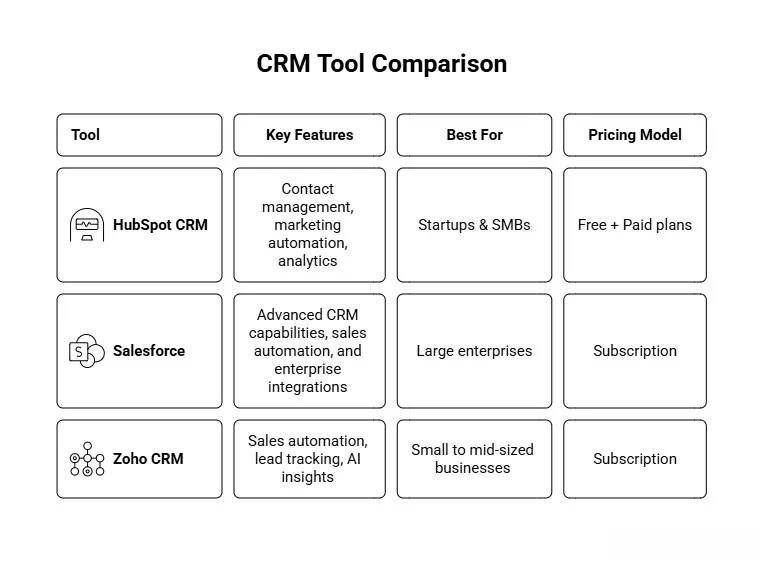
CRM platforms help businesses manage customer data, track leads, and maintain strong relationships with prospects and existing customers. These platforms store information such as customer contact details, purchase history, engagement behavior, and communication records. Marketing teams can use this data to personalize campaigns, track leads, and improve customer relationships.
Popular CRM Tools
HubSpot CRM
Salesforce
Zoho CRM
CRM Tools Comparison
2. Marketing Automation Platforms
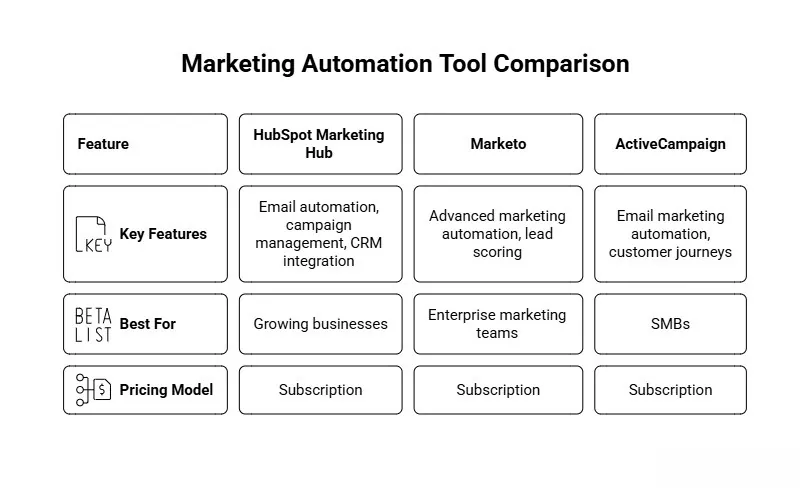
Marketing automation tools allow businesses to automate campaigns, nurture leads, and manage customer journeys more efficiently. Automation platforms allow marketers to create workflows that trigger specific actions based on customer behavior. For example, when a customer downloads a whitepaper or signs up for a newsletter, the system can automatically send follow-up emails or assign the lead to a sales representative.
Popular Marketing Automation Tools
HubSpot Marketing Hub
Marketo
ActiveCampaign
Marketing Automation Tools Comparison
Businesses looking to understand automation strategies can also explore the Marketing Automation Complete Guide
3. AI Marketing Tools
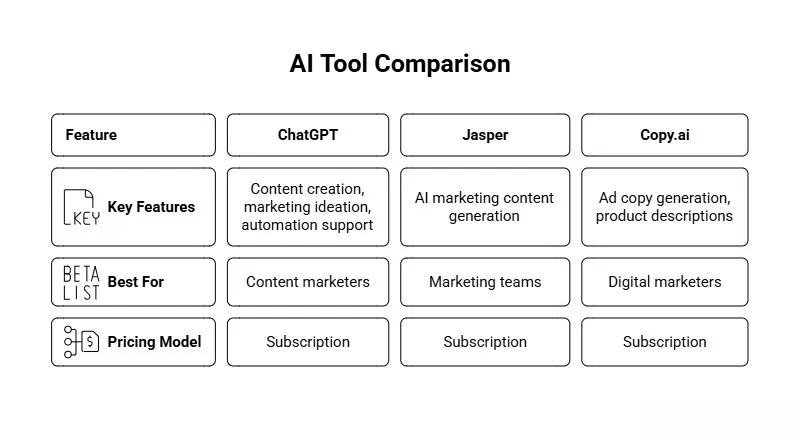
AI tools are becoming a core component of the modern marketing stack by helping marketers create content, analyze data, and optimize campaigns. These tools can analyze large amounts of data and suggest content strategies that align with audience preferences. AI-powered tools also help marketers produce content faster while maintaining consistency across campaigns.
Popular AI Marketing Tools
ChatGPT
Jasper
AI Marketing Tools Comparison
Businesses interested in understanding how AI supports marketing strategies can explore the AI Marketing Guide
4. Social Media Management Tools
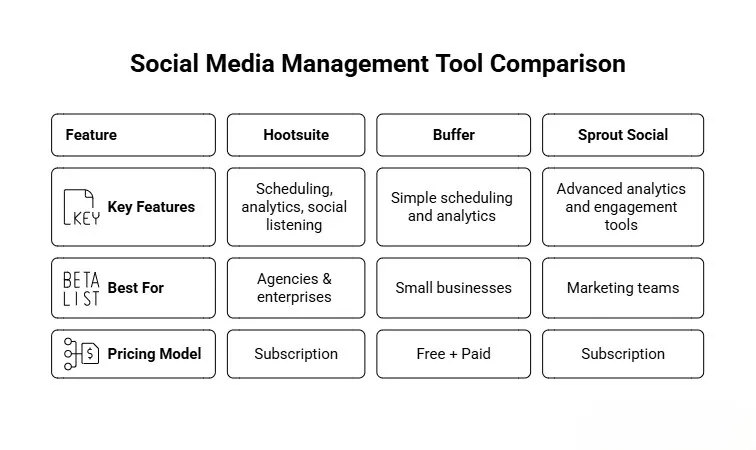
Social media management platforms help marketers schedule posts, track engagement, and manage social campaigns efficiently. Key capabilities like Social media scheduling and automation, Engagement monitoring, Content calendar management, Analytics and reporting, and Brand mention tracking.
Popular Social Media Tools
Hootsuite
Buffer
Sprout Social
Social Media Tools Comparison
5. Email Marketing Tools
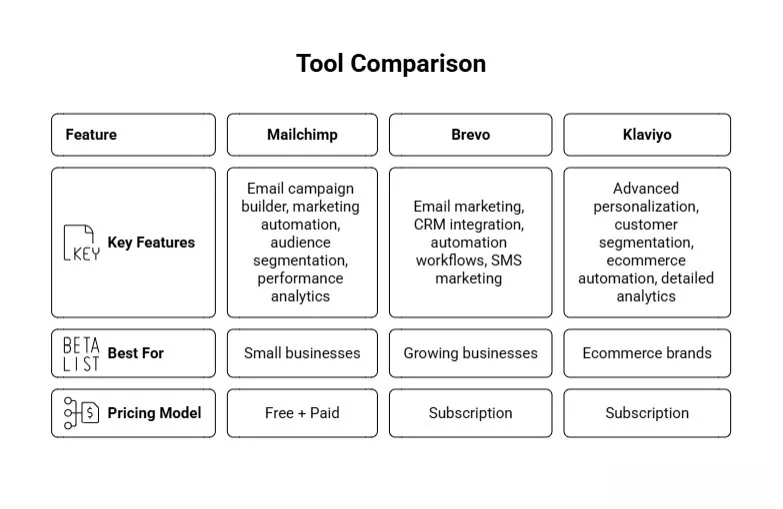
Email marketing remains one of the most reliable channels for building direct relationships with customers. These tools help businesses send targeted campaigns, automate follow-ups, and nurture leads through personalized communication. Most email marketing platforms also provide analytics dashboards so marketers can track open rates, click-through rates, and campaign performance.
Popular Email Marketing Tools
Mailchimp
Brevo (Sendinblue)
Klaviyo
Email Marketing Tools Comparison
6. SEO and Content Optimization Tools
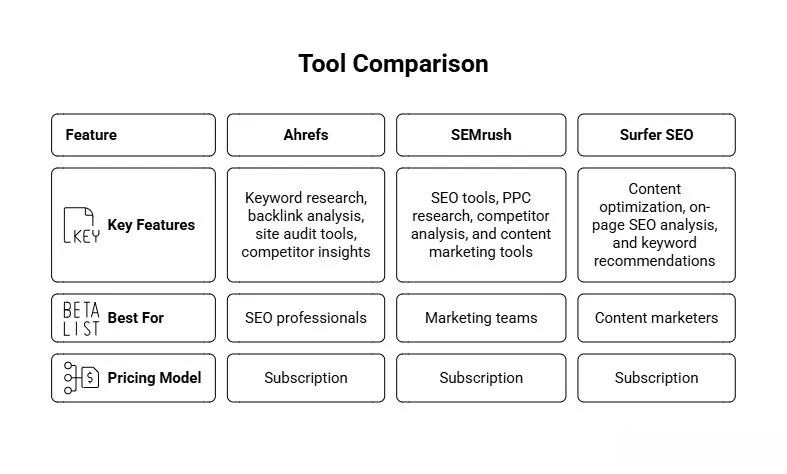
SEO and content optimization tools help businesses improve their visibility in search engines by identifying the right keywords, analyzing competitors, and optimizing website content. These platforms provide insights into search trends, backlink profiles, and content performance, which helps marketers refine their SEO strategies.
Popular SEO Tools
Ahrefs
SEMrush
Surfer SEO
SEO Tools Comparison
7. Marketing Analytics Tools
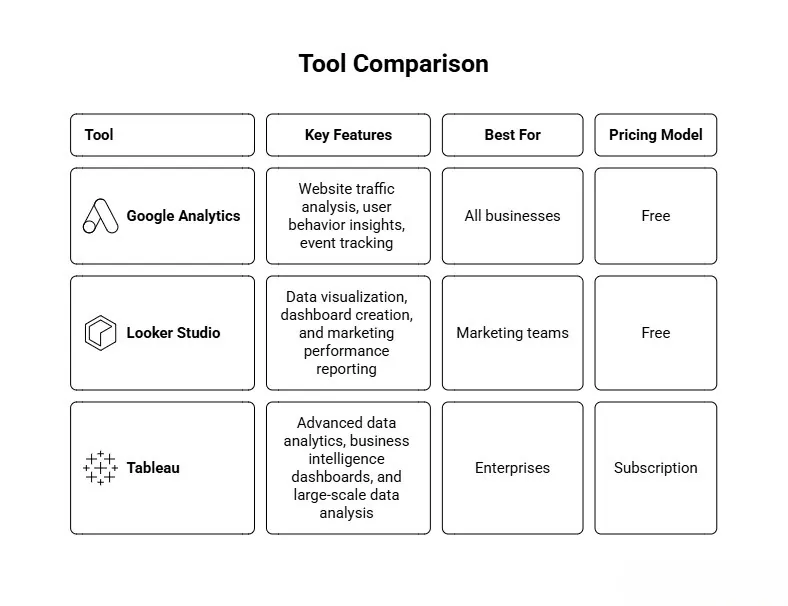
Marketing analytics tools allow businesses to measure campaign performance, analyze user behavior, and evaluate marketing ROI. By combining data from websites, campaigns, and customer interactions, these tools help marketing teams understand what strategies are working and where improvements are needed.
Popular Analytics Tools
Google Analytics 4
Looker Studio
Tableau
Marketing Analytics Tools Comparison
How to Build the Right Marketing Tools Stack
Building a marketing tools stack should not be about adding as many tools as possible. The real goal is to create a system where marketing platforms work together to support campaign execution, customer engagement, and performance analysis. Many businesses start by adopting tools individually, perhaps an email marketing platform for setting email automation workflow, a CRM system, or AI Marketing Analytics tools, but over time, this can lead to disconnected systems that make marketing operations harder to manage.
To build an effective marketing tech stack, businesses should focus on a few key considerations:
Start with clear marketing goals
Before selecting tools, businesses should understand what they want to achieve through their marketing efforts. Whether the focus is AI-powered lead generation, brand awareness, AI-powered customer engagement, or campaign automation, the marketing stack should support those specific objectives.Choose tools that integrate easily
Integration is one of the most important factors in a successful marketing stack. When tools share data—such as CRM systems connecting with email marketing platforms or analytics dashboards marketing teams gain better visibility into the full customer journey.Avoid unnecessary tool overlap
Many marketing platforms already include multiple capabilities such as automation, analytics, and campaign management. Selecting tools with overlapping features can increase costs and complicate workflows, so businesses should aim for a streamlined stack.Ensure the stack can scale with growth
As businesses expand their marketing activities, their technology needs also evolve. Choosing scalable tools allows organizations to add new capabilities without replacing their entire marketing stack.
Choose Tools That Can Scale With Your Business
Marketing needs change as businesses grow. A startup may begin with a simple stack that includes basic CRM functionality, email marketing automation, and social media scheduling tools. However, as the company expands, marketing teams often require more advanced capabilities such as customer data platforms, predictive analytics, and marketing automation workflows.
For this reason, scalability should always be considered when selecting tools. The ideal marketing tools stack should support the organization’s current marketing activities while also providing room for growth. Choosing scalable platforms ensures that businesses do not need to rebuild their entire stack every time their marketing operations expand.