
AI Email Marketing Automation: Complete Setup Guide
Master AI email marketing automation with predictive segmentation, smart workflows, and personalized campaigns.
 By Divyesh Savaliya
There’s a version of email marketing that most businesses still use. They manually segment a list, write a campaign, schedule it, and then watch the rate. It works. But it doesn’t scale. It also doesn’t personalize well. It leaves a lot of performance behind.
AI email marketing changes everything. It’s a powerful subset of broader AI marketing strategies transforming how brands engage customers. For a full overview of AI’s impact across marketing channels, see our Complete Guide to AI Marketing in 2026. When automation is combined with intelligence, the results are different. You get open rates, higher conversions, and less time managing the mechanics.
This guide will lead you through setting up AI-powered email automation from scratch. We'll cover the decisions you need to make, the tools worth considering, and the workflows that are worth building.
What AI Actually Does in Email Marketing (And What It Doesn't)
Before we dive in, let's be clear about what AI email marketing means. Some tools call themselves AI-powered. They only offer basic features like send-time optimization. That's useful. It's limited.
True AI-powered email automation involves:
Predictive segmentation: identifying who's likely to buy, leave, or engage
Dynamic content generation: changing content based on individual subscriber data
Behavioral triggers: responding to real-time actions
Ongoing optimization: adjusting lines and content blocks
AI doesn't replace strategic thinking. It can surface patterns and automate execution. You still need a human brain behind it.
AI Email Marketing vs Traditional Email Automation
Here’s a simplified breakdown:
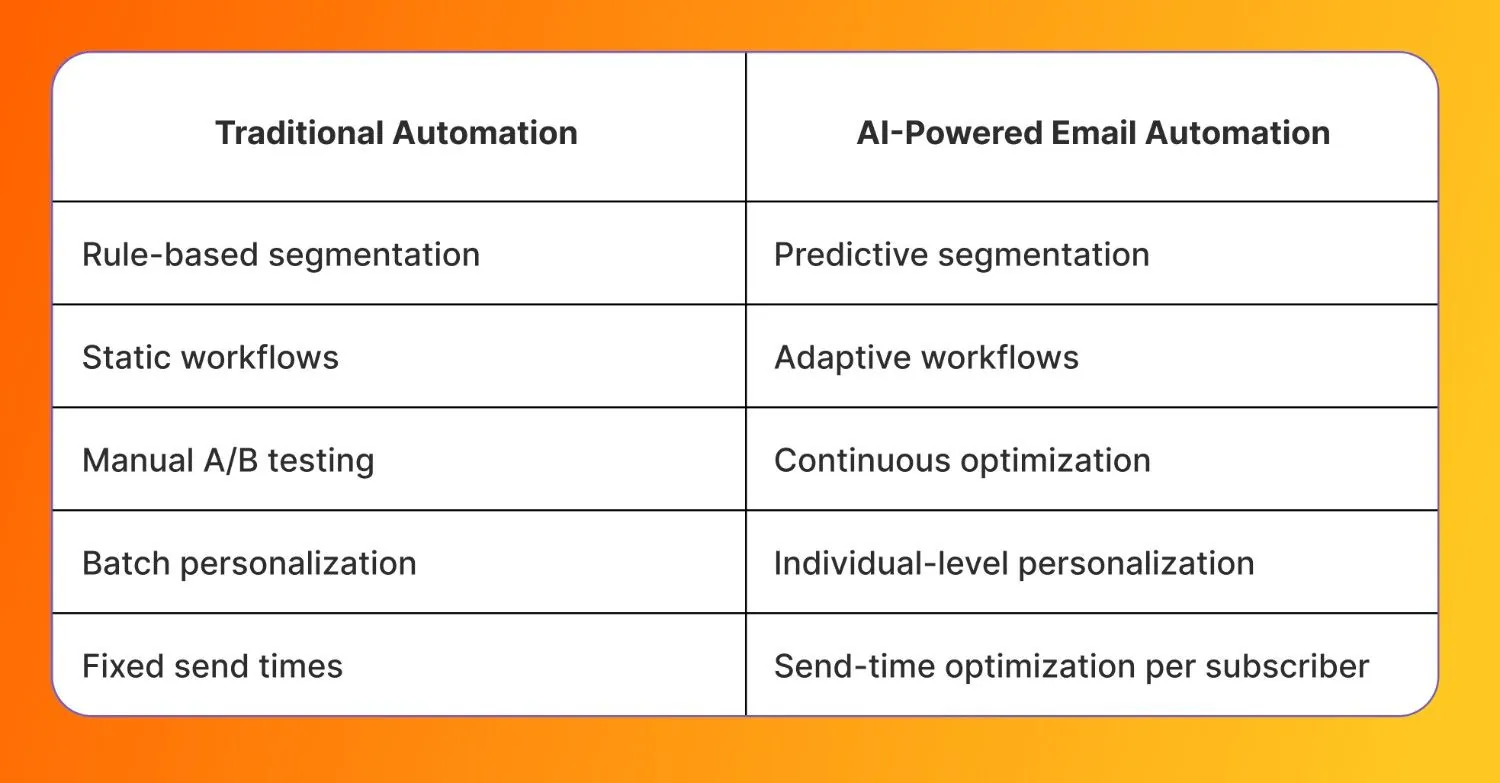
Traditional automation executes instructions.
AI email marketing refines and improves those instructions continuously.
If you already have automation in place, AI is an optimization layer — not a replacement.
Step 1: Get Your Data Foundation Right
No AI system performs well on bad data. You need to audit your subscriber data and make sure it's accurate. Your data should include:
Acquisition source: where the subscriber came from
Engagement history: opens, clicks, last active date
Purchase or conversion history: what they bought, when how
Behavioral data: pages visited, products viewed, content consumed
The richer your data, the more useful AI-powered email automation becomes. Cleaning your list and integrating your email platform with your CRM or ecommerce platform is essential.
Step 2: Choose the Right Platform for AI Email Marketing
The platform you choose matters. Look for platforms that offer:
Segmentation
Dynamic content blocks
Behavioral trigger automation
Send-time optimization at the individual level
Native integrations with your CRM, ecommerce platform, and data sources
Step 3: Build Your Core Automated Email Workflows First
This is where most of the setup work happens. You need to build automated email workflows, including:
Welcome series: introduce your brand. Set expectations
Abandoned cart and browse abandonment: recover lost sales
Re-engagement sequences: recover subscribers
Step 4: Layer in AI-Driven Email Personalization
Once your core workflows are running, you can add AI-driven email personalization. This includes:
Content blocks: changing content based on individual subscriber data
Predictive Content recommendations: suggesting products or content based on subscriber behavior
Subject line optimization: testing and optimizing subject lines
Step 5: Measure What Actually Matters
Don't measure the success of AI email marketing by open rate alone. Instead, focus on metrics like:
Click-to-open rate (CTOR)
Revenue, per email sent
Workflow conversion rate
List health metrics
Build a reporting rhythm to keep your system optimized and catch issues before they compound.
The AI Email Automation Stack
To think strategically about implementation, break the system into layers:
1. Data Layer
Subscriber attributes, behavioral data, purchase history, engagement signals.
2. Segmentation Layer
Rule-based segments plus predictive scoring models.
3. Workflow Layer
Core automated email workflows like welcome, abandoned cart, and re-engagement.
4. Personalization Layer
Dynamic content blocks, product recommendations, and subject line optimization.
5. Optimization Layer
Send-time intelligence, performance modeling, and AI testing.
6. Reporting Layer
Revenue tracking, workflow performance, lifecycle metrics.
If one layer is weak, the entire system underperforms. Most companies try to jump straight to personalization without strengthening their data and workflow layers first.
30–60–90 Day AI Email Marketing Implementation Plan
If you're starting from scratch, here’s a realistic rollout timeline.
First 30 Days
Audit and clean subscriber data
Connect CRM and ecommerce integrations
Build or refine welcome and abandoned cart workflows
Establish baseline metrics
Days 30–60
Implement predictive segmentation
Add dynamic content blocks
Introduce send-time optimization
Begin structured performance reviews
Days 60–90
Layer in predictive product or content recommendations
Expand behavioral triggers
Optimize underperforming workflows
Refine reporting dashboards
AI improves with time and data. Expect meaningful gains after consistent optimization, not immediately after activation.
Common Mistakes in AI Email Automation
Even strong teams make these errors:
1. Turning on AI without clean data
Garbage in, garbage out. AI models amplify bad data.
2. Over-automating too early
Start with core workflows before layering advanced personalization.
3. Measuring vanity metrics
Open rates matter less than revenue per subscriber and lifecycle value.
4. Ignoring lifecycle strategy
AI cannot fix broken customer journeys.
5. Expecting instant results
Predictive systems need data volume and iteration.
Avoid these, and your automation becomes an asset instead of a technical experiment.
A Few Honest Considerations Before You Go All-In
AI-powered email automation is useful. It has some limits. It takes time to learn. You need a meaningful volume of data for it to work well. Build your workflows. Temper your expectations until your data volume grows.
Privacy regulations are important. GDPR, CCPA, and many regional data protection laws affect what data you can collect, how long you can store it, and how it can be used. Make sure your AI email marketing setup follows the regulations that apply to your audience. This is an area where taking shortcuts can create risks.
Don't let automation lose your brand voice. Automated email workflows can save time. They can also make emails feel cold or robotic if no one checks the content. Every automated email is still a message from your brand. Keep an eye on the words, tone, and overall experience the system creates.
Conclusion
Setting up AI email marketing automation properly takes initial effort than most people plan for. It's worth it. Once your data is clean, your basic workflows are running, and AI personalization is in place, you get an email program that works behind the scenes, learns from each send, and improves over time.
That's a kind of advantage over managing campaigns manually. For businesses where email's a key revenue channel, it's a valuable investment.
Start with data.
Choose a platform that fits your tools.
Build workflows before adding advanced features.
Keep measuring. Because only your data can show if AI email marketing is delivering for your audience.