
Conversion Rate Optimization (CRO) with AI: How to Turn More Visitors Into Leads
Learn AI-powered CRO strategies to improve website conversions, optimize funnels, and turn more visitors into leads.
 By Divyesh Savaliya
Here is a number that most marketing teams quietly accept but never say out loud: the average website converts only 2.35% of its visitors. That means 97 out of every 100 people who land on your site leave without doing anything you wanted them to do.
You invest in SEO, paid ads, LinkedIn outbound, and content syndication. Traffic comes in, and then most of it leaves.
Only about 22% of businesses are satisfied with their conversion rates, which means the vast majority of marketing teams know their website isn't working hard enough, but haven't built a systematic approach to fixing it.
That's what Conversion Rate Optimization (CRO) is: the discipline of improving what happens after someone lands on your site.
CRO doesn't exist in a vacuum. It works best when your traffic quality is high. If you're running AI-driven demand generation or programmatic advertising, the visitors arriving on your site are only as valuable as the page they land on. CRO is the multiplier on every traffic investment you make.
What Are Good Conversion Rates? Industry Benchmarks You Should Know
Conversion rates vary dramatically by industry, traffic source, and funnel stage. This table gives you the benchmarks to measure against, sourced from WordStream and Statista primary data.
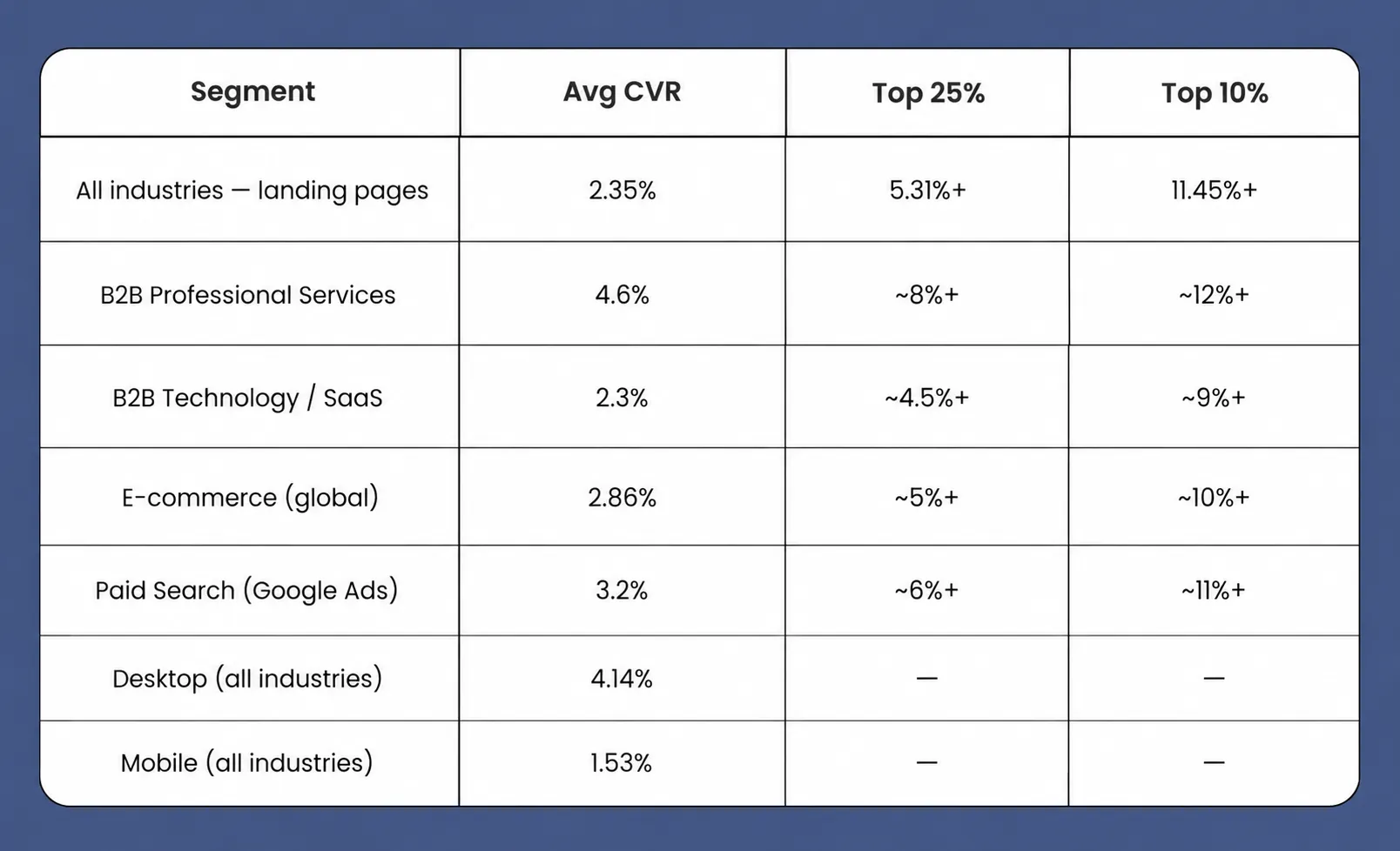
The mobile vs desktop gap is one of the most overlooked CRO issues. Statista data confirms desktop converts at 4.14% while mobile sits at just 1.53% — yet mobile now represents the majority of web traffic. If your site isn't optimised for mobile conversion, you're losing more than half your traffic before they even see your offer.
Why Most CRO Efforts Fail — And What AI Changes
Most CRO programmes fail for three reasons. They test the wrong things, they test too slowly, and they make decisions based on gut feel rather than statistical evidence. Here's the honest picture:
Testing the wrong things: Changing button colour when the real problem is form length. Rewriting headlines when the real issue is page load speed. Without a diagnostic layer that identifies where conversions are actually dying, most CRO tests optimise noise rather than signal
Testing too slowly: Traditional A/B testing requires statistically significant sample sizes — often weeks or months of traffic before any conclusion is valid. For most B2B teams, this means one or two tests per quarter. That's not iteration; that's hope
Acting on incomplete data: Heatmaps show where people click. Session recordings show individual journeys. But neither tells you why the behaviour is happening, which is the question that actually informs a good hypothesis
What AI specifically changes about each of these problems
AI diagnostic tools — heatmap analysis, session recording analysis, predictive user behaviour modelling — identify the specific pages, steps, and elements where conversion is dying, and rank them by impact. Instead of guessing where to test, you test where the data tells you conversion is leaking.
AI multivariate testing runs dozens of variants simultaneously rather than sequentially, reaching statistical significance faster and on lower traffic volumes. What used to take a quarter of testing can run in weeks.
AI personalisation removes the 'one version for everyone' limitation entirely. Instead of choosing between Variant A and Variant B for all users, AI serves the version most likely to convert for each individual visitor based on their device, traffic source, behaviour history, and predicted intent. This is the core principle we cover in Hyper-Personalization at Scale — applied specifically to your conversion funnel.
The AI CRO Toolkit: What Each Technology Does and When to Use It
Not every AI CRO tool does the same job. Here's how to match the right technology to the right problem:
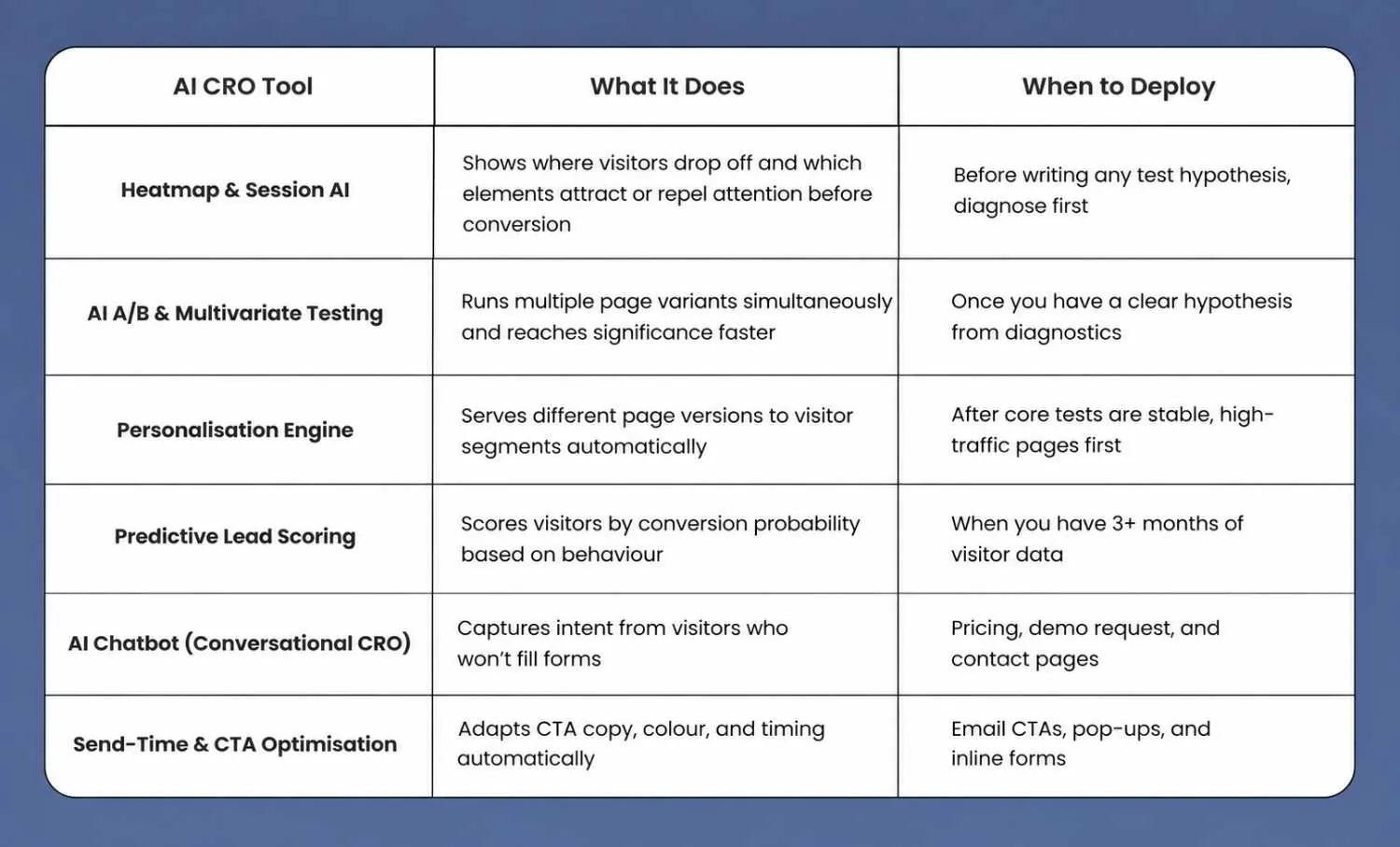
Predictive lead scoring in particular connects CRO directly to your pipeline. When a visitor's behaviour predicts high intent but they don't convert — they visited three pages, spent four minutes, and abandoned a form — AI can trigger a targeted follow-up through AI email personalisation or AI retargeting before that intent signal goes cold.
The CRO Audit Framework: A Step-by-Step Process to Find What's Killing Conversions
A CRO audit is not a design critique. It is a systematic process for identifying the specific points in your funnel where visitors are failing to convert and why. Here is the five-step model:
Map your full funnel: List every step from first touch to conversion: ad → landing page → form → confirmation → follow-up. Calculate the conversion rate at each step separately. A 2% overall conversion rate might be hiding a 40% drop at the form step, which changes your entire optimisation priority
Identify your highest-impact leak: The step with the biggest percentage drop is your first priority. Improving the step where 60% of visitors abandon will produce more total revenue than optimising a step where 20% drop off, even if the latter is easier to fix
Run behavioural diagnostics: Deploy a heatmap and session recording tool on the leak page. Watch the recordings. What do users do before they leave? Where do they hesitate? What do they click that isn't clickable? This takes two weeks, but produces the hypotheses that A/B tests should be built on
Build and test one hypothesis at a time: Each test should answer a specific question: 'Does removing navigation increase form completions?' is a testable hypothesis. 'Making the page better' is not. Run tests for statistical significance — minimum 500 conversions per variant before calling a result
Document and iterate: Every test — win or loss — teaches you something about your visitors. Build a test log that tracks the hypothesis, the result, and the learning. After 10 tests, you have a picture of what your specific audience responds to that no competitor can replicate
The MQL-to-SQL handoff is one of the most commonly overlooked CRO opportunities in B2B. Optimising the landing page is only half the problem — if your form-to-follow-up process is slow or misaligned, you lose conversions that the page already earned. Our MQL to SQL: How to Fix Your Lead Handoff Process with Automation guide covers the pipeline side of this conversion gap.
Quick CRO Wins You Can Implement This Week
Not all CRO requires a six-week testing programme. Some changes are supported by enough cross-industry evidence that they're worth implementing without a full test first:
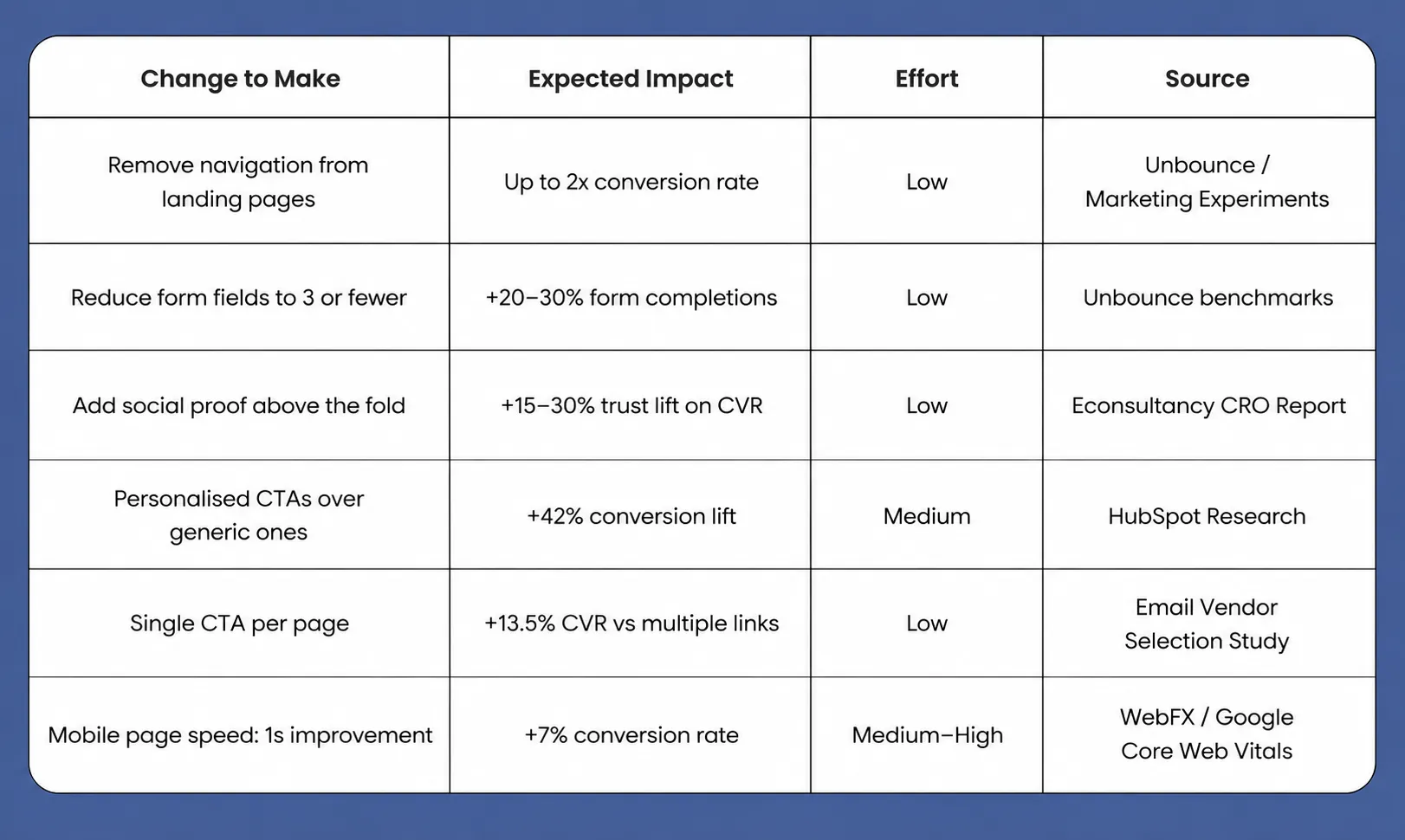
The personalised CTA finding is significant. Unbounce's landing page research confirms that specificity in your CTA — 'Start my free audit' versus 'Get started' — consistently outperforms generic alternatives. This is the landing page equivalent of the personalised email principle we cover in AI Email Personalisation: Beyond First Name Tokens.
For B2B teams, the form-length finding deserves special attention. B2B marketers instinctively want more data from form fills — company size, budget, timeline. But every additional field reduces completion rate. The solution is progressive profiling: capture the minimum initially, then enrich the lead data using intent data tools and CRM enrichment rather than asking the visitor to provide it manually.
Conversion rate optimisation also connects directly to how you run your broader buyer journey. If visitors are landing on high-intent pages but not converting, the problem might be in your content and messaging alignment, which our Buyer Enablement Strategy guide addresses: making it easier for buyers to say yes, not just harder for them to say no.
CRO strategy in 2026 is not about running more tests. It's about running the right tests — informed by AI diagnostics, validated by proper statistical methods, and connected to your full revenue funnel from first click to closed deal.
The gap between the average 2.35% conversion rate and the top-quartile 5.31% is not a design gap or a copywriting gap. It's a systematic testing and optimisation gap. The teams closing it aren't doing anything magical, they're simply more deliberate about diagnosing, testing, and iterating than their competitors.
Start with an audit. Find your biggest leak. Test one hypothesis. Document the learning. Repeat.
Explore more practical growth and revenue guides at the Marketricka blogs — written for teams who want to turn marketing investment into pipeline, not just impressions.