
B2B Intent Data Platforms: Top Tools to Find In-Market Buyers in 2026
Discover top B2B intent data tools in 2026 to find in-market buyers, boost pipeline, and reach prospects before they shortlist vendors.
 By Divyesh Savaliya
Here's an uncomfortable truth most marketing teams don't talk about: the majority of your ideal buyers are actively researching solutions right now, and they will never fill out your form, download your ebook, or raise their hand in any way that your CRM can track.
They're reading comparison articles. Browsing review platforms. Consuming competitor content. Building a shortlist in their heads. And by the time they contact any vendor, 6sense's 2025 Buyer Experience Report found that 94% of B2B buying groups have already ranked their preferred vendors — before a single sales call.
If your name isn't already on that shortlist, you're probably not winning the deal.
That's the problem B2B intent data platforms are built to solve. Instead of waiting for buyers to come to you, they reveal who's actively researching your category right now so your team can engage them while the decision is still being made.
This guide breaks down what intent data is, why it's become critical in 2026, and which platforms are worth your budget.
What Is B2B Intent Data, and Why Does It Matter in 2026?
Intent data is behavioral signal intelligence. It tracks the digital research activity of companies and individuals and the content they consume, topics they search, review platforms they visit, and keywords they engage with, and uses those signals to identify who is likely in an active buying cycle.
Think of it as the difference between fishing randomly and fishing where the fish are already biting.
The market itself is exploding. Spherical Insights values the global B2B intent data tool market at $3.30 billion in 2024, growing to $17.95 billion by 2035 at a 16.65% CAGR. Autobound's 2026 analysis puts the current 2026 market at $4.49 billion — meaning adoption is outpacing nearly every analyst forecast.
Why? Because the buying journey has fundamentally changed.
70% of the B2B buyer journey now happens in the "dark funnel" — anonymous research that traditional marketing cannot track (MarketBetter, 2026)
83% of buyers mostly or fully define their requirements before ever speaking with sales (6sense, 2025)
92% of B2B buyers start with at least one vendor already in mind, and 41% have selected a preferred vendor before formal evaluation begins (Forrester, 2025, via Salesmotion)
91% of B2B marketers now use intent data to prioritize accounts (Autobound, 2026)
The 3 Types of Intent Data Every Marketer Should Know
Not all intent data is the same. Understanding the differences will save you from buying the wrong tool or overpaying for signals you can't activate.
1. First-Party Intent Data
This is behavioral data from your own properties — website visits, content downloads, pricing page views, demo requests, and email clicks. You already own it. The question is whether you're capturing and using it strategically.
Best for: Teams that want to identify warm accounts already engaging with their brand.
2. Second-Party Intent Data
Data shared directly from a partner's platform. The most powerful examples are review platform signals — when a buyer visits G2 or TrustRadius and views your category, compares specific products, or reads reviews of your competitors. These are high-confidence signals because the behavior is explicitly evaluative.
Best for: SaaS companies selling to buyers who actively use review platforms.
3. Third-Party Intent Data
Data aggregated from across the web — content consumption, search behavior, and topic engagement tracked across thousands of B2B publisher sites. The most widely known source is Bombora's Data Co-op, which monitors 17 billion interactions monthly across 5,000+ B2B websites.
Best for: Enterprise and mid-market teams that want broad account-level signals across their total addressable market.
Top B2B Intent Data Platforms in 2026: Comparison Table
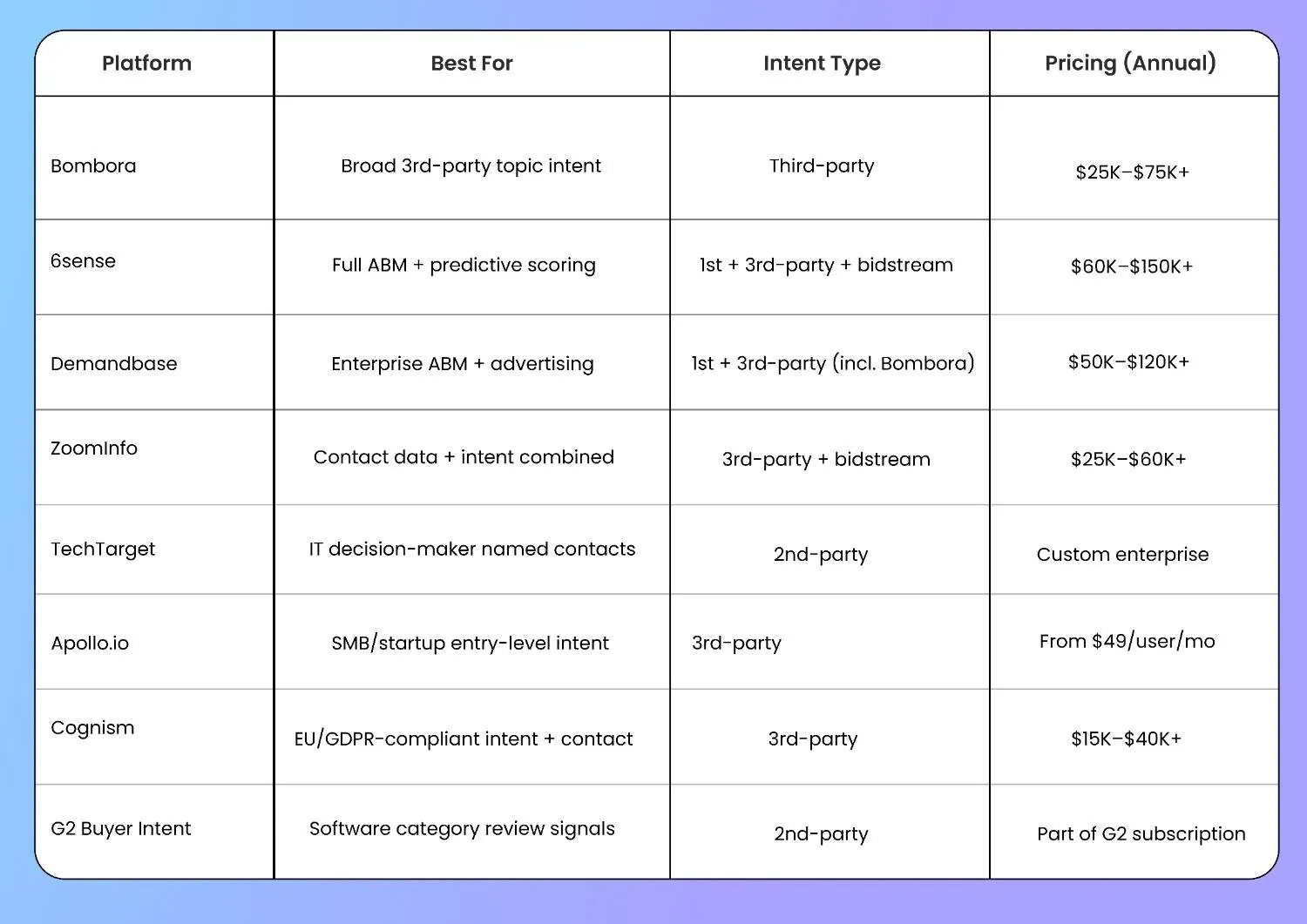
Note: Pricing based on publicly available data, Salesmotion's analysis, and Autobound's 2026 provider comparison. Most enterprise contracts require 12-month minimums.
Deep Dive: The Top 5 Platforms Explained
1. Bombora — The Industry Standard for Third-Party Intent
Bombora is where the B2B intent data category started. Their Data Co-op aggregates consent-based signals from 5,000+ premium B2B publisher websites, tracks 17,000+ topics, and identifies when a company's research activity spikes above its normal baseline, what they call Company Surge®.
What makes Bombora unique is the scale of the cooperative. 86% of co-op data is exclusive to Bombora, and the network grew approximately 20% in the past 18 months. Multiple major platforms including 6sense, Demandbase, and Cognism, resell or integrate Bombora data, which is a strong signal of its foundational credibility.
The catch: Bombora is a data feed, not a workflow tool. It tells you which companies are surging on relevant topics; it doesn't tell you who at those companies to call or what to say. You need a separate contact and activation layer to turn signals into a pipeline.
Best for: Mid-market and enterprise teams feeding intent signals into an existing ABM or CRM stack.
Pricing: Typically $25,000–$75,000/year (Salesmotion, 2026) Analyst recognition: Named a Forrester Wave Leader: Intent Data Providers, Q1 2025
2. 6sense — The AI-Powered Full ABM Platform
6sense is the platform that most separates itself from the "data feed" category. It combines three layers of intent data — your own first-party website signals, third-party content consumption (including Bombora), and bidstream advertising data and runs them through AI-powered predictive models to estimate where each account sits in its buying journey.
The result is a buying-stage prediction: not just "this company is researching," but "this company is in the decision stage." That's a meaningfully different signal. 6sense's Signalverse pulls in over a trillion pieces of B2B data daily, which gives its models a substantial training advantage.
The platform also includes digital advertising, automated email orchestration, and sales-facing tools, making it genuinely an operating system for ABM, not just a data source.
The catch: Implementation typically takes 3–6 months and requires dedicated RevOps resources. At $60K–$150K+/year, the cost is high. Teams without a mature ABM program often struggle to extract the full value.
Best for: Enterprise marketing and sales teams running multi-channel ABM programs with the budget and operational capacity to use predictive scoring at scale.
Pricing: Median contract ~$58,310/year per Vendr deal data via Salesmotion; range $60K–$150K+
Analyst recognition: Gartner Magic Quadrant Leader, 5 consecutive years
3. Demandbase — The Enterprise ABM Pioneer
Demandbase has been building account-based marketing technology longer than most, and it shows. Their Demandbase One platform combines first-party behavioral data, Bombora intent signals, and their own proprietary advertising network to give enterprise teams an end-to-end ABM workflow: identify, engage, convert.
The standout differentiator is advertising. Demandbase's account-based advertising capabilities are considered best-in-class, and in early 2025, they launched Agentbase — an agentic AI layer that autonomously identifies in-market accounts, suggests engagement strategies, and orchestrates campaigns (Salesmotion, 2026).
The catch: This is an enterprise platform priced accordingly. Teams without a dedicated ABM program and significant display advertising budget may find it more than they need.
Best for: Enterprise marketing teams that want ABM advertising tightly integrated with account intelligence and intent signals.
Pricing: Typically $50,000–$120,000+/year (Autobound, 2026)
Analyst recognition: Gartner Magic Quadrant Leader, 5 consecutive years
4. ZoomInfo — Intent + Contact Data in One Platform
ZoomInfo's core strength has always been its database: 321 million+ contacts with verified direct dials and emails. The platform added intent data as a layer on top of that — giving sales teams the rare combination of "who is researching" and "here's how to reach them immediately."
This integration closes the biggest gap in most intent data workflows. Most third-party intent providers (including Bombora at its core) tell you which company is surging, but not who specifically to contact. ZoomInfo solves that problem by pairing intent signals with contact-level data and sales engagement tools.
The catch: ZoomInfo's intent data is not as sophisticated as 6sense's predictive models or as broadly cooperative as Bombora's network. It's a strong all-in-one platform, but it's not the deepest intent solution if that's your primary need.
Best for: Sales-led organizations that want intent signals combined with immediate, actionable contact data for outreach.
Pricing: $25,000–$60,000+/year for packages including intent (Salesmotion, 2026)
5. G2 Buyer Intent — High-Accuracy Second-Party Signals
If your buyers evaluate software on review platforms and in B2B SaaS, almost all of them do — G2's intent data is uniquely valuable. When a buyer visits your category page, views competitor profiles, or reads reviews on G2, that's not an inferred signal. That's explicit evaluation behavior.
This makes G2's intent signals among the highest-accuracy available for SaaS and software companies. The coverage is narrow (only G2 visitors), but the signal quality is exceptional because the behavior is unambiguously purchase-oriented.
The catch: If your buyers don't use G2, or if you sell to verticals that aren't heavily represented on the platform, coverage will be limited.
Best for: B2B SaaS companies wanting high-confidence signals from buyers in active vendor evaluation.
Pricing: Included in G2 marketing subscriptions; typically part of broader G2 packages.
How to Choose the Right Intent Data Platform
With pricing ranging from $49/user/month (Apollo) to $300,000+/year (6sense enterprise), the question isn't which platform is "best" — it's which platform fits your stage, budget, and sales motion.
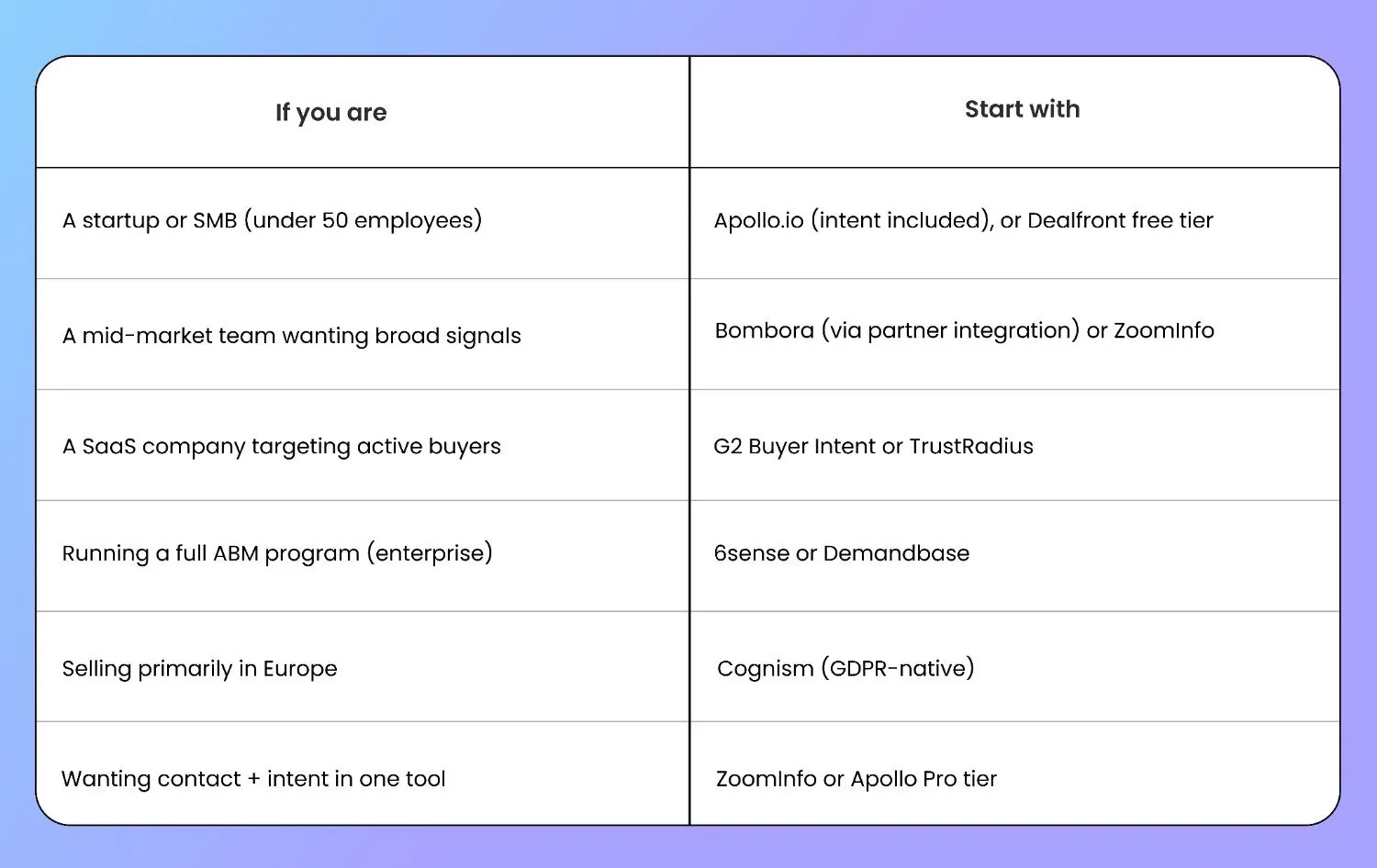
One practical framework: start with your first-party signals (your own website and CRM data), prove the intent-driven approach works in your pipeline, then layer in third-party data once you have the process to activate it. Teams that buy expensive intent data before building an activation workflow are essentially buying a list they don't know how to use.
What to Watch in Intent Data in 2026
Three trends are reshaping the category right now:
AI Overviews and LLM research are creating new blind spots. 94% of B2B buyers now use LLMs during their buying process, and these AI-assisted research sessions are largely invisible to traditional intent data providers. The intent data platforms that figure out how to track AI-driven research behavior will have a significant advantage.
Signal layering is becoming standard practice. Leading teams no longer rely on a single intent source. They combine first-party website data + third-party topic surges + review platform signals + job change triggers into a composite intent score. This multi-signal approach reduces false positives and surfaces a higher-quality pipeline.
The Forrester Wave named new priorities. Forrester's Intent Data Providers Q1 2025 Wave emphasized a shift from raw signal delivery to activation-ready intelligence — meaning the platforms that help you act on signals quickly are winning over those that simply surface them.
Final Thought
Today, marketing is shifting from interrupting people to actually being relevant.
Instead of sending your message to a broad audience and hoping it sticks, intent data helps you find companies that are already looking for a solution like yours. That means your team can reach out at the right time, with the right message — before those buyers even finalize their shortlist.
This isn’t just about changes like cookie restrictions or privacy rules. It’s a real competitive advantage.
Companies using intent data are building something powerful:
A pipeline full of buyers who are already interested
Sales conversations that feel informed, not cold
Marketing budgets spent on people who are ready to evaluate — not just browsing
Today, most buyers (about 83%) decide what they need before they ever talk to a sales team. So the goal is simple: find them early, while they’re still exploring, and make sure they already know who you are.
If your current strategy depends on luck and timing, you’re probably missing out on real opportunities.
Let’s change that. Build a smarter, intent-driven approach that connects you with buyers who are ready.
Looking for more simple, effective strategies? Head over to the Marketricka blog and start exploring.