
Revenue Operations (RevOps) Complete Guide 2026
Revenue operations 2026 guide to RevOps strategy—align sales and marketing to drive predictable growth and higher revenue.
 By Divyesh Savaliya
If you've been in sales or marketing for more than a few years, you've probably lived through the chaos: marketing blames sales for not following up on leads, sales blames marketing for sending bad-fit prospects, and customer success is isolated on the sidelines; nobody visits until there's a churn problem. Sound familiar?
That's exactly the problem Revenue Operations, or RevOps, was built to fix.
In 2026, RevOps is no longer a buzzword that only enterprise companies talk about at conferences. It's becoming the operating system for any business that wants predictable, scalable growth. And if your competitors haven't adopted it yet, they're already researching it.
This guide breaks down exactly what RevOps is, why it matters more than ever in 2026, and how marketing and sales professionals like you can start using it to drive real results.
What Is Revenue Operations (RevOps)?
Revenue Operations is the strategic alignment of your Sales, Marketing, and Customer Success teams under a shared set of processes, data, and technology — all focused on one goal: growing revenue efficiently.
Think of it this way. Most companies run their go-to-market (GTM) motion like three separate departments fighting over a shared budget. RevOps turns those three departments into one coordinated engine. It's not a department you hire. It's a philosophy you implement.
The core pillars of RevOps are:
People: Breaking down team silos and creating shared accountability
Processes: Standardizing how leads flow from awareness to retention
Technology: Integrating your CRM, marketing automation, and CS tools into one clean data layer
Data: Using shared metrics so everyone is looking at the same dashboard
When these four pillars work together, the result is a predictable revenue engine — not one that surprises you at the end of every quarter.
Why RevOps Is Non-Negotiable in 2026
The numbers make a strong case on their own.
RevOps by the Numbers
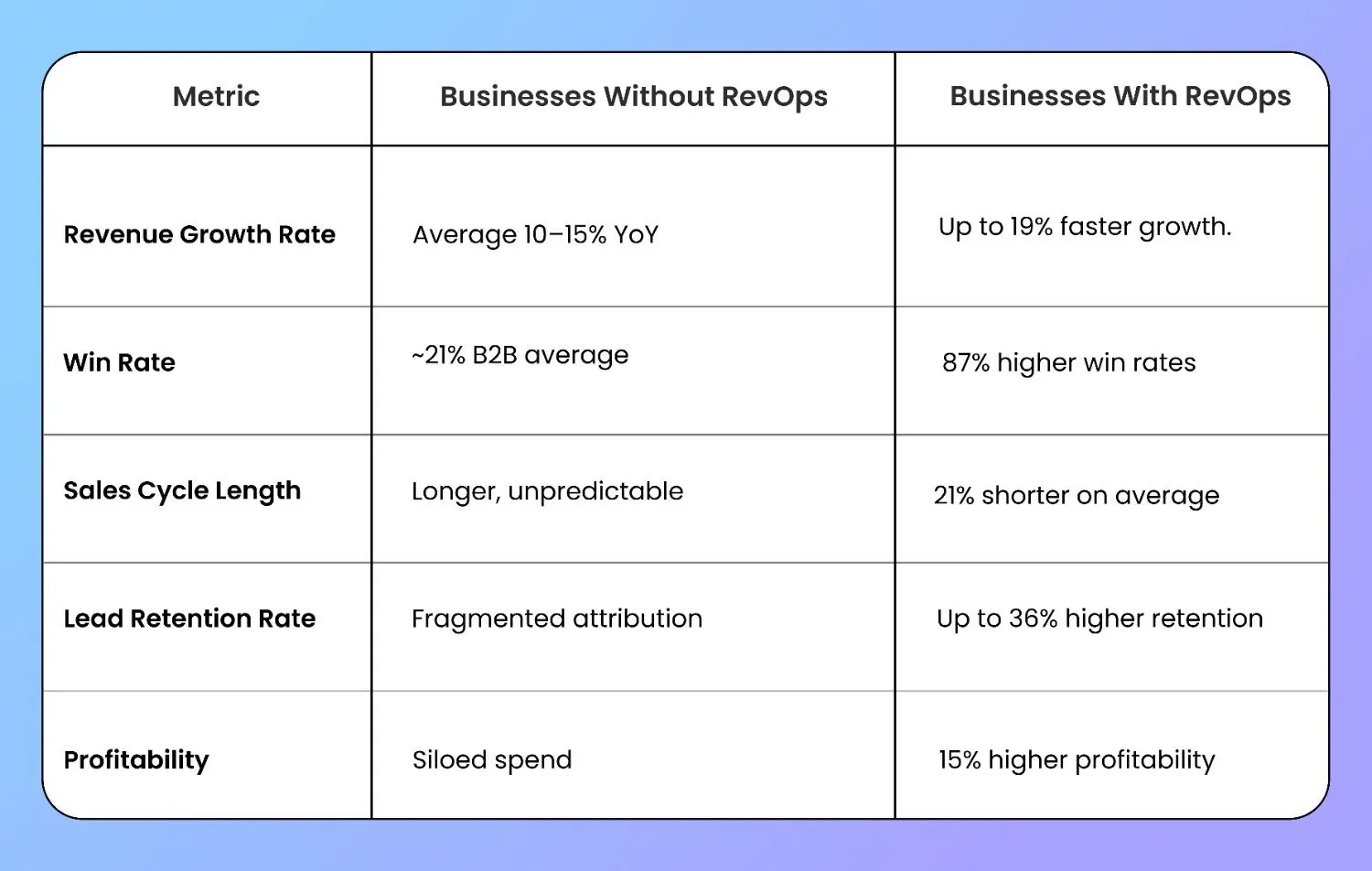
Sources: Forrester, Hubspot, Benchmarks, Zywave
Beyond the stats, consider what's changed in the buying environment:
Buyers are more informed: The average B2B buyer now completes over 70% of their research before talking to a salesperson (Skaled, RevOps Trends 2026). If your marketing and sales messaging aren't aligned, you're sending mixed signals during that research phase.
Data privacy regulations are tightening: Third-party data is shrinking. Companies that depend on unified first-party data as a core RevOps capability have a massive competitive advantage.
Economic pressure is forcing efficiency: "Grow at all costs" is dead. Boards and investors want profitable growth, which means every team needs to justify its spend. RevOps creates the accountability structure for that.
The adoption curve is accelerating: Gartner predicted that 75% of the highest-growth companies worldwide would deploy a RevOps model, and recent data shows 79% of organizations entering 2025 already have a formal RevOps function in place (Skaled, 2025).
The Three Core Teams RevOps Connects
1. Marketing Operations
Marketing's job is to generate demand. But without RevOps, marketing often operates on vanity metrics — impressions, clicks, and MQLs that sales never convert. A RevOps-aligned marketing team measures pipeline contribution, not just lead volume.
If you've built out your Sales Funnel Automation or invested in Marketing Automation ROI, RevOps is the layer that ensures those investments actually connect to closed revenue.
2. Sales Operations
Sales operations handles the process, tools, and data that enable your reps to sell effectively. In a RevOps structure, sales ops isn't just fixing CRM hygiene; it's actively collaborating with marketing on handoff criteria, lead scoring, and pipeline forecasting.
A clean CRM Automation Strategy is the backbone of good sales ops. Without it, your RevOps foundation has cracks in it before you even start.
3. Customer Success Operations
This is the team most companies forget about when they think about "revenue." But in a subscription economy or any business with repeat purchase potential, retention and expansion revenue is just as important as new business. RevOps ensures CS has the same data visibility as sales and marketing, so they can identify expansion opportunities and catch churn signals early.
How RevOps Actually Works: The Revenue Funnel Reimagined
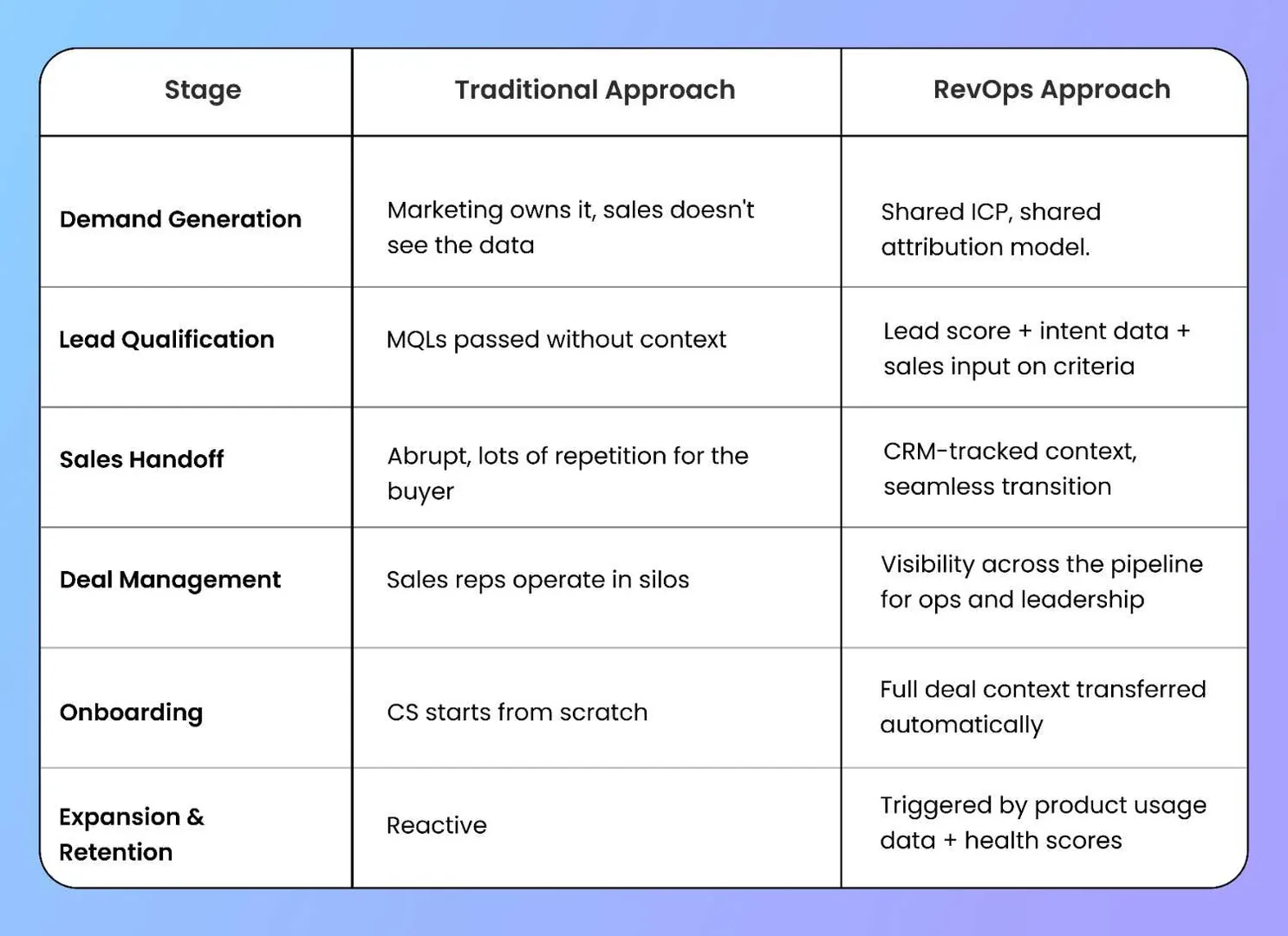
Traditional funnel thinking is linear — leads come in at the top, and customers fall out at the bottom. RevOps thinking is circular. Customer insights feed back into marketing. Expansion revenue feeds back into the pipeline. Every team learns from what every other team sees.
Here's what the RevOps-aligned funnel looks like in practice:
Building Your RevOps Stack: What Tools You Actually Need
You don't need to buy 15 new tools to implement RevOps. In most cases, you need to better connect the tools you already have.
The Core RevOps Technology Stack
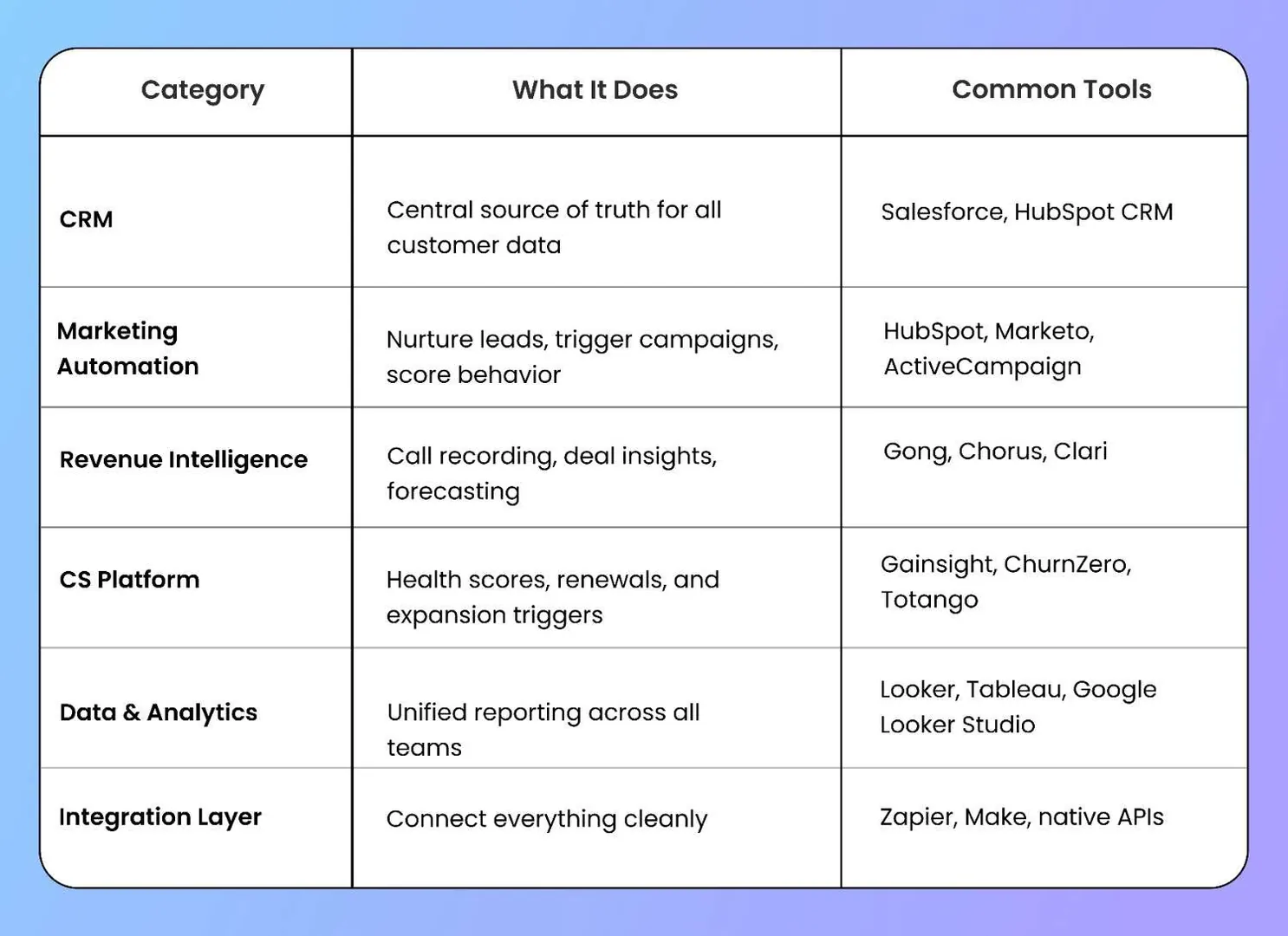
The mistake most teams make is buying the tools first and figuring out the process later. In RevOps, it's the opposite — define your process, define your data model, then pick the tools that fit.
5 RevOps Metrics Every Marketing & Sales Leader Should Track
If you're going to align three teams around revenue, you need metrics that everyone agrees on. These are the five that matter most:
1. Pipeline Velocity: How fast are deals moving through your funnel?
Calculated as: (Number of Deals × Win Rate × Average Deal Size) ÷ Sales Cycle Length
2. Marketing-Sourced Revenue: Not leads, not MQLs. Actual closed revenue that traces back to marketing campaigns. This ends the debate about marketing's ROI.
3. Lead-to-Close Rate: What percentage of leads your marketing generates actually close into customers? This single metric exposes misalignment faster than anything else.
4. Net Revenue Retention (NRR): What percentage of your existing revenue are you retaining and growing? World-class SaaS companies target 120%+ NRR, meaning expansions outpace churn (ORM Technologies, 2025).
5. Time-to-Revenue: From first marketing touch to closed deal, how long does it take? RevOps teams work to systematically shrink this number.
Industry Benchmarks to Know
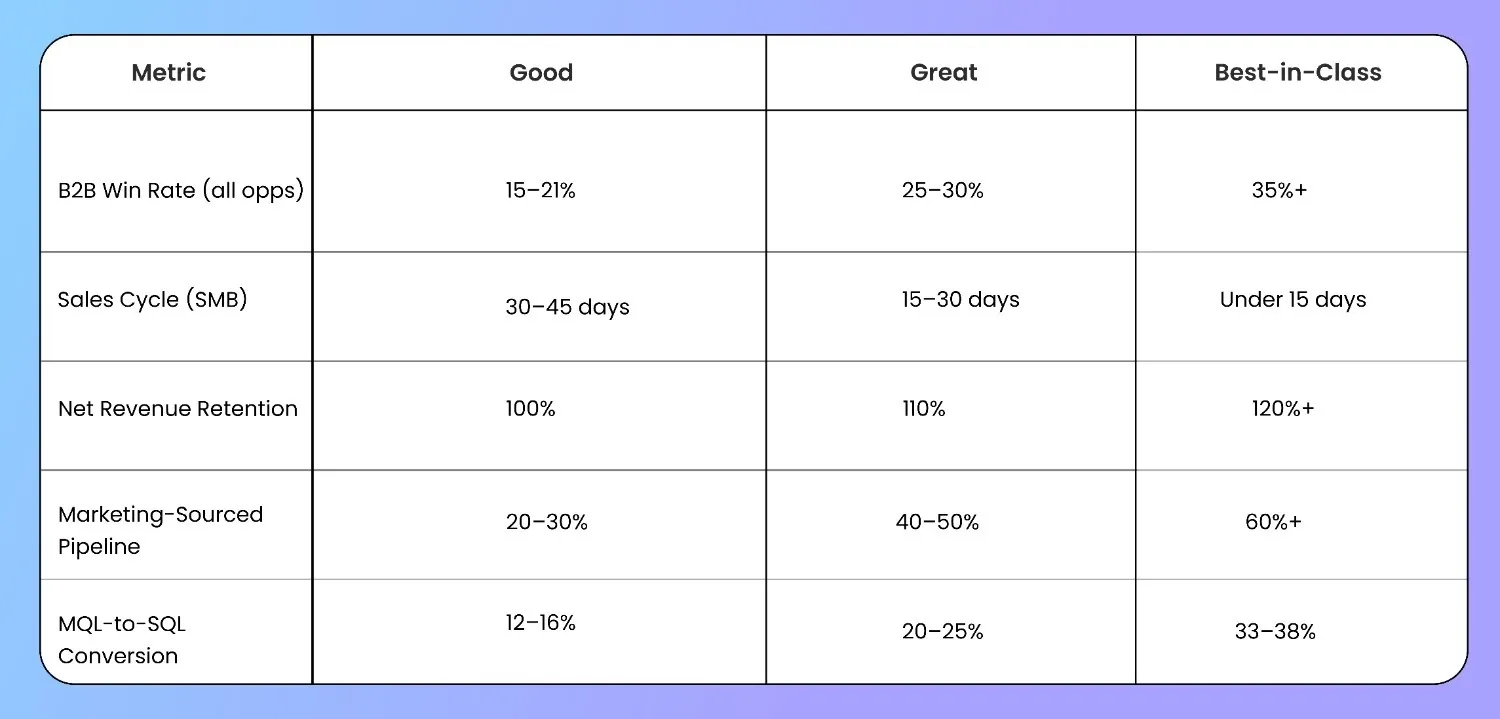
Sources: Ebsta × Pavilion 2024, Salesmotion 2026, ORM Technologies 2025, Gradient Works Benchmarks
How to Start Your RevOps Journey (Without Overhauling Everything)
Most marketing and sales professionals hear "RevOps" and imagine a massive transformation project. It doesn't have to be.
Here's a pragmatic 90-day starting point:
Days 1–30: Diagnose Audit where your data breaks down. Where do leads get lost between marketing and sales? Where does context drop off between sales and CS? You can't fix what you haven't mapped.
Days 31–60: Align Get marketing, sales, and CS leadership in a room (or on a call) and agree on three things: the definition of a qualified lead, the handoff process at each stage, and which metrics you'll report together. This conversation alone is transformative for most teams.
Days 61–90: Systematize. Use your existing CRM and automation tools to enforce the process you agreed on. This is where your investment in CRM Automation Strategies and Sales Funnel Automation starts paying double dividends because now the automation serves a unified strategy, not three separate ones.
RevOps vs. Sales Ops vs. Marketing Ops: What's the Difference?
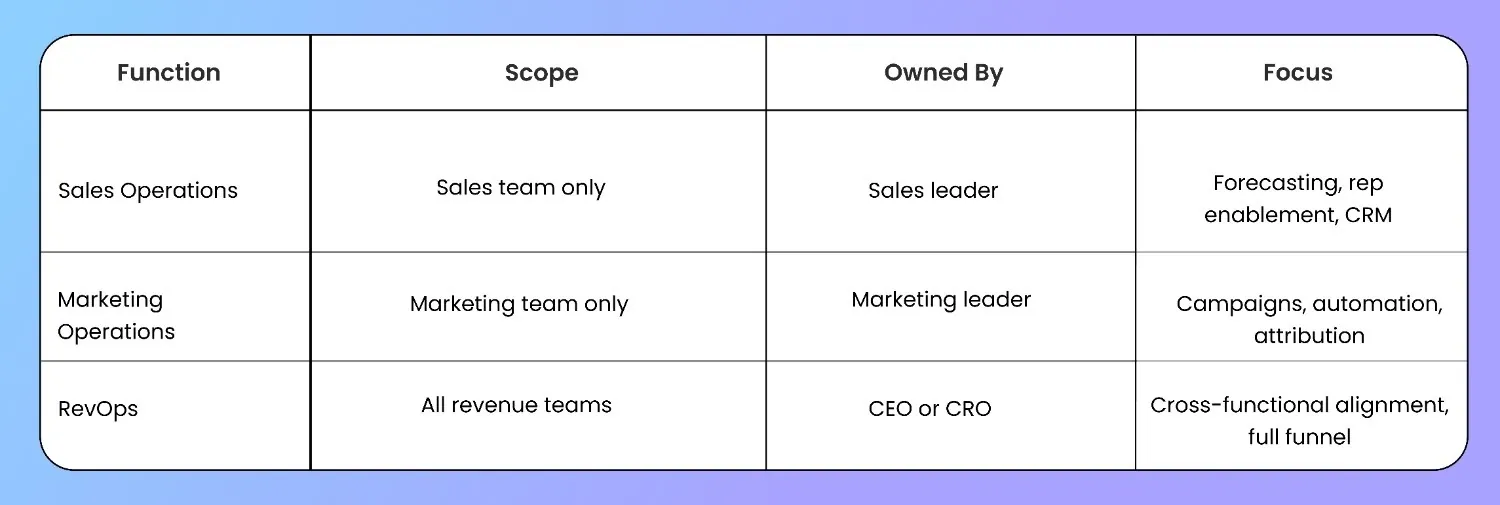
RevOps doesn't replace sales ops or marketing ops. It sits above them and ensures they're working from the same playbook. According to SiriusDecisions research published by Forrester, organizations that maintain focused alignment across their revenue engine achieve 19% faster revenue growth and 15% higher profitability than those operating in isolation.
The RevOps Mindset Shift That Changes Everything
Here's the thing about RevOps that the tool vendors won't tell you: the technology is the easy part. The hard part is cultural.
When sales can see exactly which marketing campaigns sourced their best customers — and marketing can see which sales reps close their leads fastest — accountability gets real. That can be uncomfortable. But it's also where the breakthroughs happen.
Companies that succeed with RevOps in 2026 are the ones that make shared revenue accountability part of their culture, not just their org chart. They run weekly pipeline reviews that include marketing. They measure Marketing Automation ROI in terms of pipeline and revenue, not just email opens. They celebrate customer success wins with the same energy they celebrate new logos.
That mindset shift? That's the real unlock.
Final Thought: RevOps Is the Competitive Advantage You Can't Ignore
RevOps represents a shift from assumption to alignment.
Instead of three teams chasing three different definitions of success, you build a system where sales, marketing, and customer success are pulling from the same data, working toward the same goals, and learning from the same results.
This is not just a response to rising CAC or tightening budgets — it's a competitive advantage.
Brands that invest in RevOps today are building a long-term asset:
More accurate pipeline forecasting
Better customer experiences across every touchpoint
Stronger, faster revenue growth
In a world where every deal is harder to close and every dollar of spend needs to justify itself, your competitive advantage is simple: understand your revenue engine better than your competitors understand theirs.
If your current go-to-market depends on isolated teams and disconnected data, you're leaving revenue on the table. Let's build a RevOps strategy that drives real, predictable growth.
Explore more practical marketing guides at the Marketricka blog — written for marketers who want to do the work, not just read about it.