Sales Funnel Automation: From Lead to Close
A practical 2026 guide to sales funnel automation: which tools to use, how to score leads, and the workflow that turns more leads into closed deals.
 By Divyesh Savaliya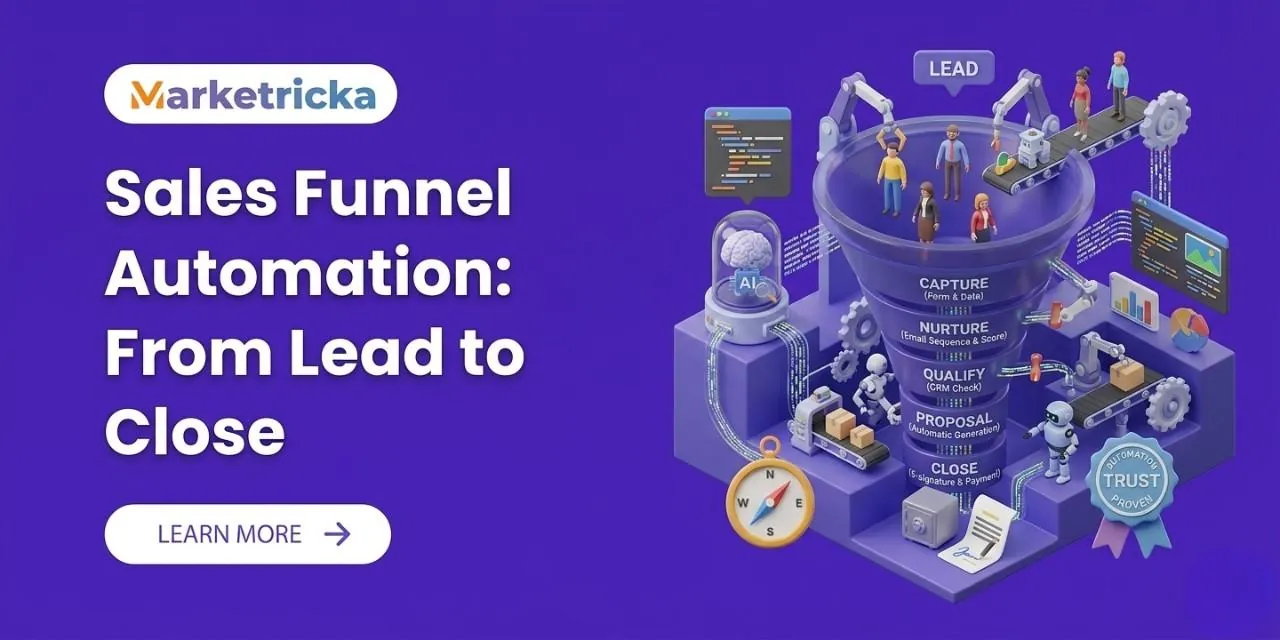
Quick answer: Sales funnel automation connects lead capture, your CRM, and your email/engagement tools so leads are captured, scored, nurtured, and handed to sales automatically instead of being tracked by hand in spreadsheets. Start with one stage at a time: lead capture and CRM sync first, then nurturing emails, then lead scoring and sales handoff. A CRM with built-in automation (HubSpot or Pipedrive) paired with an email automation tool (ActiveCampaign) covers most of this for small and mid-sized teams without needing five separate platforms.
Sales teams today deal with a large volume of leads coming from websites, ads, social media, webinars, and email campaigns. Managing this flow manually often leads to delays in follow-ups, missed opportunities, and inconsistent communication with prospects.
This is why businesses are increasingly adopting sales funnel automation. Automation tools help capture leads, qualify them, nurture them with relevant content, and move them toward conversion with minimal manual effort. According to Nucleus Research, companies using marketing automation report 14.5% higher sales productivity and 12.2% lower marketing overhead.
Why This Matters Right Now
The cost of staying manual keeps climbing. Most B2B sales funnels lose the majority of leads somewhere between first contact and closed deal, and that loss is rarely a product or pricing problem. It's a follow-up problem. Leads that get a response within minutes convert at dramatically higher rates than leads that wait even an hour. That gap is exactly what automation is built to close.
It's also worth being honest about how automation fails: teams often scale up lead volume and nurture sequences without scaling the systems underneath them, and end up automating noise instead of signal. The goal here isn't "automate everything," it's automating the right stages, in the right order, with tools that actually talk to each other.
Where Traditional Sales Funnels Break
Many businesses assume their sales funnel works fine because leads keep entering the system. But when teams look closely, they usually find three specific failure points.
Slow response time. Leads from digital campaigns expect quick engagement, but manual processes make fast responses difficult. Research found that companies responding to leads within one hour are seven times more likely to qualify them than those who respond later.
Inconsistent nurturing. Not every lead is ready to buy immediately. Without automated nurturing workflows, prospects who need more time lose interest and go quiet before sales ever get a real shot at them.
No visibility into behavior. Marketing teams often know where a lead came from but not how that lead actually engaged with content before reaching sales, which page convinced them, what they read twice, and what they ignored.
Sales funnel automation fixes all three by connecting your marketing tools, CRM, and engagement platforms into one coordinated workflow instead of three disconnected systems.
What Sales Funnel Automation Actually Means
Sales funnel automation is the use of technology to manage the lead-to-customer journey without manual tracking. Instead of a person checking spreadsheets and sending follow-ups by hand, automation platforms monitor behavior and trigger actions at each funnel stage on their own.
Here's what that looks like in practice: a visitor downloads a resource from your site. The system automatically sends a follow-up email sequence, logs engagement activity, and updates the lead's CRM profile; no one has to remember to do any of that. If the same prospect later visits your pricing page or requests a demo, the system flags the lead and notifies sales that it's time for a direct conversation.
That's the entire point: leads get timely communication, and your team keeps full visibility into the pipeline, without anyone manually babysitting every step.
How AI Changes What's Possible in Sales Funnels
AI doesn't replace the automation described above; it makes the decisions inside it smarter. Four areas see the biggest practical impact.
Smarter Lead Qualification
AI tools analyze behavioral data — website visits, email interactions, and content downloads to flag which leads are actually likely to convert, instead of sales reps manually reviewing every single one. According to Salesforce's State of Marketing report, 83% of marketing organizations already use AI in some form to improve customer insights and targeting.
Faster Lead Engagement
Automated emails, chatbots, and instant sales-team notifications mean leads get a response in minutes, not hours. This matters most for inbound leads who are actively comparing solutions right now and will move on to a competitor if no one answers.
Scalable Personalization
AI systems can tailor messaging to individual behavior and preferences across thousands of leads at once, the same kind of 1-to-1 relevance a great salesperson gives one prospect, applied at a scale no human team could manage manually.
Data-Driven Funnel Optimization
AI-powered analytics show which campaigns produce high-quality leads, exactly where prospects drop off in the funnel, and which sequences actually convert, so you stop guessing and start fixing the specific stage that's leaking revenue.
Which Tools Actually Do This Job?
Sales funnel automation usually isn't one piece of software; it's two or three tools working together, each responsible for a different job. Here's how that breaks down, and what we'd actually recommend depending on team size.
Job | What it solves | Example tools | Best for |
|---|---|---|---|
CRM & pipeline tracking | One place to see every lead, deal stage, and next action | Pipedrive, HubSpot, Salesforce | Pipedrive for sales-first teams who want speed; HubSpot/Salesforce for teams that also need built-in marketing automation |
Email & nurture automation | Behavior-triggered sequences that keep leads warm pre-sale | ActiveCampaign, GetResponse | ActiveCampaign for branching logic based on real behavior; GetResponse if you also want landing pages and webinars bundled in |
Lead capture & funnel building | The actual forms, landing pages, and checkout flow where a visitor becomes a lead | Dedicated funnel/page builders | Teams running frequent campaign-specific landing pages, used alongside a separate CRM and email tool, not as a replacement for either |
Our recommendation if you're starting from zero: don't shop for "the best all-in-one tool," pick a CRM with native automation (HubSpot or Pipedrive both work) and connect it to a dedicated email automation tool (ActiveCampaign is the most common pairing). That covers roughly 80% of what a sales funnel needs. Add a dedicated funnel builder only once you're running enough campaigns that a generic landing page no longer cuts it.
The real failure point usually isn't the tool, it's the gap between tools. A CRM that never gets updated because the email platform isn't actually synced to it will underperform even the "best" software. Check your integrations before you check feature lists.
How to Implement Sales Funnel Automation: 6 Steps
Installing software and turning on automated emails isn't the same as building a working automated funnel. A funnel that actually performs is built around how your specific customers move through the buying process, not a generic template. Here's the order that works.
1. Map the Customer Journey First
Before automating anything, find out how prospects actually interact with your brand: website visits, content downloads, email engagement, webinar registrations, demo requests. This reveals where most leads originate, what content actually influences buying decisions, and at what point prospects typically reach out to sales. Automation should support that real journey, not interrupt it with generic timing.
2. Connect Your Tools Before You Automate Anything
Pick your CRM and your email/marketing automation tool, then confirm they actually sync data both ways before you build a single workflow. If a website visit, form fill, or email click doesn't automatically update the lead's CRM profile, you're still doing manual work; you've just hidden it behind a dashboard.
3. Build Reliable Lead Capture
Every automation depends on clean lead capture: landing pages, website forms, downloadable resources, and webinar sign-ups. Each one should push data straight into the CRM the moment it's submitted, triggering the next step automatically (a welcome email, a segment assignment) without anyone touching it manually.
4. Build Nurturing Workflows That Educate, Not Sell
Most prospects research and compare before they're ready to talk to a person. Nurture sequences should fill that gap with educational emails, comparison guides, case studies, and webinar invites. Value first, pitch later. The goal is to keep leads engaged through their own evaluation process, not rushing them.
5. Score Leads So Sales Only Talk to Ready Buyers
Lead scoring assigns points to behavior so you can tell who's actually close to buying. A simple starting model looks like this:
Opens an email: +1 point
Clicks a link in an email: +3 points
Visits the pricing page: +5 points
Downloads a case study or comparison guide: +5 points
Requests a demo or fills out a "contact sales" form: +15 points
Set a threshold commonly somewhere around 20-25 points for a mid-funnel B2B offer and have the system automatically notify sales the moment a lead crosses it. Revisit the thresholds every quarter with your sales team; if reps say the leads coming through aren't actually ready, the scoring model needs adjusting, not more leads.
6. Monitor and Fix the Funnel Continuously
Automation isn't "set and forget." Track lead conversion rates, email engagement, where exactly leads drop off, and how long leads take to move through each stage. If leads consistently drop off after downloading a resource, the nurture sequence needs work. If leads reach sales but rarely convert, your scoring threshold is probably too low. The funnel should get reviewed and adjusted as customer behavior changes, not left running on autopilot indefinitely.
The 5 Stages of an Automated Sales Funnel
Every automated funnel moves prospects through the same five stages, even if the specific tools and triggers differ by business.
Lead Generation
Attracting potential customers through SEO, social media, advertising, and content marketing.
Lead Qualification
Automation evaluates behavioral and demographic signals to identify which leads actually have purchase intent.
Lead Nurturing
Automated email sequences and targeted content build trust with prospects who are still evaluating.
Sales Engagement
Once a lead shows strong buying signals, it's handed to a sales rep for direct conversation, demo, or consultation.
Closing the Deal
Automation streamlines proposal generation, contract steps, and follow-up communication so the final stage moves faster without losing the personal touch that actually closes deals.
Wrap-Up
Sales funnels remain one of the most important frameworks for managing customer acquisition and revenue growth, but manual funnels struggle to keep up with how complex digital buying journeys have become.
Sales funnel automation lets you capture leads, nurture prospects, and guide them toward conversion through structured, connected workflows instead of scattered manual effort. The businesses that get the most out of it aren't the ones with the most tools; they're the ones whose CRM, email automation, and lead capture actually talk to each other, and who review the data closely enough to keep fixing the weakest stage.
Start with one stage. Get it actually working end-to-end. Then automate the next one.