
Best AI Writing Tools 2026: Comprehensive Comparison
Compare the best AI writing tools in 2026 including ChatGPT, Jasper, and Writesonic to find the right tool for your content strategy.
 By Divyesh Savaliya
Content creation used to be one of the most time-consuming parts of digital marketing. Writing blog posts, ad copy, email campaigns, and product descriptions required hours of research, drafting, and editing. As businesses expanded across more digital channels, the demand for content increased dramatically.
This is where AI writing tools have changed the landscape. These tools help marketers generate ideas, create first drafts, optimize SEO content, and scale content production without increasing team size. According to HubSpot’s marketing research, around 80% of marketers now use AI tools in some part of their content creation process, showing how quickly AI has become part of modern marketing workflows.
What Makes a Great AI Writing Tool in 2026
The best AI writing tools today go far beyond simple text generation. They combine language models, SEO insights, and workflow integrations to support the entire content creation process. A strong AI writing platform should help users generate ideas, maintain a consistent brand voice, optimize content for search engines, and integrate smoothly with existing marketing tools. As businesses scale their content operations, these capabilities become essential because the goal is not just faster writing, but smarter and more strategic content production.
Key Use Cases for AI Writing Tools
AI writing tools support a wide range of marketing and content workflows. Some of the most common use cases include:
Blog and article writing for SEO-driven content marketing
Marketing copy generation for ads, landing pages, and campaigns
Social media content creation for consistent posting across platforms
Email marketing campaigns, including newsletters and promotional emails
Product descriptions for ecommerce websites
Content summarization and rewriting for faster editing workflows
Content ideation and headline generation for marketing teams
Comprehensive Comparison of Leading AI Writing Tools
AI writing tools differ in how they support content creation. Some platforms focus on long-form writing and ideation, while others specialize in marketing copy, SEO optimization, or research-driven content development. Understanding these differences helps businesses select tools that align with their content strategy.
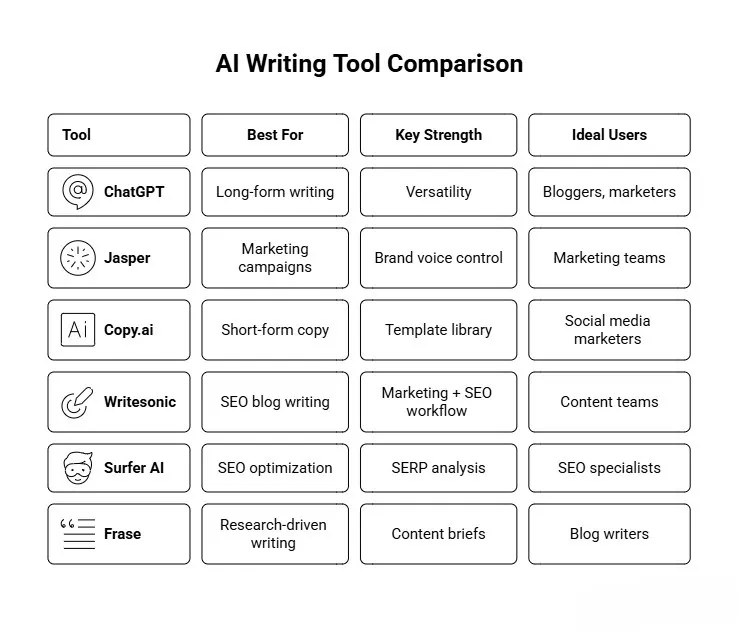
Below is a detailed comparison of some of the most widely used AI writing tools in 2026.
1. ChatGPT
ChatGPT has become one of the most widely used AI writing platforms because of its flexibility. Unlike many tools that specialize in a specific type of content, ChatGPT can support multiple writing tasks ranging from brainstorming ideas to generating complete long-form articles.
Writers often use ChatGPT to create outlines, draft blog posts, rewrite content, and refine messaging. Its conversational interface allows users to refine prompts and iterate on content until it matches the desired tone and structure. This makes it particularly useful for content teams that want an AI assistant capable of adapting to different types of writing projects.
Key capabilities
Long-form blog writing
Content ideation and brainstorming
Editing and rewriting content
Summarizing research or documents
Strengths
One of ChatGPT’s biggest advantages is its versatility. It can support everything from marketing copy to research summaries, making it suitable for many different content workflows.
Best for
Content marketers, bloggers, and teams are looking for a flexible AI writing assistant.
2. Jasper
Jasper is designed specifically for marketing teams that produce large volumes of content across multiple channels. Unlike general AI writing tools, Jasper focuses heavily on brand voice consistency and campaign messaging.
Businesses can train Jasper to understand brand tone, style guidelines, and messaging frameworks. This allows teams to generate content that remains aligned with brand identity across blogs, advertising campaigns, email marketing, and landing pages.
Another advantage of Jasper is its collaboration features. Marketing teams can work together on campaigns, share templates, and manage content workflows within the platform.
Key capabilities
Brand voice training
Marketing campaign content generation
Blog writing workflows
Team collaboration features
Strengths
Jasper helps maintain consistent messaging across large marketing campaigns, which is particularly useful for companies managing multiple content channels.
Best for
Marketing teams, agencies, and organizations are producing consistent brand messaging.
3. Copy.ai
Copy.ai focuses on short-form marketing content such as advertisements, product descriptions, social media captions, and email copy. The platform includes a large template library that helps marketers quickly generate content for specific campaigns.
For example, users can select templates designed for Facebook ads, landing pages, or promotional emails. The system then generates several variations that marketers can refine or test.
This approach makes Copy.ai particularly useful for teams that need to produce high volumes of marketing content quickly without starting from scratch.
Key capabilities
Social media post generation
Advertising copy creation
Email campaign writing
Product description generation
Strengths
Copy.ai excels at generating concise marketing copy and providing multiple variations that marketers can use for testing and optimization.
Best for
Startups, social media managers, and digital marketers are producing short-form content.
4. Writesonic
Writesonic combines AI writing capabilities with marketing and SEO tools. The platform allows users to generate blog posts, landing page content, advertising copy, and email marketing campaigns.
One of its distinguishing features is the integration of SEO functionality into the writing workflow. Writers can create articles that align with search engine optimization strategies by incorporating keyword suggestions and content optimization recommendations.
Writesonic also includes tools for generating long-form content quickly, which makes it popular among businesses focused on content marketing.
Key capabilities
AI blog article generation
SEO content suggestions
Marketing copy creation
Landing page content writing
Strengths
Writesonic bridges the gap between AI writing and SEO strategy, helping marketers produce content that supports organic search visibility.
Best for
Content marketing teams focused on SEO-driven blog strategies.
5. Surfer AI
Surfer AI focuses heavily on SEO content optimization rather than simply generating text. The platform analyzes search engine results pages (SERPs) and identifies the content characteristics associated with high-ranking pages.
Based on this analysis, Surfer provides recommendations for keyword usage, content structure, and word count. Writers can use these insights to create content that aligns with search engine ranking factors.
Surfer is often used alongside other AI writing tools because it helps optimize content for search performance after the initial draft has been created.
Key capabilities
SERP analysis
Keyword optimization recommendations
Content scoring systems
SEO content structure suggestions
Strengths
Surfer helps ensure that written content aligns with SEO best practices and search ranking factors.
Best for
SEO professionals and businesses are focused on organic search growth.
6. Frase
Frase combines AI writing with content research capabilities. Instead of starting from a blank page, writers can use Frase to analyze top-ranking articles and generate structured content briefs.
These briefs highlight the key topics, questions, and keywords that appear in high-performing content. Writers can then use this information to develop comprehensive articles that address search intent more effectively.
Frase also includes AI writing features that help generate sections of articles based on the research insights.
Key capabilities
AI research summaries
Content brief generation
Blog writing assistance
SEO content optimization
Strengths
Frase significantly reduces research time by automatically analyzing existing content and extracting relevant insights.
Best for
Content teams producing research-driven blog articles.
AI Writing Tools Comparison Table
How to Choose the Right AI Writing Tool
Choosing an AI writing tool is not simply about selecting the platform with the most features. The real question businesses should ask is how well the tool supports their content strategy and workflow.
The first factor to consider is content type. Some tools specialize in long-form writing, such as blog articles and research content, while others focus on short-form marketing copy. Businesses producing large volumes of blog content may prioritize tools that support research, outlining, and long-form generation.
Another important factor is SEO capability. For companies relying on organic search traffic, AI tools that integrate keyword analysis, SERP insights, and content optimization features provide much greater value than simple text generators.
Teams should also evaluate workflow compatibility. AI writing tools are most effective when they integrate with existing systems such as content management platforms, marketing automation tools, and analytics dashboards. This ensures that content production fits naturally into the broader marketing process.
Finally, organizations should look at collaboration features and brand voice controls. As content teams grow, maintaining consistent messaging becomes more difficult. AI tools that allow users to define brand tone, style guidelines, and reusable templates help maintain consistency across campaigns.
Businesses exploring how AI fits into their broader marketing infrastructure can also refer to the AI Marketing Guide on Marketricka, which explains how AI technologies support modern marketing operations.
Wrap-Up
AI writing tools are becoming an essential part of modern content strategies. They help businesses generate ideas faster, produce content at scale, and maintain consistency across multiple marketing channels. However, selecting the right tool requires understanding how it fits into your overall content workflow rather than simply choosing the most popular platform.
At Marketricka, we help businesses explore and implement modern marketing technologies that support scalable content and campaign strategies. If you want to understand how AI tools integrate with broader marketing automation systems, you can explore our Marketing Automation Complete Guide for deeper insights.