AI in Social Media Marketing: The Complete 2026 Guide
Discover how AI in social media marketing is transforming social media through content automation, audience insights, sentiment analysis, and paid campaign optimization.
 By Divyesh Savaliya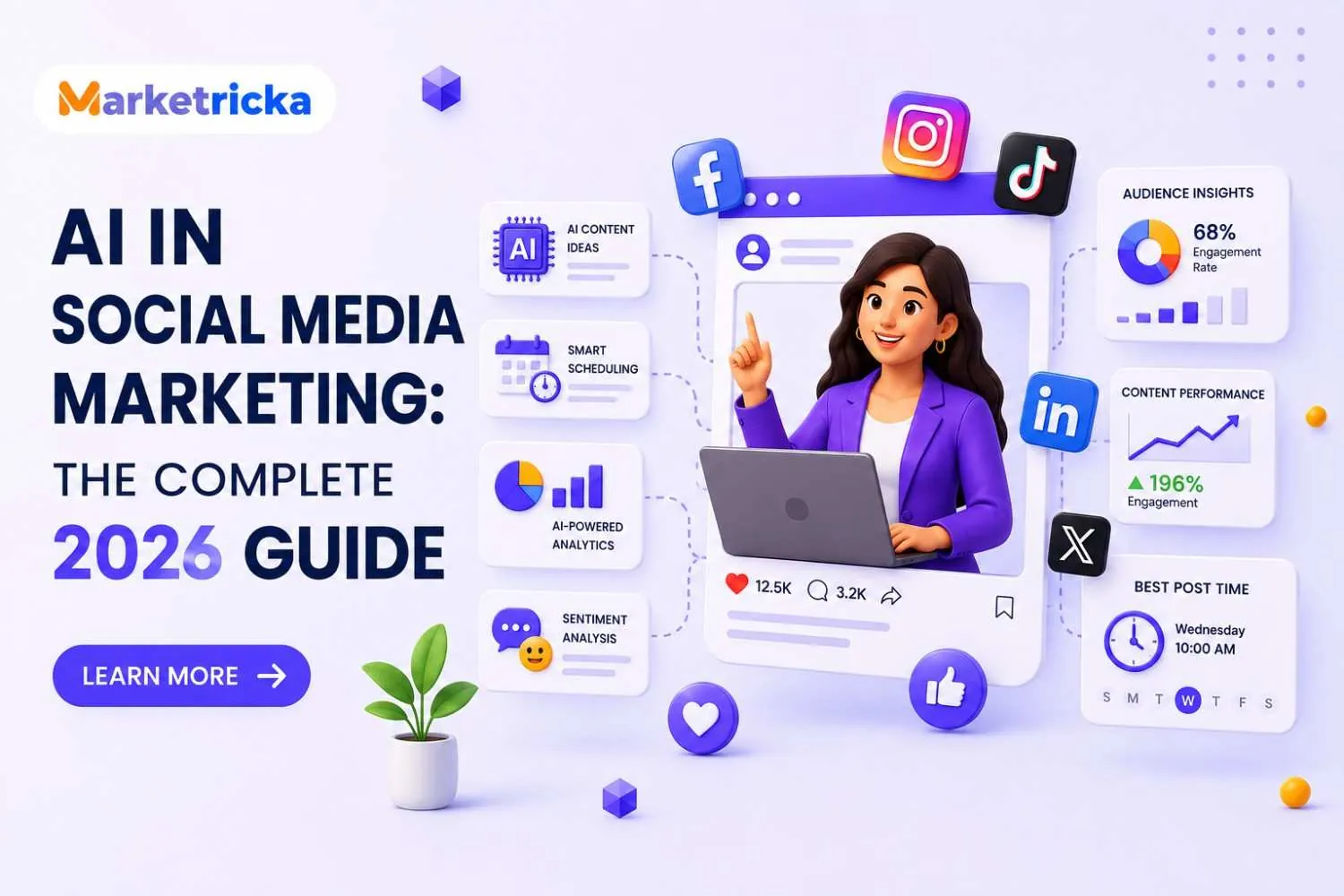
Brands that posted manually five years ago are now deploying AI systems that publish, respond, analyze sentiment, and reallocate ad budgets. This shift has made AI in social media marketing one of the most impactful applications of artificial intelligence for modern brands.
According to McKinsey's 2025 State of AI report, organizations using AI in marketing see a 10–20% reduction in cost per lead and a 15–25% increase in marketing ROI. In social media specifically, the impact shows up in content output, audience targeting, engagement quality, and paid performance simultaneously.
This guide covers exactly how AI is applied across each layer of social media marketing, what the measurable benefits look like, what the real risks are, and how to implement it without losing the human judgment that keeps your brand credible.
99% of marketers report using AI tools in their day-to-day marketing tasks — Marketing AI Institute, 2024
What AI in Social Media Marketing Actually Does
Most teams think of AI in social media as a content writing shortcut. That is the smallest part of what it does.
AI in social media marketing is a collection of machine learning, NLP, and predictive systems that operate across three layers of your social programme simultaneously:
• Content layer: Drafting, testing, optimizing, and scheduling posts across platforms
• Audience layer: Segmenting followers, predicting behaviour, personalizing what each segment sees
• Performance layer: Analyzing what works, reallocating paid budget, flagging emerging sentiment shifts
Among the many use cases for AI in marketing, social media remains one of the fastest-moving environments because audience behaviour generates immediate feedback signals.
What makes this significant is that these three layers used to require separate tools, separate teams, and separate reporting cycles. AI platforms increasingly connect them into a single, continuously optimizing system.
This is the same infrastructure powering broader AI-driven marketing automation. Social media is simply the channel where the volume demands are highest and the feedback loops are fastest.
6 Key Ways AI in Social Media Marketing Is Used
Understanding how AI in social media marketing works requires looking at the technology across content creation, audience intelligence, community management, and campaign optimization.
1. AI-Powered Content Creation and Optimization
Content volume is the first hurdle AI solves. A brand actively managing LinkedIn, Instagram, X, and TikTok needs 40–60 pieces of content per month, each formatted differently, with platform-specific tone, optimal length, and relevant hashtags.
Best writing AI tools generate first drafts, caption variants, and content briefs at scale. More usefully, they analyze which post formats drive the highest engagement for your specific audience. Carousels vs. single images, short-form vs. long-form captions and feed those patterns back into your content planning automatically.
Critical editorial note: AI handles volume and pattern recognition. Brand voice, cultural sensitivity, and topical judgment still require human oversight on every piece before publication.
2. Audience Intelligence and Hyper-Personalization
Traditional social media targeting uses demographics. AI-driven targeting uses behavioural signals of what your followers engage with, how long they linger on specific content types, what they click through to, and how their interests shift over time.
This enables dynamic audience segments that update continuously rather than at campaign intervals. A brand can automatically serve trail-running content to one segment and gym-focused content to another based on prior engagement without manually building every variant.
62% of senior executives cite AI personalization as a top 12-month marketing priority — Salesforce
This connects directly to the broader shift toward hyper-personalization at scale, where AI models trained on customer behaviour predict future actions, not just current preferences.
3. Social Listening and Sentiment Analysis
At volume, social listening is impossible without AI. A brand with 500,000 followers receiving 10,000 comments and mentions per week cannot manually monitor tone, flag crises, or surface emerging trends. AI does all three simultaneously.
AI sentiment tools classify every mention as positive, negative, neutral, and surface patterns:
Is a specific product getting unexpectedly negative feedback?
Is a competitor's audience expressing frustration that creates an opportunity for you?
Is a topic gaining traction in your category before it goes mainstream?
Brands using AI social listening identify emerging issues 48–72 hours faster than manual monitoring, the difference between managing a situation and reacting to a crisis.
The strategic value extends beyond crisis prevention. Sentiment data is a direct content brief. When your audience expresses a recurring pain point in comments, that is a content opportunity your competitors are also missing.
4. Automated Community Management and Response
76% of social media users expect a brand response within 24 hours. For teams managing multiple channels across time zones, that expectation is impossible to meet manually at any scale.
AI handles the high-volume, low-complexity layer: FAQs, order status questions, event details, standard product queries. These account for 60–70% of inbound social messages and represent exactly the repetitive workload AI manages well.
The model that works is tiered:
• AI handles: routine queries, basic sentiment classification, response routing
• Humans handle: complaints, brand-sensitive conversations, relationship-critical interactions
• AI flags for humans: high-urgency issues, escalating negative sentiment, unusual activity patterns
The outcome is faster average response times across the board, with human attention concentrated on interactions that actually require it.
5. Paid Social Optimization
Paid social has some of the most mature AI applications in marketing. Platform algorithms already optimize delivery and bidding, but brands layering in their own AI tools consistently outperform those relying on platform defaults alone.
AI improves paid social at three specific points:
• Audience targeting: Predictive models identify segments most likely to convert based on behavioural signals, not just demographic proxies, significantly improving cost-per-acquisition
• Creative testing: Multi-variant tests across formats, messaging angles, and visuals run simultaneously, compressing learning cycles from weeks to days
• Budget allocation: Real-time performance data shifts spend toward the highest-performing placements automatically, without manual reporting cycles
Brands using AI-optimized paid social report 20% higher conversion rates and 30% lower customer acquisition costs compared to non-AI campaigns (MarketsandMarkets, 2025). This pairs directly with how AI influencer marketing campaigns now use the same targeting intelligence to drive paid amplification.
This reflects a broader trend across AI in marketing, where predictive analytics and automation are increasingly improving campaign performance across channels.
6. AI-Driven Video Content for Social
Video is now the highest-performing format across Instagram, TikTok, LinkedIn, and YouTube Shorts. Short-form video drives 3x more engagement than static posts on most platforms (HubSpot, 2025), but it has historically been the most resource-intensive content type to produce consistently.
AI is compressing that production cost dramatically. From AI-generated scripts and voiceovers to automated video editing and thumbnail optimization, teams that previously produced 4 videos per month can now produce 20 without proportional headcount increases.
Distribution intelligence matters equally: AI determines which video format, length, and posting time performs best for each platform and audience segment. See how AI video marketing strategies are reshaping full-funnel content production for a deeper look at what this looks like in practice.
Benefits of AI in Social Media Marketing
Here is what the shift from manual to AI-assisted social media management actually produces, broken down by business impact:
1. Speed and Content Throughput
AI removes the blank-page problem. First drafts, caption variants, and creative briefs are generated in seconds. Scheduling, reformatting for different platforms, and adapting evergreen content for new contexts happen automatically. Teams that used to spend 40% of their time on content production are redirecting that time to strategy and relationship-building.
2. Sharper Audience Targeting
Static demographic targeting is replaced by dynamic behavioural segments. Audiences update in real time based on engagement patterns, not manually refreshed spreadsheets. The practical result is higher relevance scores, lower scroll-past rates, and stronger follow-through from social to conversion.
3. Faster Crisis Detection
AI sentiment monitoring runs continuously, not once a day when someone checks the dashboard. A sentiment shift that would previously be noticed 24–48 hours after it started is flagged within minutes. For brand protection, that is a material operational advantage.
4. More Efficient Paid Spend
Automated bid management, creative testing, and budget reallocation mean paid social budgets work harder without larger teams to manage them. Brands applying AI-powered demand generation strategies consistently report lower cost-per-lead and higher return on ad spend across paid channels.
5. Scalable Community Management
Response time improves across the board without proportional increases in headcount. AI handles volume; humans handle complexity. The combined result is faster average response times and higher-quality interactions on conversations that actually matter.
Real Risks You Need to Account For
The same tools that accelerate social media performance create blind spots that experienced teams need to actively manage. None of these are reasons to avoid AI; they are reasons to implement it thoughtfully.
1. Brand Voice Inconsistency
AI-generated content is trained on aggregate patterns. Your brand voice is specific, idiosyncratic, and earned. Without consistent editorial review, AI output tends toward competent-but-generic, indistinguishable from every other brand using the same tools. Every AI-generated post needs a human editorial pass before it goes live.
2. Context and Cultural Understanding Gaps
AI does not understand irony, regional sensitivity, or timing the way a human editor does. A technically accurate post can still be wrong for a specific moment or audience. This is particularly significant for global brands managing audiences across different cultural contexts.
3. Algorithmic Bias in Targeting
AI targeting models learn from historical data, which can encode existing biases. Audience exclusions that appear algorithmic may actually be discriminatory, and many brands discover this through adverse outcomes rather than proactive audits. Regular reviews of targeting logic and exclusion criteria are not optional.
4. Over-Automation and Authenticity Loss
Audiences in 2026 are sophisticated at detecting AI-generated content. Over-reliance on automated responses and templated AI posts erodes the authenticity that drives genuine community growth. AI should scale your human presence, not replace it.
5. Data Privacy Exposure
AI social tools ingest significant volumes of customer behaviour data. Brands need clear data governance policies, explicit user consent frameworks, and regular audits of what their AI tools are actually storing and processing, particularly in the context of GDPR and evolving platform data policies.
How to Implement AI in Your Social Media Strategy
The brands that get the most out of AI in social media do not try to automate everything at once. They start with the highest-friction, lowest-judgment tasks and build capability systematically.
Step 1: Audit Where Time Actually Goes
Before choosing any AI tool, map your team's current workload.
Where are the repetitive, high-volume tasks?
Where does manual work create hurdles?
Common answers: content drafting, performance reporting, community management triage, and scheduling.
These are the right places to start.
Step 2: Start with Content and Listening, not Automation
AI content assistance and social listening have the lowest implementation risk and the fastest visible payoff. Use AI to produce first drafts and caption variants that humans refine and approve. Set up AI-powered listening for brand mentions and sentiment tracking. Establish a clean baseline of what "normal" looks like before expanding.
Step 3: Layer in Audience Intelligence
Once your content and listening systems are stable, connect the audience behavioural data. Build dynamic segments based on engagement patterns rather than static demographics. This is the foundation for the hyper-personalization approach that drives the biggest measurable lifts in campaign effectiveness.
Step 4: Apply AI to Paid Social
With content, listening, and audience intelligence in place, extend AI to your paid social campaigns. Use predictive models for audience targeting, automated creative testing, and real-time budget reallocation. Set human oversight checkpoints, particularly on audience exclusions and brand safety parameters.
Step 5: Introduce Response Automation Carefully
Community management automation carries the highest brand risk if implemented poorly. Start with AI-powered triage and routing, only flagging and prioritizing messages for human response before expanding to any automated reply flows. AI-powered webinar and event campaigns offer a useful framework for thinking about where automated response adds value versus where it backfires.
Step 6: Measure Against Baselines Every Quarter
AI integration without clear measurement is difficult to justify and impossible to improve. Define your key metrics before implementation: response time, engagement rate, cost-per-acquisition, and content output volume and review against those baselines quarterly. Adjust tool selection and automation scope based on actual outcomes, not platform promises.
For teams building the full AI marketing stack beyond social media, AI Agents in Marketing: 2026 Automation Guide covers how autonomous systems are replacing manual workflows across channels, with social media as one of the primary deployment areas.
Conclusion
AI in social media marketing is not a future consideration. It is already determining which brands show up, respond faster, spend more efficiently, and build audiences that convert. The brands treating it as a gradual experiment are running out of time.
The practical approach is clear: start with content and listening, build audience intelligence, then extend to paid optimization and community management. Keep humans in control of anything brand-sensitive. Measure everything against a baseline.
Social media is one of the most visible applications of AI in marketing, but its influence now extends across customer acquisition, engagement, retention, and campaign optimization.
Explore the full AI in Marketing Guide and the resource series on Marketricka articles to see how these capabilities connect across the complete marketing stack.