
AI-Powered Email Personalisation: Beyond First Name Tokens
Explore AI email personalisation in 2026, from segmentation to predictive AI, behavioural triggers, and dynamic content strategies.
 By Divyesh Savaliya
You probably already know that putting someone's first name in a subject line is not personalisation. It's a mail merge. And your subscribers know it too.
Real email personalisation in 2026 means sending the right content to the right person at the exact moment they're most likely to act — based on their behaviour, their stage in the buying journey, their declared preferences, and predictive signals about what they're likely to need next. Not their name. Their context.
The gap between basic and true personalisation is not a small performance difference. It's the difference between email that functions as a revenue engine and email that fills an inbox until someone hits unsubscribe.
Campaign Monitor data confirms that personalised subject lines alone lift open rates by 26%. And segmented campaigns — the foundation of any personalisation strategy generate 760% more revenue than unsegmented broadcasts.
These numbers don't come from using first names more. They come from understanding what each subscriber actually needs and building the systems to deliver it automatically.
Email personalisation is also deeply connected to your broader hyper-personalisation strategy. If you haven't read our guide on Hyper-Personalisation at Scale: How AI Delivers 1-to-1 Marketing Without a 100-Person Team, that covers the full philosophy, email is one of the most important execution channels for it.
The Five Levels of AI Email Personalisation
Before building anything, it's worth understanding where basic personalisation ends and AI-powered personalisation begins. Most teams are operating at level one or two and wondering why results are disappointing.
Level 1: Field merge
First name, company name in the subject line or opening. This is table stakes. Every email tool has done this for 20 years. It does not make an email personalised, it makes it addressed.
Level 2: Static segmentation
Different emails for different list segments — industry, company size, job title. Better than nothing, but segments are static, defined manually, and updated infrequently. A contact who was in 'Small Business' six months ago might be an enterprise buyer today.
Level 3: Behavioural triggers
Emails are sent based on specific subscriber actions — visiting a pricing page, downloading a specific piece of content, or going inactive for 30 days. This is where performance starts to meaningfully separate from broadcast sending.
Level 4: Dynamic content
The same email shows different content blocks to different subscribers based on their profile or behaviour — different product recommendations, different case studies, different CTAs — assembled in real time at send.
Level 5: Predictive AI personalisation
AI analyses historical behaviour patterns across your entire subscriber base and predicts what content each individual is most likely to engage with, what send time maximises their probability of opening, and what offer is most likely to convert before you've manually segmented anything.
The goal is to move as far up this stack as your data and tools support. Most teams can reach level 3 with their current ESP. Levels 4 and 5 require either a more capable platform or additional AI tools layered on top. But the jump from level 2 to level 3 alone — purely behavioural triggers — produces the biggest single performance improvement for most email programmes.
How AI Improves Email Audience Segmentation
Traditional email segmentation is mostly manual. Marketers create audience groups using filters like:
industry,
company size,
or recent email activity.
The problem is that these segments quickly become outdated as subscriber behaviour changes over time.
AI-powered segmentation works differently. Instead of depending on static filters, AI continuously tracks subscriber behaviour and updates segments automatically in real time.
For example:
A subscriber visiting your pricing page multiple times may automatically move into a high-intent segment.
Someone inactive for 60 days can be added to a re-engagement campaign.
Active product users may receive upsell or feature-focused emails.
This removes the need for constant manual list management while making campaigns more relevant.
According to Mailchimp benchmark data:
Segmented campaigns generate 30% more opens
Click-through rates improve by up to 50%
Over time, this improves engagement, conversions, and overall email list health.
Key Signals AI Uses for Smarter Segmentation
Purchase & Product Usage: AI tracks what subscribers buy, trial, or use most often to better understand intent and interest.
Content Engagement: Subscribers who regularly interact with certain topics can automatically receive more relevant content.
Funnel Stage & Customer Lifecycle: Different subscribers need different messaging depending on where they are in the journey:
New leads need educational content
Active prospects need comparison or trust-building content
Existing customers may need onboarding or upsell campaigns
RFM Scoring: AI also uses how recently someone interacted, frequency, and monetary value (RFM) to identify:
highly engaged subscribers,
valuable customers,
Inactive users are at risk of dropping off.
Why Connected Data Matters
Effective AI segmentation depends on data from multiple systems, not just your email platform.
Connecting your CRM, product analytics, and behavioural tracking tools allows subscriber data to flow automatically into your segmentation strategy, eliminating the need for manual exports and updates.
How to Send the Right Email at the Exact Right Moment
Behavioural triggers are one of the most powerful improvements in any email programme. These are automated emails sent based on specific user actions or lack of action, rather than a fixed schedule.
Instead of sending emails on set dates, you send them when a user shows intent.
Key Behavioural Triggers Every B2B Email Strategy Should Have
1. Pricing or High-Intent Page Visits:
When a subscriber visits pricing or contact pages, it signals strong buying intent.
Instead of a hard sales pitch, send:
Case studies
ROI examples
Customer success stories
This helps move the lead forward without pressure.
2. Post-Download Follow-Up:
If someone downloads content but stops engaging afterwards, they may lose interest quickly.
A timely follow-up email (within a few days) can:
Reconnect with the lead
Share related resources
Offer a conversation or next step
3. Inactivity Re-Engagement:
If a subscriber hasn’t opened emails for around 60 days, they risk becoming inactive.
A re-engagement sequence can:
Remind them of value
Ask if they still want updates
Help clean and improve your email list quality
4. Product or Feature Milestones:
For SaaS or digital products, user actions are key signals.
Trigger emails when users:
Complete their first key action
Fail to complete onboarding steps
Reach a usage milestone
This improves activation and long-term retention.
Why Behavioural Triggers Matter
Behavioural emails work because they respond to real user intent. They are timely, relevant, and automated, making them far more effective than generic scheduled campaigns.
How Dynamic Content and Predictive AI Personalisation Work
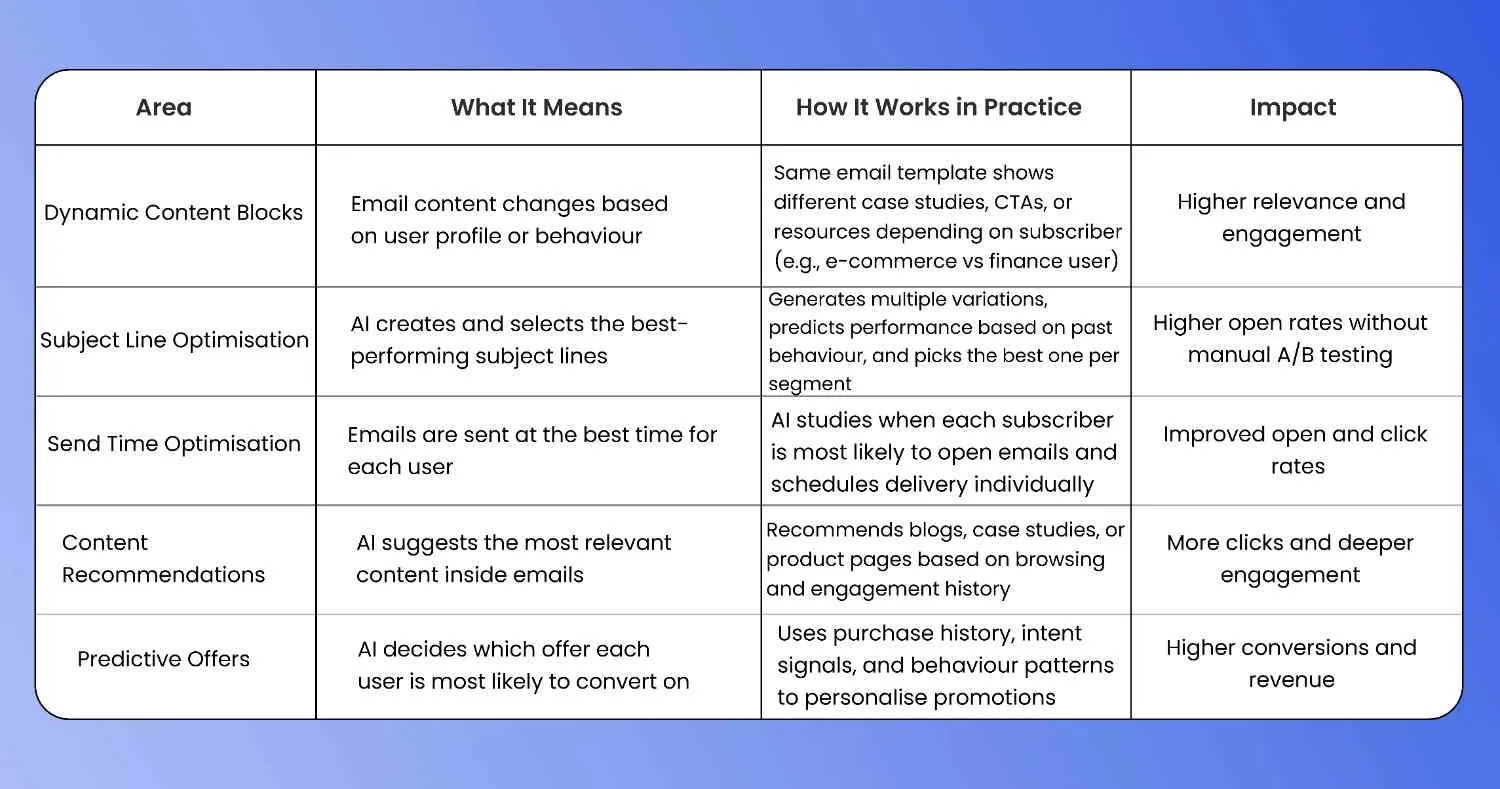
How to Build an AI Email Personalisation Stack Without Starting From Scratch
You do not need to rebuild your entire email programme to start seeing the benefits of AI personalisation. Here is the practical build in order of impact and effort.
Start with behavioural triggers on your three highest-intent pages:
Identify which pages on your site indicate the strongest buying intent — typically: pricing, contact, specific product or service pages. Set up a trigger email for each that fires within 24 hours of a visit from a known subscriber who hasn't already converted. This single implementation produces measurable pipeline impact and requires minimal ongoing maintenance.
Implement lifecycle segmentation in your ESP:
Define four to six lifecycle stages that reflect your actual buyer journey — new subscriber, engaged prospect, active evaluation, customer, at-risk, inactive. Set rules that automatically move contacts between stages based on behaviour. Then create a default email sequence for each stage that sends when a subscriber enters it. This is not complex to build — it is simply systematic about something most programmes do in an unstructured way.
The data that drives lifecycle stage assignment comes from your CRM. Our Revenue Operations (RevOps) Complete Guide 2026 covers how to define lifecycle stages consistently across marketing, sales, and customer success so a contact's status in email reflects the same reality as their status in your CRM and your customer success platform.
Add dynamic content blocks to your highest-volume sends:
Your weekly or bi-weekly newsletter is the highest-leverage place to add dynamic content because it reaches the most people most regularly. Start with one dynamic block — a featured case study or content recommendation that changes by industry or role, and measure the click-through improvement against the previous static version. Add blocks progressively as you build confidence in the results.
Test predictive send-time optimisation:
Most major email platforms — Klaviyo, HubSpot, Marketo, Brevo now include send-time optimisation as a native feature. Enable it, run it alongside a fixed-time control group for four to six weeks, and measure the open rate difference. The improvement is typically meaningful enough to make it a permanent programme decision.
For the full measurement framework that makes these improvements visible and attributable, our Marketing Automation ROI: How to Track & Improve guide covers how to build dashboards that connect email performance metrics to pipeline and revenue so you can report personalisation impact in business terms, not just open rates.
And if your email programme is generating leads that need to be handed off to sales effectively, our MQL to SQL: How to Fix Your Lead Handoff Process with Automation guide covers how to ensure that high-intent email signals — a subscriber who has visited pricing and opened your last three emails — trigger the right sales action rather than sitting unnoticed in a lead queue.
Final Thought
Email remains 40x more effective at acquiring new customers than social media and delivers $36 for every $1 spent — making it the highest-ROI channel in most B2B marketing stacks. But those returns require genuine personalisation. Not a first name. A relevant message, sent at the right moment, to a subscriber whose behaviour has told you exactly what they need.
The technology to do this exists in the tools most teams are already paying for. The gap is not in the budget; it's in the implementation. Build the triggers. Implement the segmentation. Add the dynamic content. Let AI handle the timing. That is how email graduates from a broadcast channel into a revenue system.
Explore more practical marketing and sales guides at the Marketricka blogs — no fluff, no bluff, just strategy that works.