
Demand Generation Playbook 2026: Complete Guide to AI-Driven Pipeline Building
Learn a simple AI-driven demand generation strategy to build a pipeline, balance demand creation, and reduce reliance on ads in 2026.
 By Divyesh Savaliya
Most B2B marketing teams are running two parallel programs without knowing it. The first is demand capture — paid search, retargeting, gated content, and lead forms that intercept buyers already looking for a solution. The second is demand creation — thought leadership, community, ungated content, and brand presence that shapes what buyers think before they ever Google anything.
Here is the problem: according to the Forrester B2B Marketing Survey (2026), 74% of B2B marketing budgets go toward demand capture activities, leaving only 26% for demand creation — almost exactly the inverse of what research says is optimal.
The result is a weak pipeline that depends too much on ads—stop spending, and leads slow down quickly. There’s little organic interest, low brand awareness, and no hidden (“dark funnel”) impact helping you. In this blog, we’ll explore how to fix this by building a simple, AI-driven demand generation strategy that balances demand creation and capture, uses data the right way, and helps you get steady growth without depending only on ads.
Why Your 2024 Demand Gen Strategy Is Already Outdated
The B2B buying environment has changed structurally, not cyclically. The tactics that worked a couple of years ago are now bringing weaker results, and this isn’t likely to change anytime soon.
The dark funnel is now the main funnel. Research from Growigami shows that 60–80% of the B2B buying journey happens in channels that cannot be tracked — private Slack communities, peer conversations, podcasts, AI-assisted research sessions, and direct messages that never generate a UTM parameter. Your MQL dashboard is showing you 20–40% of the journey you can see. The rest is shaping buyer decisions without your knowledge.
AI has radically changed how buyers research. A Leadsopt report found that nearly 90% of B2B buyers have now adopted generative AI in their purchase research. Buyers use tools like ChatGPT and Perplexity to compare vendors, define requirements, and build shortlists — often before ever visiting a vendor's website. If your brand does not show up in AI-generated answers, you are invisible to a growing percentage of your market.
The demand generation strategy for 2026 that works is one built around precision targeting, AI-driven personalization, and pipeline outcomes, not form fills. The global marketing technology market that powers this shift is projected to reach $2.4 trillion by 2033, growing at 20.1% CAGR according toGrand View Research, via Demand Gen Report. The investment reflects the urgency. The teams that get this right now will build pipeline advantages that their competitors cannot quickly close.
The 5-Part AI-Driven Demand Gen Playbook for 2026
1. Build an Intent-Led ICP Engine — Find the 3% Ready to Buy
Stop targeting based only on demographics. Focus on behavior.
Only about 3% of your market is actively buying at any time. The rest aren’t ready yet. Instead of spreading efforts across everyone, winning teams focus on identifying and targeting that 3%.
Use intent data and AI scoring to find accounts already researching solutions. This helps you prioritize the right leads and improve conversion rates without increasing volume.
2. Shift to Ungated Content — Build Trust First
Gated content is losing effectiveness. Buyers don’t want to fill out forms just to access basic information.
Top teams now focus on ungated content like insights, research, and helpful guides to build trust early.
Match your content to the buyer journey:
Awareness → Educational content
Consideration → Comparisons and demos
Decision → Case studies and proof
The easier your content is to access, the more it influences buyers behind the scenes.
3. Use AI Across Execution — Not Just for Content
AI is no longer just a writing tool. It should support your entire demand gen process.
High-performing teams use AI for:
Lead scoring based on real-time behavior
Predicting which accounts will buy soon
Personalized outreach at scale
Dynamic content and ad optimization
This improves efficiency, targeting, and overall campaign performance.
4. Move to Account-Based Demand Generation
ABM is now a core strategy, not a niche tactic.
Instead of broad campaigns, focus on target accounts:
Tier 1 → Highly personalized
Tier 2 → Semi-personalized
Tier 3 → Scaled outreach
Align marketing and sales around these accounts. When done right, this approach drives a stronger pipeline and better conversion.
5. Measure Pipeline, Not Just Leads
Leads alone don’t show real impact. Pipeline does.
Focus on metrics like:
Pipeline coverage
Conversion rates
Marketing-driven revenue
The teams that measure pipeline performance, not just MQLs, are the ones that grow consistently.
The five demand gen metrics that matter in 2026
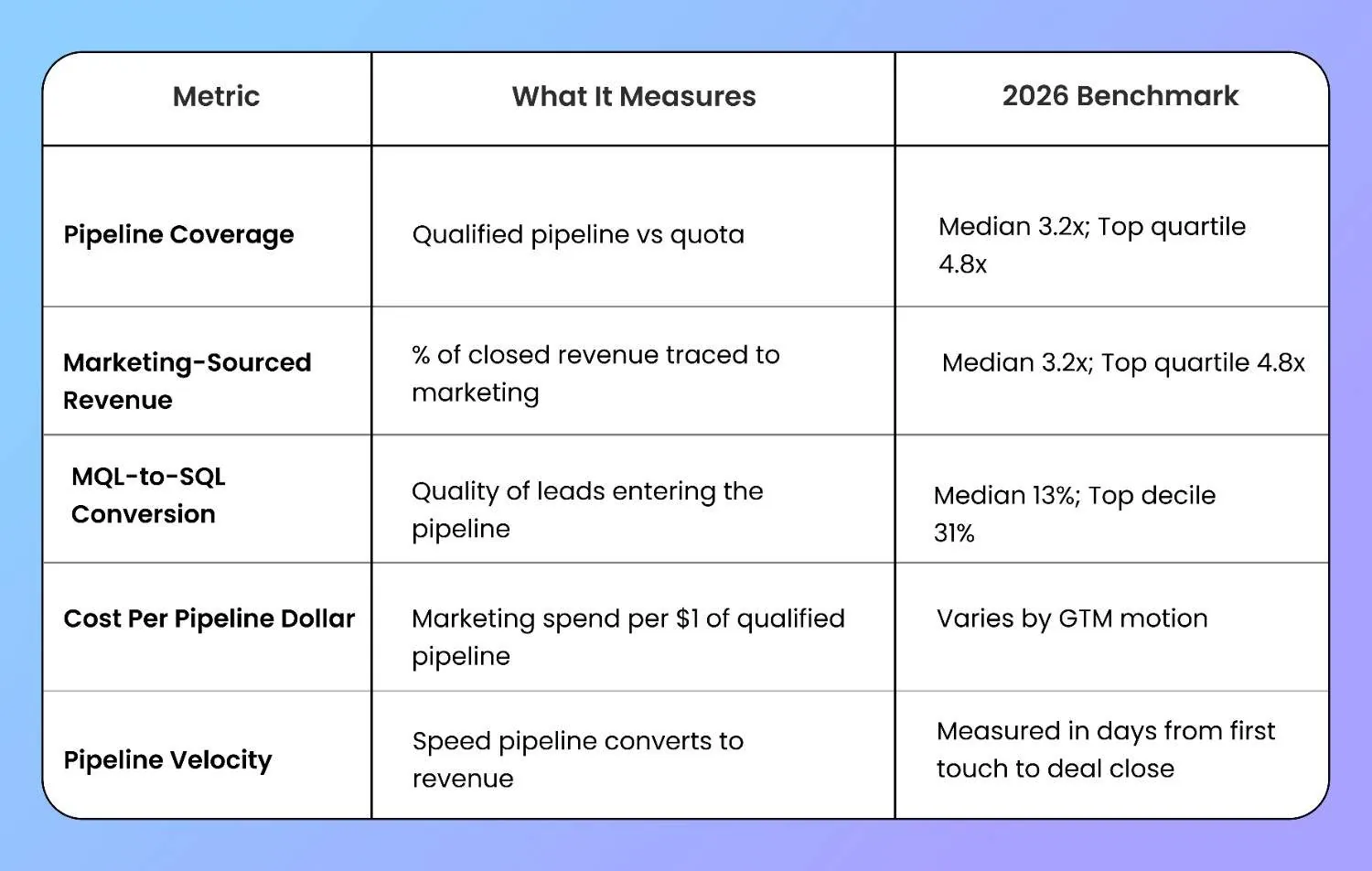
This metric framework connects directly to the Revenue Operations foundation. RevOps-aligned demand gen teams that report on pipeline outcomes, not lead volume — build the credibility with sales and leadership that unlocks more budget, more headcount, and more strategic influence.
The Demand Gen Stack That Supports This Playbook
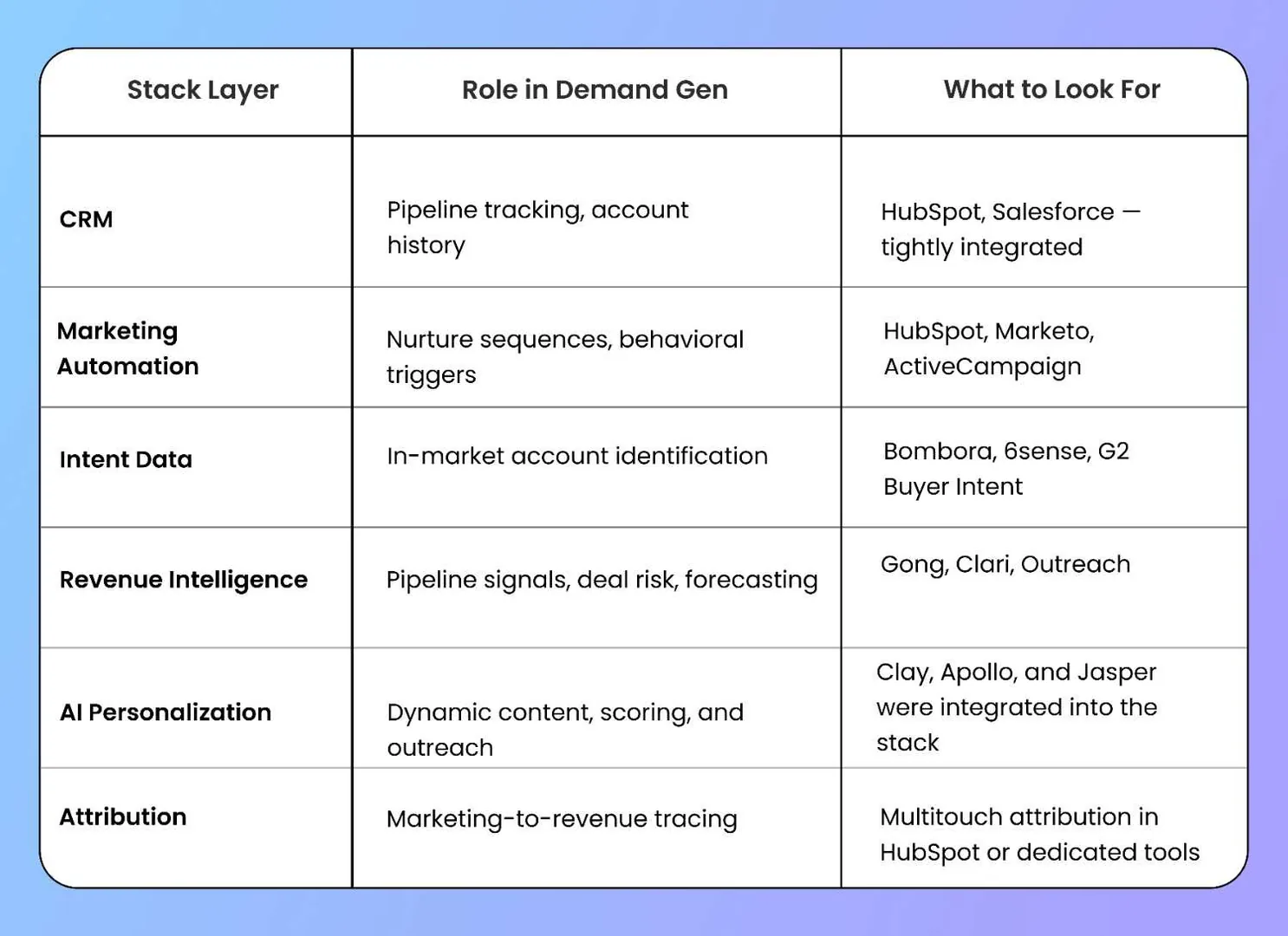
The signal that ties this stack together is intent data, which includes what accounts are in-market, what content they are consuming, and what stage of evaluation they are in. When intent signals flow into your CRM, trigger your marketing automation sequences, update your account scores in your revenue intelligence platform, and inform your personalized outreach, demand generation becomes a system rather than a collection of campaigns.
For a deeper look at how these tools integrate in practice, our guide on Cold Email in 2026 covers the outbound execution layer, and Buyer Enablement in 2026 covers how to support the self-directed buying journey that most demand gen campaigns need to enable.
Final Thought: Demand Generation in 2026 Is a System, Not a Campaign
The best demand gen playbook for 2026 represents a fundamental shift from campaign-driven lead capture to system-driven pipeline creation.
Instead of running quarterly campaigns that spike lead volume and leave your sales team chasing low-intent contacts, you build a machine where intent signals identify who is ready, AI personalization engages them with relevance, ungated content builds trust in the dark funnel, and every touchpoint is traced back to pipeline and revenue.
This is not just a tactical upgrade. It is a competitive advantage that compounds.
Revenue and marketing teams that invest in AI-driven demand generation today are building something their competitors cannot replicate quickly:
A pipeline filled with accounts that are already in-market, already engaged, and already familiar with your brand
Marketing spend that proves its value in pipeline coverage and revenue attribution, not vanity metrics
An AI-driven execution layer that improves continuously as it processes more data, more signals, and more outcomes
In a world where 90% of buyers use AI for research, 74% of budgets go to demand capture instead of creation, and the dark funnel controls 60–80% of the buying journey — your competitive advantage is simple: build demand where your competitors are not looking, with precision your competitors cannot match.
If your current demand generation is still optimized for MQL volume instead of pipeline velocity, you are building the wrong engine for the market you are competing in.
Check out more simple, practical marketing guides on the Marketricka blogs — made for marketers who want to actually apply and get results, not just read.