
Buyer Enablement Strategy for B2B Growth 2026
Learn how buyer enablement strategy helps B2B teams close faster in 2026 with smarter content, DSRs, and value-driven selling.
 By Divyesh Savaliya
Here is a hard truth most sales teams are still ignoring: your buyer has already done the work you think you are doing for them.
By the time a prospect speaks to your sales rep, they have read the comparison articles, studied your competitor's pricing page, consumed peer reviews, built an internal shortlist, and in many cases already decided which vendor they prefer. According to a March 2026 Gartner survey of 646 B2B buyers, 67% of B2B buyers now prefer a rep-free buying experience — up from 61% just nine months earlier. And 45% reported using AI tools during a recent purchase, making the buying journey faster, more self-directed, and far less dependent on your sales team than it was even two years ago.
This is not a problem with your sales rep. It is a structural shift in how buying decisions are made. And the strategic response is buyer enablement, removing the friction between your buyer's decision and your signed contract, so that choosing you becomes the easiest thing they do all week.
This guide breaks down what buyer enablement is, why it has become the most important growth driver for B2B revenue teams in 2026, and the exact tactics that make it work.
What Is Buyer Enablement and How Is It Different from Sales Enablement?
Most revenue teams are familiar with sales enablement, equipping your reps with the content, tools, and training they need to sell effectively. Buyer enablement flips the frame entirely.
Instead of asking "How do we make our sellers better?", buyer enablement asks: "How do we make it easier for buyers to buy?"
In practice, that means giving buyers exactly what they need to complete each stage of their decision internally without waiting for a rep to send it, schedule it, or approve it. It means proactively surfacing ROI calculators, competitive comparisons, security documentation, case studies, and business case templates that buyers need to convince their own internal stakeholders.
The distinction matters because buyers are spending remarkably little time with vendors. Gartner's B2B buying journey research shows that B2B buyers spend only 17% of their total purchase time meeting with potential vendors. If they are evaluating three suppliers, each vendor gets approximately 5–6% of the buyer's calendar. The rest of the time, buyers are conducting independent research, building internal consensus, and managing stakeholder alignment entirely without your input.
Buyer enablement is your strategy for influencing that 83% of the journey where your reps are not in the room.
Why Buyer Enablement Has Become Non-Negotiable in 2026
The data on B2B buying behavior in 2026 tells a consistent, urgent story, and every data point reinforces the same conclusion: the buying journey has moved decisively away from the seller.
67% of B2B buyers prefer a rep-free buying experience, and 73% actively avoid vendors that send irrelevant outreach (Gartner, March 2026)
86% of B2B purchases stall during the buying process, and 81% of buyers are dissatisfied with the provider they ultimately choose (Forrester, 2024) — a clear signal that complexity and friction are destroying deal quality on both sides
92% of B2B buyers start their journey with at least one vendor already in mind, and 41% enter with a single preferred vendor before any formal evaluation begins (Forrester, via Corporate Visions)
Only 24% of buyers in rep-led purchases completed a high-quality deal, compared to 65% of buyers who self-navigated the purchase (Gartner, via Clevenio)
That last data point is the most striking finding in the entire category. Buyers who self-navigate their purchase with the right resources, content, and tools to do so are nearly 3x more likely to report a high-quality deal than buyers dependent on a rep to guide them. The implication is direct: the more you enable buyers to move on their own terms, the better the outcome for both parties.
Gartner's senior principal analyst Alyssa Cruz put it directly: "B2B buyers are progressing through critical buying tasks in more autonomous ways, and sellers can't depend on static collateral to carry influence in those moments."
The buying environment has changed. Your revenue strategy needs to catch up. This also connects to the broader Revenue Operations framework we cover on Marketricka — RevOps teams that align their systems and content around the buyer journey, not just the seller's process, are the ones achieving predictable growth in 2026.
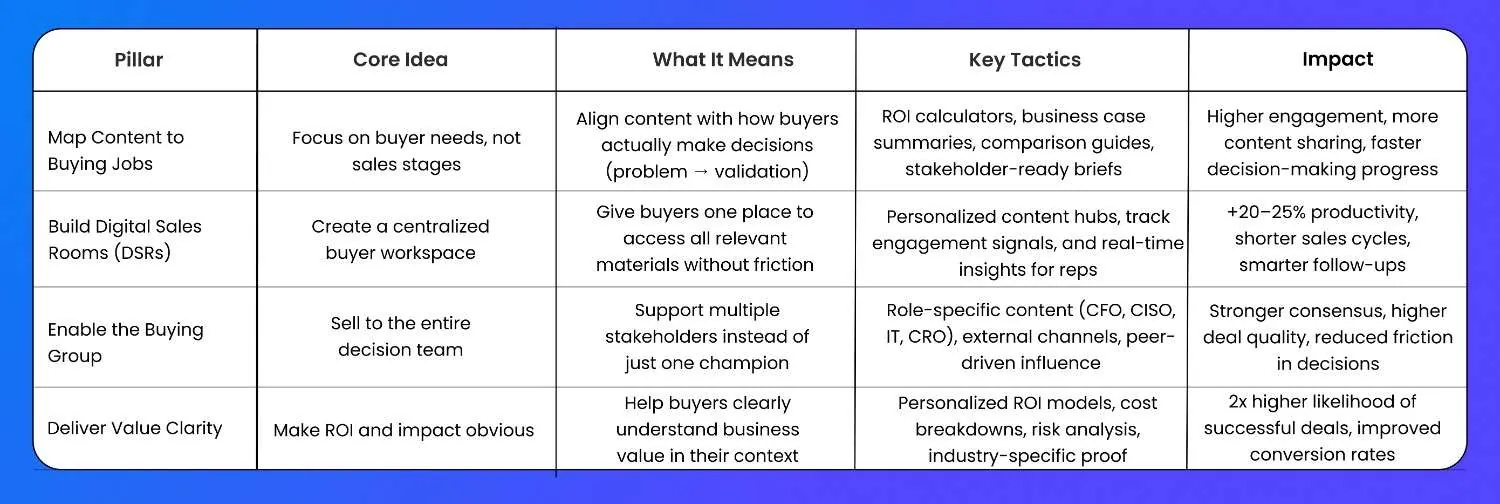
The 4 Pillars of a Winning Buyer Enablement Strategy
1. Map Content to Buying Jobs, Not Sales Stages
Most B2B content is organized around what sellers do — prospecting content, demo decks, closing assets. Buyer enablement requires a different organizing principle: mapping content to what buyers need to accomplish at each stage of their internal decision process.
Gartner describes buying as a set of distinct "jobs": problem identification, solution exploration, requirements building, supplier selection, and validation. Each job requires specific information at a specific moment. A buyer trying to build internal consensus needs a one-page business case summary and an ROI calculator, not a 40-slide product deck.
When you map your content to these jobs, you create assets that buyers actually share internally, forward to decision-makers, and use to advance their own purchasing process. Research from Forrester shows that salespeople who actively support the self-directed buying process are 57% more successful than those who stick to traditional rep-led approaches.
The content types that perform best in buyer enablement include: interactive ROI calculators, security and compliance one-pagers, competitive comparison guides written from the buyer's perspective, industry-specific case studies with quantified outcomes, and consensus briefs designed to be forwarded to internal stakeholders without explanation.
This content strategy is the demand generation layer of your Marketing Automation ROI work — the automation that delivers the right content to the right buyer at the right moment of their journey.
2. Build Digital Sales Rooms That Work When You Are Not There
A digital sales room (DSR) is a shared, personalized workspace where buyers can access all the materials relevant to their evaluation proposals, case studies, ROI models, legal documents, and product demos in one place, without emailing back and forth or hunting through their inbox.
The data on DSRs is compelling. McKinsey research shows that companies using digital sales rooms achieve 20–25% increases in sales productivity and 15–30% reduction in sales cycle length. Gartner projects that by 2026, over 30% of all B2B companies will implement AI-powered buying guides, a growth of over 500% compared to 2023 (Brixon Group analysis of Gartner research).
The key advantage of a DSR over email-based document sharing is the intelligence layer. When a buyer opens the proposal, forwards the ROI calculator to their CFO, or spends 12 minutes on the competitive comparison, your rep sees that signal and can respond with relevance, not a generic "just checking in" follow-up.
This is buyer enablement and Revenue Intelligence working in combination: the DSR creates the engagement signals, and the intelligence layer turns those signals into informed selling actions.
3. Enable the Buying Group, Not Just the Champion
One of the most significant structural shifts in B2B buying is that decisions are no longer made by a single champion. Gartner research reports that approximately 13 people are involved in a typical B2B purchase decision, and 74% of buying teams experience unhealthy conflict during the process. Yet the winning committees, those that reach genuine consensus, are 2.5x more likely to report a high-quality purchase outcome.
Most sales teams focus their energy on one contact: the champion who initiated the conversation. Buyer enablement requires thinking about the entire buying group simultaneously. That means creating stakeholder-specific content — a security brief for the CISO, a financial summary for the CFO, a technical overview for the IT lead, and an executive summary for the CRO — that each stakeholder can consume on their own terms without needing a dedicated sales call.
Forrester's 2025 B2B predictions add an important wrinkle: more than 50% of younger buyers now depend on external sources — social media, peer networks, community reviews to shape their purchasing decisions. Your buyer enablement strategy needs to reach stakeholders not just through your own channels but through the peer networks they actually trust.
This multi-stakeholder approach connects directly to your B2B Intent Data strategy because identifying which stakeholders at a target account are actively researching your category is the first step to enabling the right people at the right time.
4. Deliver Value Clarity, Not Just Product Information
The most important insight from Gartner's 2026 research is the concept of value clarity — a buyer's clear understanding of how a solution improves outcomes within their specific role and business context. According to Gartner, buyers who reach value clarity are twice as likely to report a high-quality deal compared to buyers with low decision confidence.
Value clarity is not achieved by better product demos. It is achieved by helping buyers answer the questions their leadership will ask: What will this cost to implement? How long until we see ROI? What risk does this introduce? How does this compare to alternatives we have already evaluated?
Your buyer enablement materials need to answer these questions specifically, not with generic marketing claims, but with quantified proof tied to the buyer's industry, company size, and use case.McKinsey research confirms that personalization reduces customer acquisition costs by up to 50% and lifts revenues by 5–15%, making contextual, specific enablement content one of the highest-leverage investments a revenue team can make.
Quick Summary
Connecting Buyer Enablement to Your Revenue System
Buyer enablement does not work in isolation. It is most powerful when it connects to the full revenue infrastructure — the pipeline, the CRM, the intelligence layer, and the outbound strategy.
When your Sales Funnel Automation routes a high-intent lead into a personalized DSR, and your Revenue Intelligence tools surface the signal that a CFO just spent time on the ROI calculator, and your rep responds with a stakeholder-specific message informed by Pipeline Velocity data that is buyer enablement operating as a system.
The result is not just a better buyer experience. It is a faster sales cycle, a higher win rate, and a more predictable revenue forecast. Every number in the table above is the downstream output of a buyer enablement strategy that is connected to the rest of your GTM infrastructure.
Final Thought: The Easiest Sale Is the One the Buyer Makes Themselves
Buyer enablement in 2026 is a shift from seller-centric to buyer-centric revenue strategy.
Instead of optimizing how your reps push buyers through a sales process, you build a system where buyers can pull themselves forward, accessing what they need, when they need it, in the format that makes sense for every stakeholder in their organization.
This is not a soft strategy. It is a competitive advantage with measurable outcomes:
Nearly 3x higher deal quality for buyers who self-navigate with the right resources
15–30% shorter sales cycles when friction is removed from the evaluation process
Confident buying groups that close faster, expand more readily, and regret their decisions less
In a world where 67% of buyers prefer to buy without ever speaking to a sales rep, your competitive edge is simple: make it so easy for buyers to understand your value, build internal consensus, and complete their purchase that choosing anyone else feels like unnecessary work.
If your current sales process is still built around what your sellers need to do rather than what your buyers need to decide, you are creating friction that costs you deals every quarter.
Need more easy ideas you can actually use? Visit the Marketricka blogs and discover simple tips to get started quickly.