
Cold Email in 2026: AI-Powered Sequences That Get 40%+ Open Rates
Learn how AI-powered cold email sequences in 2026 boost open rates, improve replies, and turn outreach into a predictable pipeline.
 By Divyesh Savaliya
Let's be honest, most cold emails deserve to be ignored. They land in an inbox with a generic subject line, a first sentence that sounds like it was written by a chatbot in 2019, and a closing line that asks for "15 minutes of your time" as though that's a small ask from a stranger.
And yet, cold email remains one of the highest-ROI outbound channels available to B2B sales and marketing teams. Email marketing delivers an average return of $36–42 for every dollar spent in 2026, outperforming paid search, social advertising, and display ads combined. The channel isn't dying. The standard for quality is just rising fast.
In 2026, the teams winning with cold email aren't sending more. They're sending smarter with AI handling research and personalization at scale, intent signals triggering outreach at exactly the right moment, and sequences built for precision rather than volume. This guide breaks down the exact cold email strategy for 2026 that gets 40%+ open rates and turns outreach into a predictable pipeline driver.
Why Most Cold Email Strategies Are Failing Right Now
Before building a better approach, it's worth understanding why the average approach is broken.
According to Hunter.io's State of Cold Email 2026 report, based on 31 million emails sent in 2025, the average cold email open rate sits at 30%, and the average reply rate is just 4.5%. That means roughly 95.5% of cold emails generate zero response.
The reasons are predictable: generic subject lines, poor targeting, no follow-up strategy, and deliverability problems that mean a meaningful portion of emails never reach the inbox at all. Gmail tightened enforcement again in late 2025, meaning non-compliant senders now face systematic rejection across all major providers simultaneously.
But here's what the same data reveals: the gap between average and elite senders is enormous. Campaigns targeted at 21–50 highly qualified recipients achieve a 6.2% reply rate, more than double the average compared to just 2.4% for campaigns blasted to 500+ contacts. Elite senders achieve open rates well above 40% by combining hyper-relevant subject lines, tight segmentation, strong deliverability infrastructure, and AI-assisted personalization.
The question is how to get there.
What "AI Cold Email" Actually Means in 2026
The phrase "AI cold email" gets thrown around loosely, but in practice, it means something specific and powerful.
According to Instantly.ai's 2026 Cold Email Benchmark Report, AI agents now handle approximately 80% of research and sequencing work for top-performing outbound teams. That includes prospect research, data enrichment, trigger identification, first-line personalization, subject line testing, and send-time optimization.
What does this free humans to do? The strategic work — positioning, ICP refinement, messaging strategy, and the high-value conversations that actually close deals.
This shift matters because it makes genuine personalization scalable. Previously, truly personalized outreach referencing a recent funding round, a specific hiring trend, a product launch, or a LinkedIn post required hours of manual research per prospect. Today, AI workflows built on tools like Clay can automate that research loop, enriching contact data with real-time signals and generating contextual opening lines that feel researched without the manual effort.
The result? AI-generated subject lines outperform human-written subject lines by 26%, and when combined with dynamic send-time optimization, that advantage compounds to a 40%+ lift in open rates. It's not magic, it's systematic signal-to-message execution at a scale humans can't match manually.
Gartner's 2026 CMO research confirms the broader direction: 65% of CMOs say AI will dramatically transform their role within two years, and only 5% of marketing leaders who use AI purely as a standalone tool rather than integrating it into core workflows report significant gains. The winners in cold email mirror this finding exactly. AI is embedded into the sequence logic, not bolted on as a writing assistant.
This connects directly to the Marketing Automation ROI strategies we've covered on Marketricka; the same principles of integrated, data-driven automation that drive marketing ROI are now reshaping how outbound email teams operate.
The 5-Part Framework for Cold Email Sequences That Work in 2026
1. Build Intent-Led Lists, Not Volume Lists
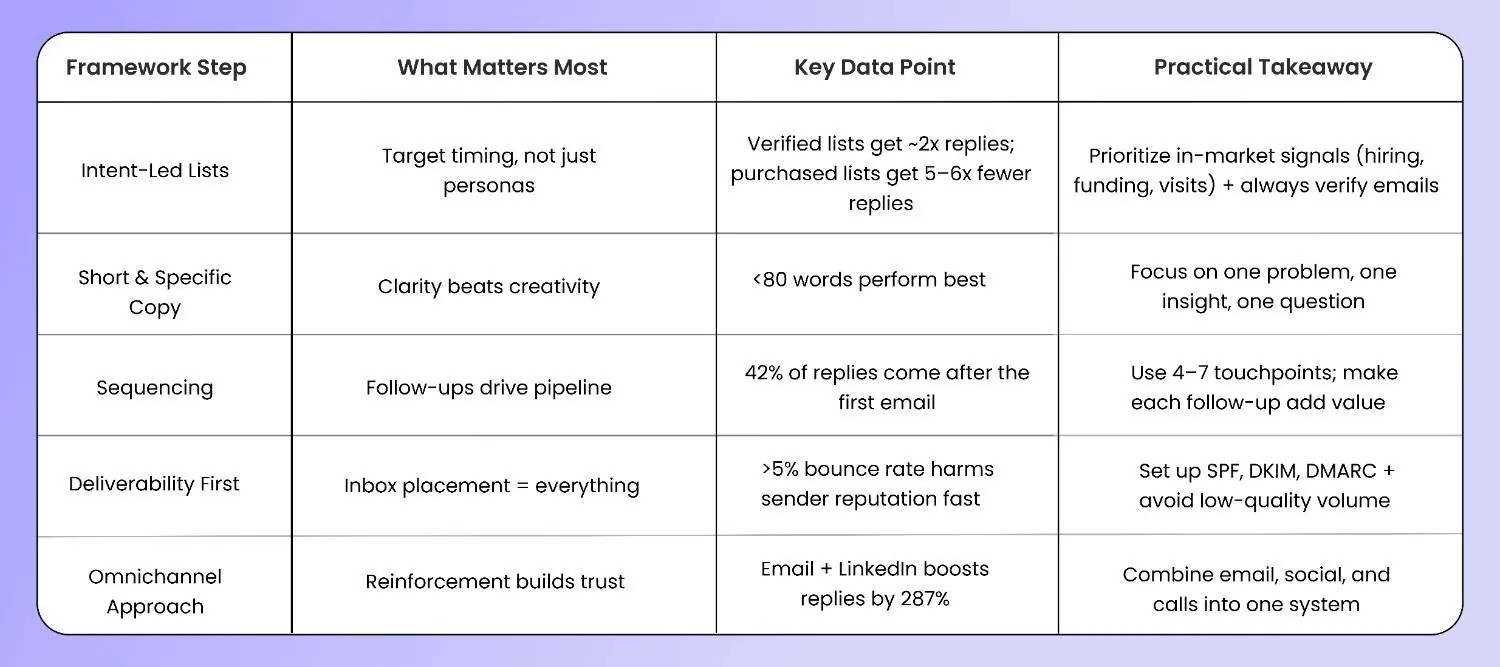
The biggest lever in cold email performance isn't your subject line. It's whether you're reaching people who are actually in-market right now.
Instantly.ai's 2026 benchmark data is clear: the best outbound teams layer intent signals into their prospecting — hiring activity, funding announcements, product launches, tech stack changes, and website visit data to time outreach to the moment of highest relevance. This is the "right-time outreach" model that separates elite senders from the average.
Verified contact data is equally non-negotiable. Campaigns sent to verified email lists achieve roughly twice the reply rate of unverified lists, and 5–6 times the reply rate of purchased lists. A bounce rate above 5% can destroy your domain's sender reputation before a single quality conversation is had.
Understanding how to pair intent signals with your outreach is also explored in our guide on B2B Intent Data Platforms — a natural companion to this cold email framework.
2. Write Shorter and More Specifically
Every data set in 2025–2026 points to the same conclusion: short, specific, problem-first emails outperform long, feature-led ones.
Instantly.ai found that the best-performing cold emails contain fewer than 80 words. That's enough to state a problem, connect it to the prospect's situation, and ask one clear question. Nothing more. Subject lines that reference a specific outcome, problem, or situation relevant to the prospect's world consistently outperform generic ones.
The anatomy of a high-performing 2026 cold email looks like this: a subject line that feels personally relevant, a first line that references something specific to the prospect's current situation (pulled from intent data or research), a one-sentence value proposition tied to a business pain, and a single low-friction call to action, not a meeting request, but a conversation opener.
3. Build a Sequence, Not a Single Send
Hunter.io's research shows that the first email captures 58% of replies, but that means 42% of all responses come from follow-ups. Teams that send one email and move on are leaving nearly half their pipeline on the table.
The optimal sequence length in 2026 is 4–7 touchpoints (Instantly.ai, 2026). Fewer than four gives up too early; beyond seven, returns diminish unless each touch genuinely adds new value. The first follow-up has the biggest incremental impact, boosting replies by up to 65.8%, and should feel like a continuation of a conversation, not a reminder that the previous email exists.
Timing matters as much as sequencing. Launch sequences on Monday, push follow-ups on Wednesday (the peak engagement day), and send during the 9:30–11:30 AM window in the recipient's local timezone. These patterns hold consistently across the largest 2025–2026 benchmark datasets.
4. Lock Down Deliverability Before Anything Else
None of the strategies above matters if your emails land in spam. Since Google and Yahoo enforced DMARC requirements in 2024, SPF, DKIM, and DMARC configurations are no longer optional; they're table stakes. Senders without proper authentication are being systematically rejected across all major inbox providers.
Beyond technical setup, behavioral signals now influence deliverability as much as technical ones. ESPs in 2026 increasingly weigh engagement quality — time spent reading, reply depth, and conversation length as inbox placement signals. This means low-quality, low-engagement sends damage to future deliverability, creating a compounding negative effect. Volume without quality is self-defeating.
This is directly connected to the Sales Pipeline Velocity, where speed without quality at the top of the funnel creates pipeline noise that slows everything downstream.
5. Make It Omnichannel — Email Is the Foundation, Not the Whole Strategy
Cold email in 2026 works best as part of a coordinated multi-touch sequence, not a standalone channel. Outreach combining email with LinkedIn touches and strategic calls can boost results by over 287%, with a combined email-plus-LinkedIn approach hitting an 11.87% reply rate compared to 4.5% for email alone.
The practical model: use cold email as the primary sequence vehicle and primary engagement signal, then layer LinkedIn visits and connection requests as social proof of research, and phone as a third touch for high-value prospects who've engaged with email but haven't replied. Each channel reinforces the others. The prospect sees your name in multiple places, which accelerates the trust-building that makes reply rates climb.
This multi-channel view of outbound connects naturally with your CRM Automation Strategies — the infrastructure that tracks each touchpoint, routes follow-ups intelligently, and ensures no high-intent prospect falls through the cracks.
Quick Summary: What Actually Works in Cold Email (2026)
How This Connects to Your Broader Revenue Strategy
Cold email doesn't operate in a vacuum. It's the top-of-funnel engine that feeds the pipeline systems your revenue team relies on. A cold email sequence that generates 40%+ open rates and 10%+ replies is only valuable if those replies enter a structured pipeline with clear handoffs, proper CRM tracking, and a sequence that moves them from first conversation to closed deal.
That end-to-end connection from cold outreach to qualified pipeline to closed revenue is exactly what Revenue Operations is designed to enable. When your cold email strategy, CRM, and pipeline management are aligned around the same data, the same ICP, and the same conversion benchmarks, outbound becomes a repeatable, forecastable growth engine rather than a hit-or-miss activity.
Final Thought: Cold Email in 2026 Is a Precision Sport
Cold email strategy in 2026 represents a shift from broadcast to precision.
Instead of blasting thousands of generic messages and hoping a small percentage responds, you build a system where every email is triggered by a relevant signal, written to reflect real research, delivered to a verified contact at exactly the right moment, and followed up with persistence that feels human rather than automated.
This is not just a strategic upgrade, it's a competitive advantage.
Sales teams that invest in AI-powered cold email sequences today are building something their competitors won't replicate quickly:
Open rates that hold above 40% because relevance is built in from the start
Reply rates that compound as each sequence learns from previous performance
A pipeline that comes from outbound, not just inbound, giving your revenue team genuine control over growth
In a market where personalized emails deliver 6x higher transaction rates, and AI-driven campaigns generate 22% higher ROI than traditional methods, your competitive advantage is straightforward: reach the right person, at the right moment, with the right message at scale.
If your current outbound email strategy depends on volume over precision, you're leaving pipeline on the table.
Looking for more simple and effective ideas? Visit the Marketricka blog and explore tips you can start using right away.