
AI Retargeting Strategy 2026 to Boost Conversions
Learn how AI retargeting in 2026 boosts conversions using first-party data, intent targeting, and omnichannel strategies.
 By Divyesh Savaliya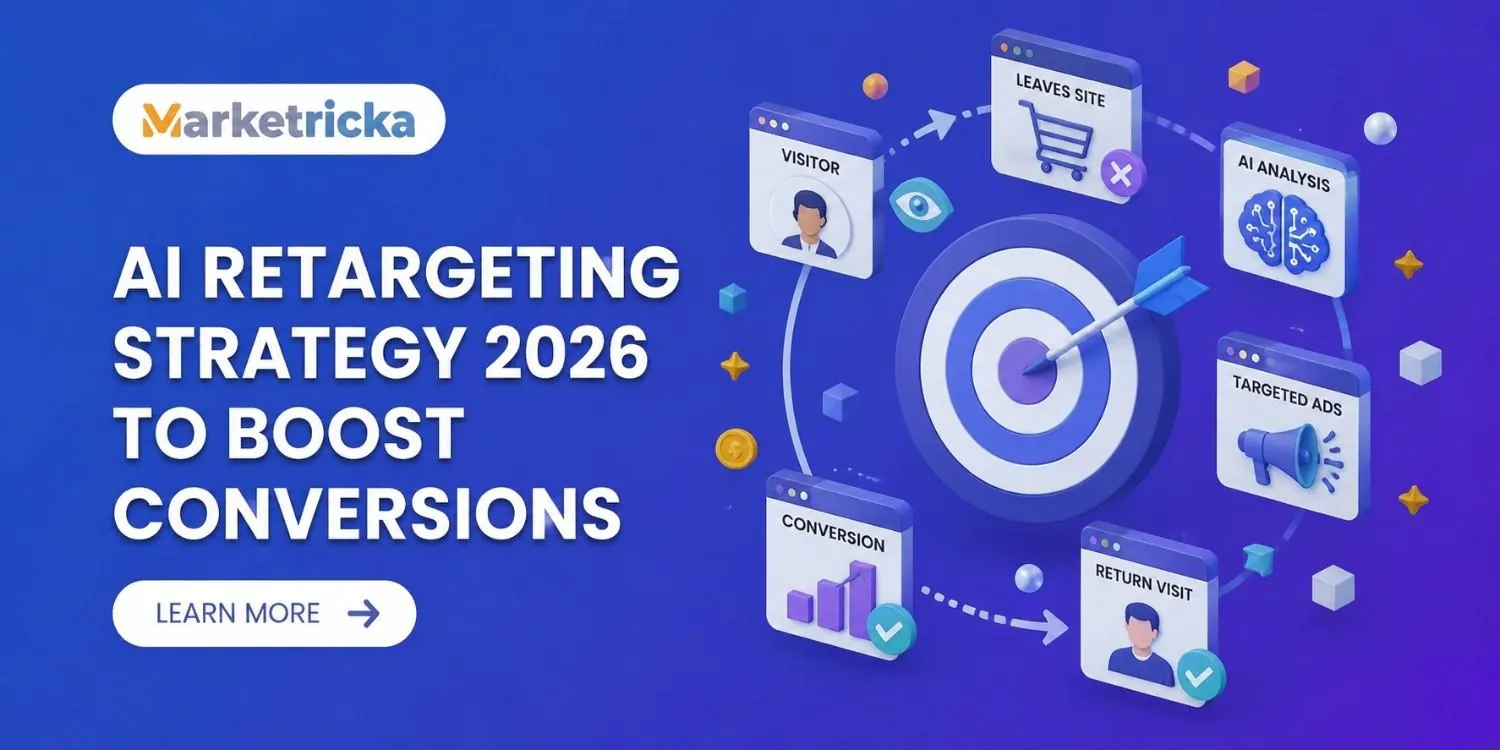
Here is a number that should change how you think about your marketing budget: 97% of visitors who arrive at your website and leave without converting — and without active re-engagement, the overwhelming majority of them never come back.
That is not a website problem. It is not a messaging problem. It is a timing problem. Most B2B buyers are not ready to act the first time they encounter your brand. They are researching, comparing, building internal consensus, and waiting for the moment the priority rises high enough to trigger a decision. The companies that stay visible and relevant throughout that entire process without waiting for buyers to return on their own are the ones that win.
That is what the retargeting strategy in 2026 is built to do. And with AI now handling audience segmentation, creative personalization, timing optimization, and cross-channel coordination, the performance potential for retargeting has moved significantly higher.
The global remarketing advertising service market was valued at $90 billion in 2024, with the retargeting software segment alone projected to reach $8.87 billion by 2025, driven by AI and first-party data systems replacing cookie-based approaches (SHNO Remarketing Statistics 2026). The investment reflects the return: retargeting consistently delivers results that cold prospecting cannot match. This guide covers exactly how to build an AI retargeting strategy that brings lost pipeline back and converts more of the traffic you are already paying to generate.
Why Most Retargeting Campaigns Underperform
The gap between average retargeting and elite retargeting is not a budget gap. It is a precision gap. Most campaigns treat all website visitors the same; they show the same generic ad to someone who spent 45 seconds on the homepage and someone who spent 12 minutes reading a case study and pricing page. That is not retargeting. That is display advertising with a slightly warmer audience.
The performance data exposes the missed opportunity. Segmented retargeting campaigns increase CTR by 76% and conversions by 147% compared to generic retargeting strategies, according to SQ Magazine's 2026 Retargeting Ad Performance data. The teams hitting those numbers are not spending more; they are targeting more precisely.
Three Forces Reshaping Retargeting in 2026
1. First-Party Data Is Now the Foundation
Third-party cookies are no longer reliable.
Google’s Privacy Sandbox was discontinued in October 2025 due to low adoption
Apple’s App Tracking Transparency reduced Meta retargeting reach by 35–40% (Source)
The old cookie-based retargeting playbook is effectively outdated
What’s working now:
Brands investing in first-party data are seeing major gains:
CRM and email lists
Server-side tracking
Consent-driven behavioral data
Native platform audiences
Research from Whitehat SEO shows 10–83% improvement in acquisition costs and ROI.
Meanwhile, brands that still depend on third-party data are seeing their reach decline every quarter.
2. AI Is Redefining Campaign Performance
AI is no longer just a support tool; it’s running the system. Platforms like Google Performance Max and Meta Advantage+ have evolved into full-scale AI engines that:
Analyze thousands of behavioral signals in real time
Adjust bids automatically
Generate dynamic ad creatives
Make audience targeting decisions instantly
Adoption is accelerating fast:
43% of large advertisers are testing AI-generated retargeting ads (Source)
86% of marketers are using or planning to use AI for retargeting and funnel optimization (Source)
Manual campaign management alone can no longer compete.
3. Omnichannel Is the New Standard
Single-channel retargeting is leaving money on the table.
Running only display ads is no longer enough. High-performing brands now use a multi-channel sequence, including:
Display
Social media
Search
Email
Connected TV (CTV), when relevant
The impact:
48% higher conversion rates
23% higher customer lifetime value
Modern retargeting isn’t about one channel; it’s about a connected experience across multiple touchpoints.
Quick Summary
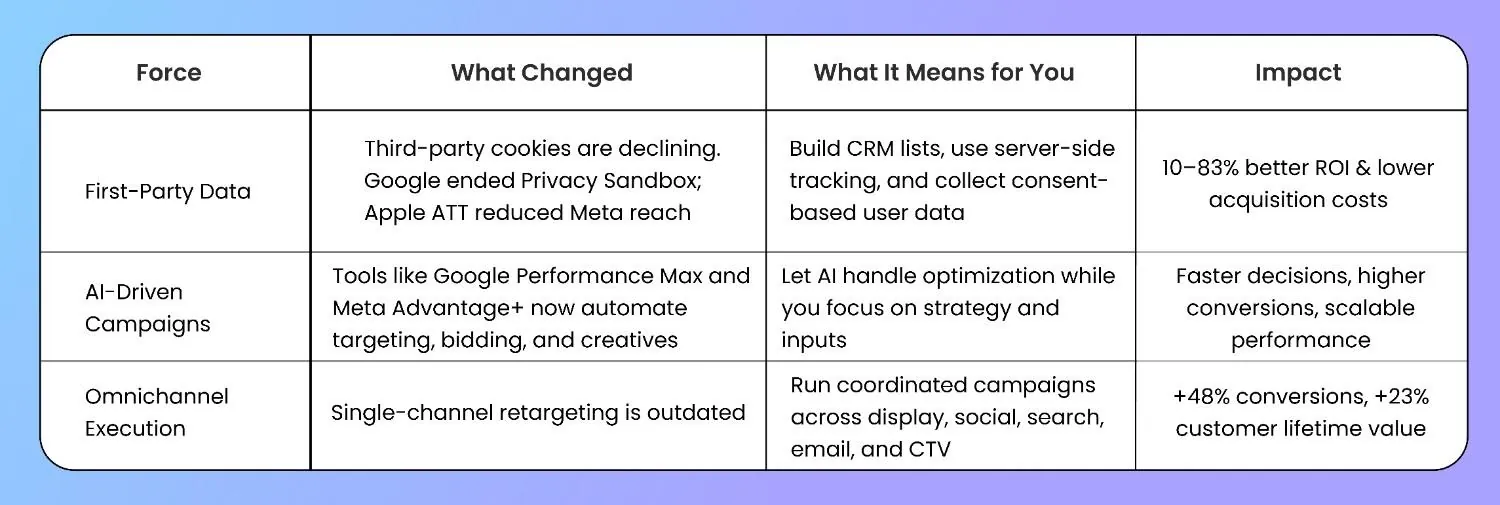
Modern retargeting = Data + AI + Omnichannel.
The 5-Part AI Retargeting Strategy for 2026
1. Segment by Intent Signal (Not Just Behavior)
Not all visitors are equal, and in 2026, segmentation based on page visits alone is no longer enough.
What to Do
Build audiences based on intent signals and engagement depth, not just URLs.
Audience Tiers
Tier 1 — High Intent: Pricing page visitors, demo abandoners, ROI calculator users
→ Highest budget + highly personalized adsTier 2 — Mid Intent: Case study readers, solution page visitors
→ Educational + social proof messagingTier 3 — Low Intent: Blog readers, quick bounces (<30 sec)
→ Exclude or suppress
Key Insight
Excluding low-intent users improves:
Ad quality scores
Cost per click
Budget efficiency
Advanced Layer
Use predictive retargeting to identify users behaving like buyers before they convert.
2. Build First-Party Data Infrastructure
Third-party data is fading fast. First-party data is now your foundation.
Why It Matters
Google discontinued Privacy Sandbox
Apple ATT reduced Meta reach by 35–40%
Core Stack for 2026
Server-side tracking
CRM audience matching
Conversions API (CAPI)
Enhanced Conversions
GA4 event-based audiences
Results
25–35% higher ROAS
1.5x revenue growth
Key Insight
Your retargeting + CRM should work as one system, not separate tools.
This infrastructure also directly enhances your CRM Automation Strategies. When CRM data flows into retargeting platforms through Customer Match and Conversions API, your paid retargeting and your owned database become one connected system, not two separate programs running in parallel.
3. Use AI Creative Personalization
Running the same ad for every user is one of the biggest mistakes.
The Fix
Match the message to the intent stage
High intent → ROI, demo, urgency
Mid intent → case studies, outcomes
Low intent → awareness or exclude
What Works in 2026
Case study videos → +58% conversion rate
ROI-driven messaging
Social proof
Resource-based retargeting
Performance Boost
Dynamic ads can deliver up to 2x higher CTR
Smart Approach
Create 3–5 core themes
Use AI to generate variations
Let algorithms optimize winners
4. Execute Cross-Channel Sequences
Retargeting is no longer a single-channel tactic; it’s a sequence.
High-Performing Flow
Day 1–3: LinkedIn → Educational + case studies
Day 3–7: Google Display → Reinforce value
Day 5–10: Email → Personalized follow-up
Day 10–21: YouTube → Product education
Parallel: Sales outreach → triggered by engagement signals
Why It Works
Feels like a conversation, not repetition
Increases engagement across touchpoints
Impact
+48% conversions
+23% customer lifetime value
5. Measure What Actually Matters
Clicks don’t equal revenue.
Shift Your Metrics
Instead of CTR and CPC, focus on:
Pipeline influenced by retargeting
Deal velocity
ROAS by audience tier
ICP account engagement
Key Insight
Retargeting should be measured by: how it moves deals forward, not just who clicks
Business Impact
15–30% faster deal cycles
Better alignment with sales
Connecting Retargeting to Your Full Revenue Engine
Retargeting does not operate in isolation. It is the middle layer of a complete revenue architecture. It captures the pipeline that demand generation creates and wasn't immediately ready to convert, re-engages it with relevance, and surfaces the accounts ready for sales engagement to your Revenue Intelligence platform.
When your cold email sequences reach a prospect at the same time your retargeting ads are reinforcing your brand across LinkedIn and Google, the two channels create a combined presence that accelerates trust and shortens the decision cycle. When your buyer enablement content lives inside a digital sales room that retargeting directs high-intent visitors toward, the sequence from ad click to qualified conversation becomes measurable and repeatable.
This is the revenue system that predictable growth runs on in 2026, and retargeting is the re-engagement engine that holds it together.
Final Thought
Retargeting in 2026 is no longer a standalone tactic; it is a core part of how modern revenue systems operate.
As buying journeys become longer and less linear, the ability to re-engage high-intent prospects with precision is what separates wasted traffic from predictable growth. The shift is clear: from broad audience chasing to signal-driven engagement, from manual optimization to AI-led execution, and from isolated campaigns to connected revenue workflows.
The opportunity is not in doing more retargeting, it is in doing it smarter.
Businesses that treat retargeting as an integrated, data-driven system will continue to capture the pipeline that others lose. Those that don’t will keep paying for traffic that never converts.
The difference is not visibility. It is how effectively you bring people back when it matters most.
Browse the Marketricka blogs for straightforward marketing ideas you can put into action right away.