
HubSpot Alternatives: 12 Better Options for Small Businesses
Explore HubSpot alternatives for small businesses. Compare CRM features, pricing, and tools for sales and marketing automation.
 By Divyesh Savaliya
HubSpot is often the first CRM many small businesses try because it brings marketing, sales, and customer management into one platform. But as companies grow, they sometimes realize they need a different balance of pricing, flexibility, or features. Some teams want simpler CRM systems focused on sales pipelines, while others look for platforms that integrate better with their existing marketing tools.
The need for these alternatives is growing as businesses invest more in automation and data-driven customer management. Research shows the global CRM market is expected to reach about $163 billion by 2030, reflecting how central these tools have become for managing leads and customer relationships. For businesses exploring smarter lead management and automation strategies, resources like Marketricka’s guide on AI-Powered Lead Scoring Automation explain how CRM platforms connect with automation and AI technologies to improve marketing and sales workflows.
Why Small Businesses Look for HubSpot Alternatives
Small businesses often start with HubSpot because of its strong reputation and free entry-level plan. However, as teams grow and their needs expand, many realize the platform may not always be the most practical option for their workflow or budget.
Pricing increases quickly as contacts grow:
HubSpot’s pricing structure often scales with contact lists and advanced features. For small businesses, this can make the platform significantly more expensive over time compared to other CRM options.Many advanced features require higher-tier plans:
While HubSpot offers powerful marketing automation and analytics tools, many of these capabilities are locked behind premium plans, which may be difficult for smaller teams to justify.The platform can feel complex for small teams:
HubSpot provides multiple hubs for marketing, sales, and service. While useful for large organizations, small teams sometimes prefer simpler tools that focus on just a few essential CRM functions.Some businesses need a more focused CRM solution:
Instead of an all-in-one platform, many small businesses prefer tools that specialize in sales pipeline management, marketing automation, or email marketing.
What to Look for in a HubSpot Alternative
Choosing the right CRM alternative requires understanding what features your business actually needs. Instead of simply switching platforms, it’s important to evaluate tools that align with your team’s workflow and long-term goals.
Ease of use and quick onboarding:
Small businesses often need tools that are simple to learn and easy to implement without long training processes or complicated setups.Flexible pricing that grows with your business:
The best CRM platforms offer scalable pricing models so businesses can add features gradually without facing sudden cost increases.Strong CRM and marketing automation capabilities:
Look for platforms that help track leads, manage customer interactions, and automate follow-ups or campaigns.Integration with existing tools:
A good CRM should connect easily with email platforms, analytics tools, and other systems your business already uses.
12 Best HubSpot Alternatives for Small Businesses
Below are the HubSpot alternatives that small businesses frequently evaluate, each offering a different approach to managing customer relationships, marketing campaigns, and sales pipelines.
Businesses exploring CRM platforms often combine them with marketing automation tools to build a more complete marketing infrastructure. If you're exploring how automation supports marketing operations, you can also explore the Marketing Automation Complete Guide on Marketricka.
1. Zoho CRM
Overview
Zoho CRM is often the first alternative businesses explore when looking beyond HubSpot. It offers a wide range of CRM capabilities while remaining relatively affordable compared to many enterprise platforms.
What It Offers
Zoho CRM allows businesses to manage leads, track customer interactions, and automate sales workflows from a centralized dashboard. It also integrates with the larger Zoho ecosystem, which includes tools for accounting, email marketing, and project management.
Key Capabilities
Sales pipeline tracking
Workflow automation
Lead and contact management
Reporting and analytics dashboards
Integration with third-party tools
Best For
Growing businesses that want a comprehensive CRM platform without enterprise-level pricing.
2. ActiveCampaign
Overview
ActiveCampaign sits at the intersection of CRM software and marketing automation. While it includes lead management and CRM functionality, the platform is best known for its advanced email automation capabilities.
What It Offers
The platform allows businesses to design customer journeys that respond to user behavior. For example, if a lead opens a specific email or visits a pricing page, the system can trigger follow-up messages automatically.
Key Capabilities
Email marketing automation
Customer journey workflows
Lead scoring and segmentation
CRM for contact management
Campaign performance analytics
Best For
Businesses focused on email marketing and automated lead nurturing.
Companies exploring these automation strategies can also refer to the AI Marketing Guide on Marketricka to understand how automation and AI technologies are transforming marketing operations.
3. Pipedrive
Overview
Pipedrive takes a different approach to CRM design. Instead of building a large marketing suite, the platform focuses primarily on helping sales teams manage deals and track opportunities through visual pipelines.
What It Offers
The interface is designed around a drag-and-drop sales pipeline, making it easy to see where deals stand and what actions need to happen next. For small teams, this simplicity often makes Pipedrive easier to adopt than more complex CRM platforms.
Key Capabilities
Visual sales pipeline management
Deal tracking and activity reminders
Sales reporting dashboards
Integration with email tools and apps
Workflow automation
Best For
Small sales teams that want a simple CRM focused on pipeline visibility and deal tracking.
4. Freshsales
Overview
Freshsales is part of the Freshworks ecosystem, which includes tools for customer support, marketing automation, and customer engagement.
What It Offers
Freshsales combines CRM functionality with built-in communication tools such as email tracking and phone integration. This allows sales teams to manage customer conversations directly within the platform.
Key Capabilities
AI-powered lead scoring
Built-in phone and email tracking
Contact management and pipeline tracking
Sales analytics and reporting
Workflow automation
Best For
Businesses are looking for a CRM platform with integrated communication tools.
5. Keap
Overview
Keap is designed specifically for small businesses and service providers who want to automate client management and follow-up processes.
What It Offers
The platform combines CRM features with marketing automation tools that help businesses send automated email sequences, manage customer communication, and track client interactions.
Key Capabilities
Contact and lead management
Automated follow-up sequences
Email marketing campaigns
Appointment scheduling
Payment and invoice tracking
Best For
Service-based businesses that need CRM combined with client automation workflows.
6. Mailchimp
Overview
Mailchimp originally built its reputation as an email marketing platform, but it has gradually expanded its capabilities to include CRM-style contact management.
What It Offers
Businesses can manage customer lists, run marketing campaigns, and automate email sequences within the same platform. For companies already using Mailchimp for email marketing, this makes it easy to extend into basic CRM functionality.
Key Capabilities
Email campaign management
Contact segmentation
Marketing automation workflows
Analytics and reporting
Audience management tools
Best For
Marketing-focused teams that want CRM-style contact management combined with email marketing.
7. Salesforce Essentials
Overview
Salesforce Essentials is a streamlined version of Salesforce’s enterprise CRM platform designed specifically for smaller businesses.
What It Offers
The platform includes core CRM capabilities such as lead tracking, opportunity management, and reporting tools. Businesses that anticipate scaling in the future often choose Salesforce Essentials because it connects seamlessly with the broader Salesforce ecosystem.
Key Capabilities
Lead and opportunity tracking
Sales pipeline management
Reporting dashboards
Email integration
Mobile CRM access
Best For
Businesses that want a scalable CRM platform backed by Salesforce infrastructure.
8. EngageBay
Overview
EngageBay positions itself as an all-in-one platform similar to HubSpot but with more accessible pricing for small businesses.
What It Offers
The platform includes CRM functionality alongside marketing automation, email campaigns, and customer support tools.
Key Capabilities
Marketing automation workflows
Contact and lead management
Email marketing campaigns
Customer support tools
Sales pipeline management
Best For
Small businesses are looking for an affordable all-in-one marketing and CRM platform.
9. Drip
Overview
Drip is a CRM platform built specifically for ecommerce businesses that rely heavily on customer lifecycle marketing.
What It Offers
Drip helps online stores track customer behavior and automate personalized marketing campaigns based on purchase history and browsing activity.
Key Capabilities
Ecommerce customer journey automation
Behavioral segmentation
Email marketing workflows
Revenue tracking dashboards
CRM contact management
Best For
Ecommerce brands focused on personalized customer journeys and lifecycle marketing.
10. Monday CRM
Overview
Monday CRM extends the popular Monday.com work management platform into sales and CRM functionality.
What It Offers
Businesses can create customizable workflows to manage leads, track deals, and automate repetitive sales processes.
Key Capabilities
Customizable CRM workflows
Deal tracking dashboards
Automation rules and notifications
Collaboration tools for teams
Integration with productivity tools
Best For
Teams that want flexible CRM workflows combined with project management capabilities.
11. Brevo (Formerly Sendinblue)
Overview
Brevo combines CRM features with marketing automation tools and email campaign management.
What It Offers
Businesses can manage customer contacts, run email marketing campaigns, and automate communication from one dashboard.
Key Capabilities
Email marketing campaigns
Marketing automation workflows
CRM contact management
SMS marketing integration
Campaign analytics
Best For
Businesses that want a budget-friendly CRM combined with marketing automation.
12. SmartSuite
Overview
SmartSuite is a flexible platform that combines CRM functionality with project management and workflow automation tools.
What It Offers
The system allows businesses to build customized workflows that manage leads, track projects, and coordinate team activities.
Key Capabilities
CRM contact and pipeline management
Workflow automation
Project management features
Collaboration tools
Customizable dashboards
Best For
Organizations that want a customizable platform combining CRM and workflow management.
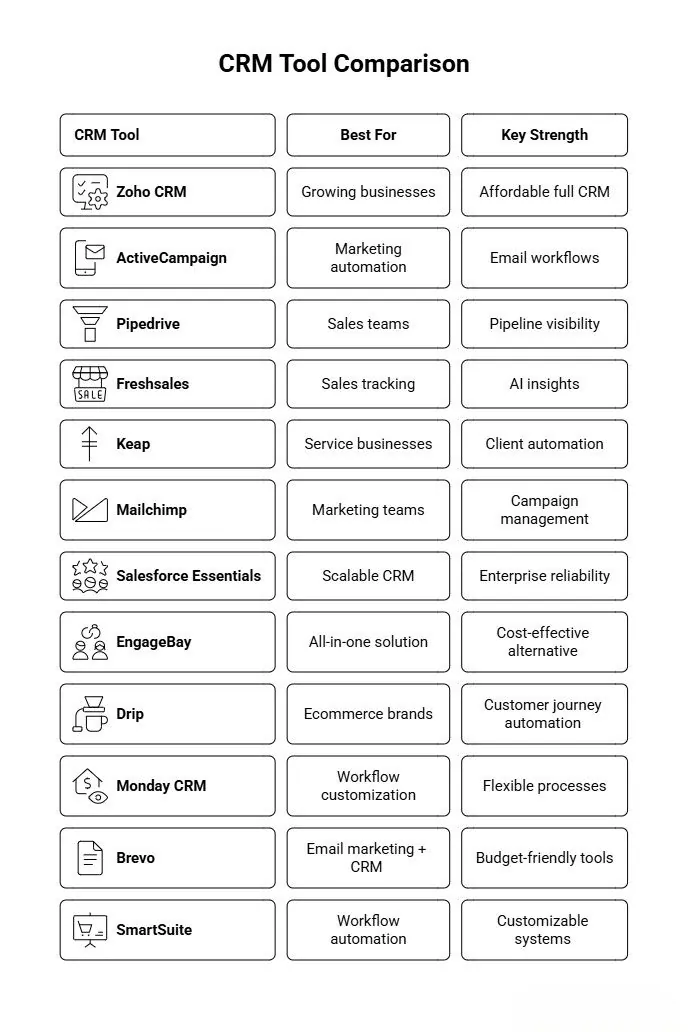
Quick Comparison Table
Choosing the Right CRM for Your Business
Choosing a HubSpot alternative is rarely about replacing one tool with another. It is usually about figuring out how your business actually manages leads, conversations, and customer relationships. Some teams need a simple sales pipeline they can glance at every morning. Others want marketing automation that quietly handles follow-ups while the team focuses on closing deals. The right CRM is the one that fits into your daily workflow rather than forcing you to redesign it.
And of course, CRM tools are only one part of the modern marketing stack. Businesses that evaluate CRM platforms often end up reviewing their SEO tools, analytics platforms, and automation systems at the same time. If you are exploring that broader ecosystem, Marketricka’s guide on best SEMrush alternatives looks at how businesses choose platforms for search analytics and marketing insights alongside their CRM and automation tools.