Best SEMrush Alternatives in 2026: Free, Paid & Similar Tools Compared
Looking for tools similar to Semrush? Explore the best Semrush alternatives, including free and paid options for SEO, PPC, backlinks, and audits.
 By Divyesh Savaliya
Looking for SEMrush alternatives that actually fit your budget and workflow? We tested and compared the best free and paid tools similar to SEMrush. Here's exactly which one fits your situation, and why.
Quick answer: The best SEMrush alternative depends on your goal. For a completely free setup - pair Google Search Console (your own site's real performance data) with Ubersuggest or Mangools (keyword research). For a full paid replacement - Ahrefs leads on backlink and competitor data, SpyFu is unmatched for spying on competitor PPC and organic keywords, and SE Ranking or Serpstat offer SEMrush-level features at a meaningfully lower price for agencies and startups.
SEMrush is one of the best-known names in SEO software, keyword research, site audits, backlink analysis, competitor tracking, and PPC data, all in one platform. But "well-known" and "right for your budget and workflow" aren't always the same thing.
At Divtechnosoft, we manage SEO for marketricka and client projects, which means we're constantly comparing SEO tools against real budgets and real deadlines, not just reading sheets. This guide reflects what we've actually used, what we'd recommend to a beginner, and what we'd recommend to an agency, broken down by outcome rather than feature count.
How We Evaluated These Tools
Rather than ranking tools by "number of features," we evaluated each one against four practical questions that come up constantly in our own SEO work and in conversations with other marketers:
Accuracy: Does the data match what we see in Google Search Console for our own sites?
Time to value: Can a non-technical team member get a useful answer (a keyword list, a content idea, a ranking issue) within minutes of logging in?
Cost vs. usage: Are you paying for modules you'll realistically never open?
Specialization fit: Does the tool do one job (e.g., backlinks, content ideas) exceptionally well, or is it a balanced generalist?
We also cross-checked our shortlist against what's already ranking for "semrush alternatives" and "tools similar to semrush," so this list reflects both our hands-on experience and the tools the wider SEO community consistently recommends.
Why People Search for Alternatives to SEMrush
Most people don't leave SEMrush because it's a bad tool, they leave because their needs and SEMrush's pricing structure stop matching up. A few patterns show up again and again:
Solo creators and freelancers sign up excited, then realize they're only using the keyword research and site audit tabs and paying full price for a suite they barely touch.
Agencies often need deeper backlink history, more projects per plan, or cleaner white-label reporting than their current tier allows.
Startups and small businesses are watching every dollar, and a $100+/month tool is hard to justify when the team is two people. (If you're at this stage, our go-to-market strategy guide for startups covers how to prioritize spend like this across your whole launch, not just SEO tools.)
Teams that want simplicity find SEMrush's interface with its dozens of reports and dashboards more overwhelming than helpful for day-to-day work.
If any of that sounds familiar, the goal isn't "more features." It's finding the tool that gets you the specific outcome you're chasing — more traffic, better rankings, faster client reporting, or clarity on what to write next without paying for everything else along the way.
Before you switch tools: Run a quick technical check on your own site first. If you have duplicate title tags, broken canonicals, or JavaScript-rendered pages that search engines can't read, no SEO tool — SEMrush or otherwise will fix that for you. Browse our SEO category for more insights.
Best Free SEMrush Alternatives
If your goal is real SEO data without adding another line item to your budget, these are the semrush free alternatives worth using and the specific outcome each one delivers.
1. Google Search Console — Best for Knowing Exactly How Your Site Performs
What it does: Shows the exact clicks, impressions, average position, and search queries bringing people to your site straight from Google.
The outcome you get: You stop guessing which pages are close to ranking on page one and start fixing the ones with high impressions but low clicks (a classic sign of a weak title tag). It also flags indexing problems before they quietly tank your traffic.
Best for: Every website owner. There's no reason not to have this connected, it's the only tool here with data straight from the search engine you're trying to rank in.
2. Ubersuggest — Best for Beginners Who Want Keyword Ideas Fast
What it does: Gives keyword ideas, search volume, SEO difficulty scores, and a look at which pages already rank for a given term.
The outcome you get: A content list of topics worth writing about, ranked roughly by how hard they'll be to compete for without needing to interpret ten different metrics first.
Best for: Bloggers, freelancers, and small business owners who need direction on "what to write next" more than deep competitive intelligence.
3. Mangools (Free Tier) — Best Beginner-Friendly Toolkit
What it does: Mangools bundles a keyword finder (KWFinder), SERP checker, and basic backlink analysis (LinkMiner) into one clean, simple interface, with a limited free plan.
The outcome you get: A gentler learning curve than most "all-in-one" tools, useful when you want keyword difficulty scores and SERP analysis without the dashboard overload SEMrush is known for.
Best for: First-time SEOs and small teams who find SEMrush's interface intimidating and want something that gets out of the way.
4. AnswerThePublic — Best for Finding What People Are Actually Asking
What it does: Instead of search volume, AnswerThePublic shows the actual questions, comparisons, and phrases people type around a keyword.
The outcome you get: A ready-made list of FAQ sections, blog angles, and "people also ask" style content ideas grounded in real search intent, the same kind of question-based structure that AI search engines tend to pull answers from. (We talk more about structuring content this way in how AI is shaping the future of content strategy.)
Best for: Content writers building blog outlines, FAQ pages, or video scripts who need topic ideas grounded in real queries.
5. Google Trends — Best for Timing Content Around Real Demand
What it does: Shows whether interest in a topic is rising, falling, or seasonal — direction, not exact volume.
The outcome you get: You avoid publishing a "best of 2024" style post in 2026, and instead time seasonal or trending content so it goes live when people are actually searching for it.
Best for: Content planners and marketers building editorial calendars around seasonal or emerging topics.
Best Paid Tools Similar to SEMrush
If free tools aren't cutting it anymore, usually because you're managing multiple sites, clients, or competitors, these are the most commonly recommended Semrush similar sites and serve as full or partial replacements depending on your priority.
1. Ahrefs — Best for Backlink Research and Competitor Analysis
What it does: Built around one of the largest backlink indexes in the industry, paired with keyword research that includes traffic potential, not just search volume.
The outcome you get: You can see exactly which links are driving competitors' rankings, find realistic link-building opportunities, and prioritize keywords that bring actual clicks rather than just looking good on paper.
Best for: Teams running outreach, digital PR, or competitive link-building campaigns where link data accuracy directly shapes strategy.
2. SpyFu — Best for Reverse-Engineering a Specific Competitor
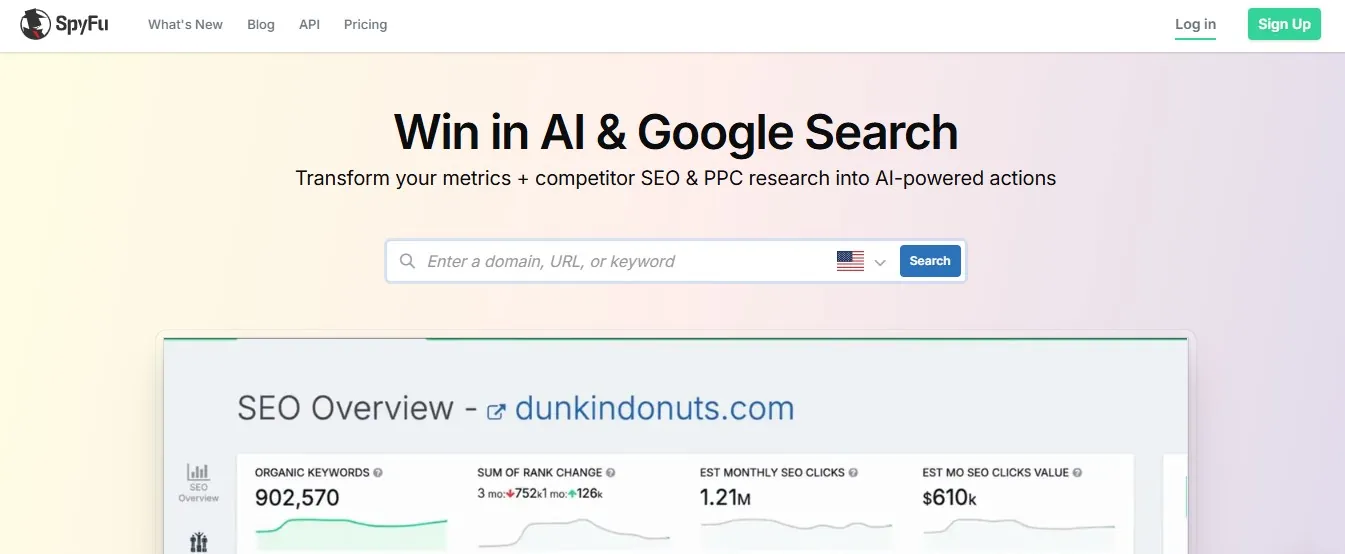
What it does: SpyFu specializes in showing you a competitor's entire SEO and PPC keyword history, what they rank for, what they bid on, and how their visibility has changed over time.
The outcome you get: Instead of broad market research, you get a focused download of "everything this one competitor is doing that's working," including their best-performing keywords and ad copy so you can shortcut your own keyword and content planning.
Best for: Marketers whose strategy is built around tracking and outranking 2–3 specific named competitors, especially where PPC and SEO overlap.
3. SE Ranking — Best Affordable All-in-One Alternative
What it does: Covers rank tracking, site audits, backlink monitoring, and competitor comparison at a price point noticeably below SEMrush's higher tiers.
The outcome you get: You keep nearly all the day-to-day functionality your team relies on (especially rank tracking and white-label client reports) while cutting your monthly SEO software cost significantly.
Best for: Agencies and growing teams that need reliable client reporting without paying agency-tier prices.
4. Serpstat — Best for Combined SEO + PPC Research on a Budget
What it does: Blends keyword research, site audits, backlink tracking, and PPC keyword analysis into one dashboard.
The outcome you get: Startups and lean marketing teams get a "good enough at everything" tool, useful when you don't want to juggle three separate subscriptions for SEO, PPC, and audits.
Best for: Startups and small marketing teams that need balanced coverage across SEO and paid search without premium pricing.
5. Moz Pro — Best for Clear Reporting and Easier Onboarding
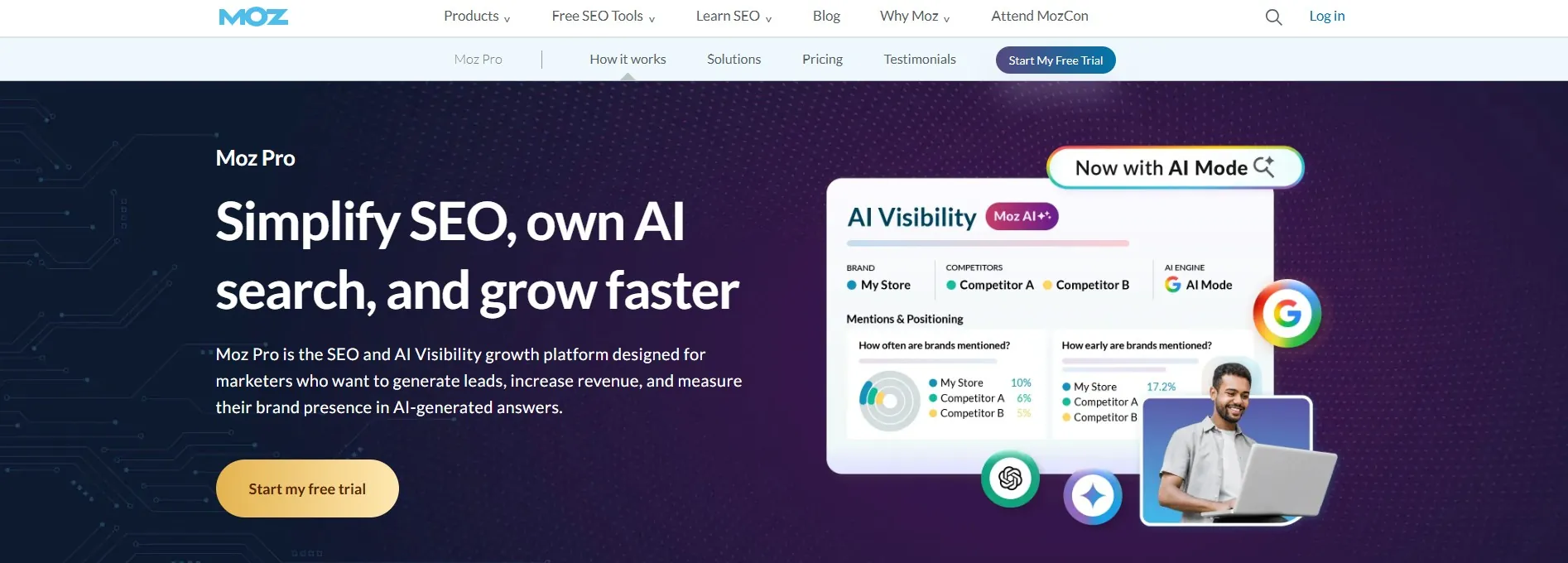
What it does: Offers keyword research, site audits, and on-page suggestions, built around its well-known Domain Authority metric.
The outcome you get: Reports that are easier to explain to non-technical stakeholders or clients are useful when half your job is translating SEO data into something a CEO will actually read.
Best for: Small to mid-sized businesses where simplicity and stakeholder-friendly reporting matter as much as raw data depth.
6. SimilarWeb — Best for Traffic Source & Market Research

What it does: SimilarWeb estimates a website's total traffic and breaks down where it comes from — search, social, referral, direct, or paid across the wider market, not just your direct competitors.
The outcome you get: A bird's-eye view of where your industry's traffic is actually coming from, which helps you decide whether to invest more in SEO, social, or partnerships, before you commit budget to any single channel.
Best for: Marketers and founders doing market research or competitive benchmarking before locking in a channel strategy.
7. Majestic — Best for Specialized Backlink and Trust Analysis
What it does: Focuses entirely on backlinks, using Trust Flow and Citation Flow metrics to assess link quality and history.
The outcome you get: A more granular view of link quality useful for vetting potential link partners, auditing toxic backlinks, or doing historical link research that general SEO suites don't go as deep on.
Best for: SEOs running link-focused campaigns where link quality assessment is the core task, not a side feature.
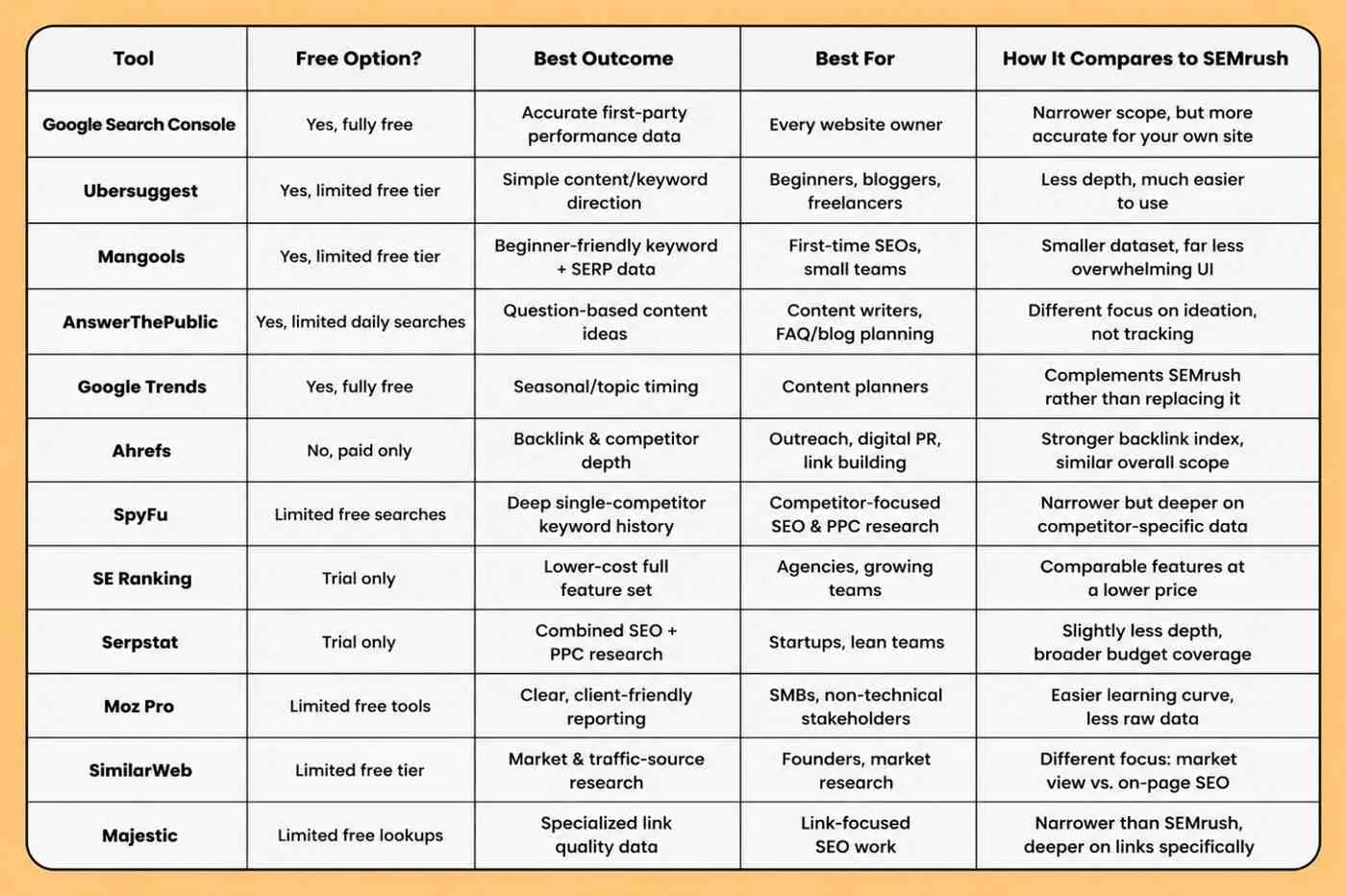
SEMrush Alternatives Comparison Table
How to Choose: Match the Tool to the Outcome You Need
Instead of picking the tool with the longest feature list, work backward from the result you're after:
"I want to know how my own site is performing in search" → Google Search Console (free, and arguably more accurate than any third-party tool for this specific job).
"I need topic and keyword ideas, and I'm just getting started" → Ubersuggest or Mangools, paired with AnswerThePublic for content angles — all free or near-free.
"I need to outrank competitors who have stronger backlink profiles" → Ahrefs, with Majestic as a deeper add-on if link quality is your main bottleneck.
"I want to know exactly what one specific competitor is doing" → SpyFu, for a direct breakdown of their keywords, ads, and visibility history.
"I manage SEO for multiple clients and need clean reports." → SE Ranking, for white-label reporting at a more manageable price.
"I'm a small team that wants one tool for SEO and PPC" → Serpstat, to avoid paying for three separate subscriptions.
"I need to explain SEO progress to non-SEO people" → Moz Pro, for its straightforward Domain Authority metric and cleaner dashboards.
"I'm deciding which marketing channel to invest in." → SimilarWeb, to see where your market's traffic actually comes from before committing budget.
One more thing worth saying clearly: switching tools won't fix problems that live on your website itself. If your pages have duplicate title tags, broken canonicals, or JavaScript-rendered content that search engines can't crawl, even the best alternative to SEMrush will just show you the same poor rankings on a different dashboard. Pair any new tool with a proper technical SEO check.
Final Thoughts
There's no single "best" alternative to SEMrush; there's only the best alternative for what you're trying to do. If you're just starting, the free combination of Google Search Console, Mangools, and AnswerThePublic will take you further than most people expect.
If you're scaling an agency or running competitive link-building campaigns, Ahrefs or SE Ranking is worth the investment. And if your whole strategy revolves around one or two named competitors, SpyFu deserves a serious look.
The real goal isn't switching tools for the sake of it, it's making sure whatever tool you use actually points you toward the keywords, content, and fixes that move your rankings. Start with the outcome you need, then pick the tool built for it.