
Community-Led Growth Strategy in 2026 Guide
Learn a community-led growth strategy for B2B in 2026. Build, grow, and turn your audience into a revenue engine.
 By Divyesh Savaliya
In 2026, the biggest challenge in B2B marketing is still getting new customers. Advertising costs keep increasing, organic reach is getting lower, and people trust company-created content less than before.
But some companies are still growing quickly while spending less on customer acquisition (CAC), keeping customers happier (higher NPS), and improving retention rates.
Their shared advantage? Community-led growth strategy.
Community-led growth means building a community of people who share similar goals, problems, or interests, and then turning that community into long-term business growth. It’s more than just running social media pages or online forums. It’s a smart business strategy where the community becomes a valuable asset that helps generate leads, sales, trust, and customer loyalty over time.
In 2026, community marketing has become one of the most effective growth strategies for B2B SaaS companies, professional service firms, and knowledge-based businesses.
This guide will help you understand what community-led growth is, why it works so well today, the data and benefits behind it, and a step-by-step process to build your own successful community strategy.
What Is Community-Led Growth and Why It Matters in 2026
Community-led growth (CLG) is a business growth strategy where a company builds and grows a community that helps attract new customers, engage users, keep existing customers loyal, and increase long-term business growth.
Instead of using only traditional marketing that pushes promotional messages to people, CLG focuses on creating a valuable community where people learn from each other, share experiences, solve problems together, and feel connected. This sense of trust, knowledge-sharing, and belonging naturally attracts more people to the brand and encourages them to stay engaged.
The Three Structural Shifts Driving CLG in 2026
1. Buyers Trust People More Than Brands
Today, most B2B buyers do a large part of their research before they ever talk to a sales team. They depend more on recommendations from other users, community discussions, reviews, and real experiences instead of company advertisements or marketing messages.
Because of this, communities have become one of the most trusted and powerful ways to influence buying decisions.
2. Paid Advertising Is Becoming More Expensive
The cost of running ads on platforms like Google and LinkedIn has increased a lot in recent years. This makes customer acquisition more expensive for many companies.
Businesses that built strong communities early now have an advantage because they can attract customers through their own audience and member network instead of depending only on paid ads. This helps them keep customer acquisition costs lower than those of competitors.
3. Keeping Customers Matters More Than Ever
In today’s crowded SaaS market, retaining customers is just as important as getting new ones. Even a small improvement in customer retention can make a huge difference in long-term business growth.
Community members are usually more engaged, loyal, and less likely to leave compared to regular customers. That’s why community-led growth is not only a strategy for getting new customers but also a powerful way to improve customer retention and long-term loyalty.
These changes have made community-led growth much more than just a marketing tactic. It has become a strong business growth model, especially when community, product, sales, and digital marketing strategies all work together.
Market Data & Key Statistics
The numbers behind B2B community marketing in 2026 are compelling. Here's the market context every growth leader needs to understand before investing in CLG.
McKinsey's research estimates that online communities generate over $1.1 trillion in global economic value annually, with B2B companies citing peer learning, co-creation, and referral generation as the three primary commercial mechanisms driving this figure. (McKinsey & Company)
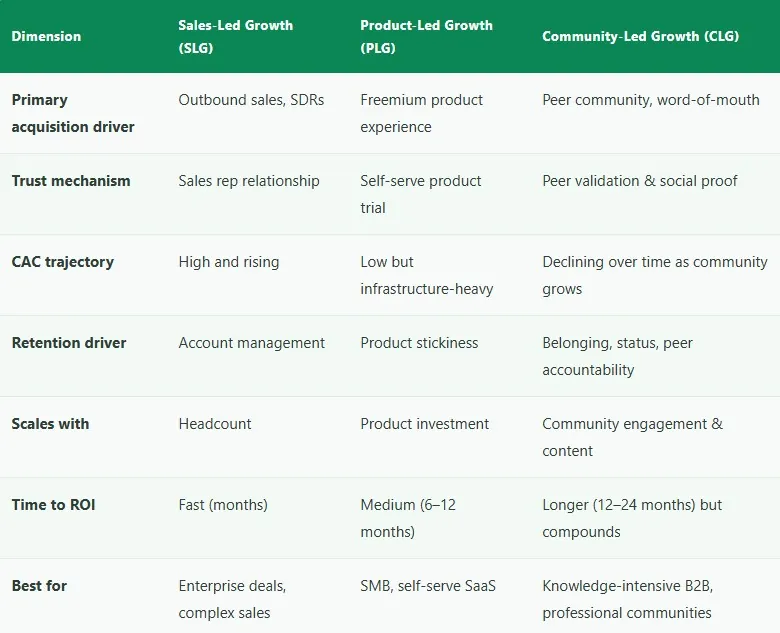
CLG vs. Product-Led Growth vs. Sales-Led Growth
Understanding where the community-led growth strategy sits relative to other B2B go-to-market motions is essential for positioning your investment correctly.
How to Build a B2B Community That Actually Grows
Most B2B communities fail because they focus too much on promoting the brand instead of helping the members.
Simply creating a Slack group or online space to share company updates does not build a real community. A successful community is one where people can connect, share knowledge, solve real problems together, and learn from each other while the brand acts as a trusted guide and supporter, not just a promoter.
Step 1: Define Your Community's Core Identity
Before choosing a platform or writing a single post, answer three questions: Who exactly is this community for? What shared challenge, aspiration, or identity unites them? Why would someone choose this community over the five alternatives that already exist?
The most successful B2B communities are built around a professional identity ("I am a RevOps leader") or a shared challenge ("I'm scaling a B2B SaaS from $1M to $10M ARR") — not around a product. Your product is the enabler; the community is built around what your ideal customer cares about most.
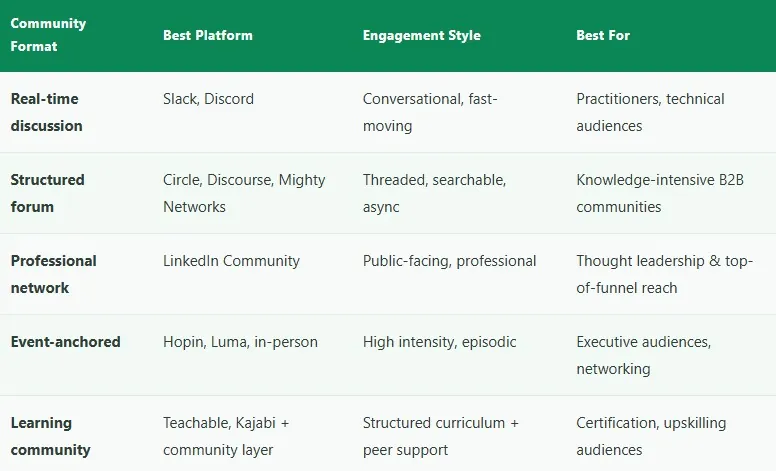
Step 2: Choose the Right Community Format
Step 3: Build Valuable Discussions Before Launching the Community
One of the biggest mistakes companies make when launching a community is opening it before there is any real activity or engagement.
Before making the community public, first invite 20–50 “founding members.” These can be your best customers, active users, industry experts, or trusted professionals who genuinely understand the space.
Start private discussions with them for a few weeks so the community already has useful conversations, insights, and engagement before new people join.
This way, when new members enter the community, they see an active and valuable space instead of an empty or inactive group.
These founding members also become your early supporters and advocates. Their involvement helps build trust, attract more members, and create momentum for the community from the beginning.
Step 4: Create a Regular and Consistent Content Plan
A community does not become active on its own from the beginning. It needs regular engagement and valuable content to keep members interested and involved.
You should consistently create activities like:
Discussion topics
Weekly questions or prompts
Member spotlights
Expert Q&A sessions (AMAs)
Exclusive content that members cannot find anywhere else
Before launching your community, prepare a 90-day content plan. Treat your community content with the same importance and planning as your overall content marketing strategy. This helps keep the community active, valuable, and engaging from the start.
Step 5: Identify and Support Your Most Active Community Members
In most communities, a small group of members creates the majority of the valuable conversations, content, and engagement. These highly active members are called community champions.
Find these members early by tracking who participates the most, helps others, shares useful insights, and keeps discussions active.
Once identified, invest in building strong relationships with them by offering benefits such as:
Early access to products or features
Opportunities to co-create content
Speaking opportunities at events or webinars
Ambassador or leadership programmes
When community champions feel valued and supported, they help grow and strengthen the community, naturally allowing your impact to grow without needing a larger team.
Metrics That Matter: Measuring Community ROI
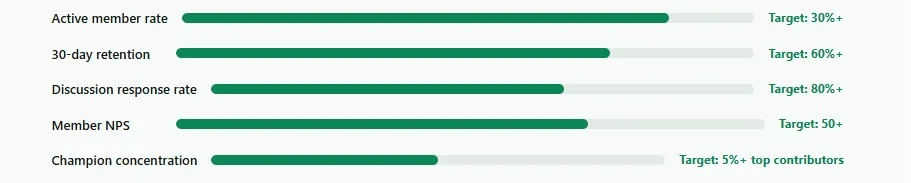
Measuring the ROI of a community-led growth strategy requires a layered approach — tracking health metrics, engagement metrics, and commercial metrics simultaneously. Here's the full measurement framework:
Community Health Metrics (Lagging Indicators)
Commercial Impact Metrics (Leading Indicators)
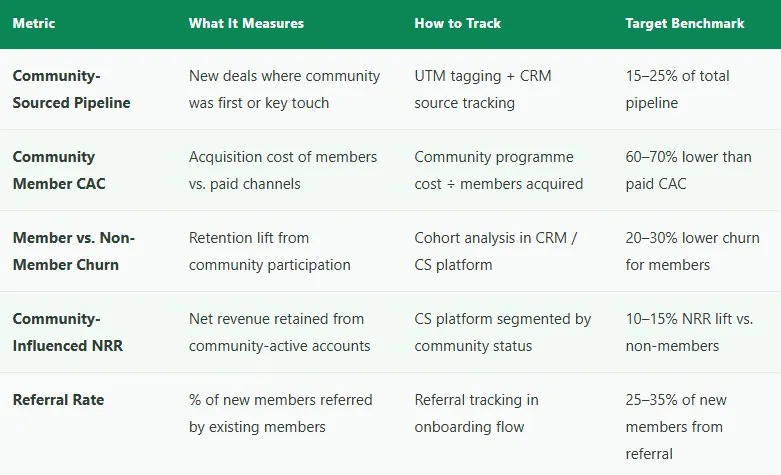
These metrics help connect your community efforts directly to business growth and revenue results. They show how the community contributes to customer acquisition, engagement, retention, and sales performance.
Including community data in your overall sales and growth reports helps businesses clearly see the value of the community. This makes it easier to justify budgets, gain leadership support, and give the community the recognition it deserves for driving business success.
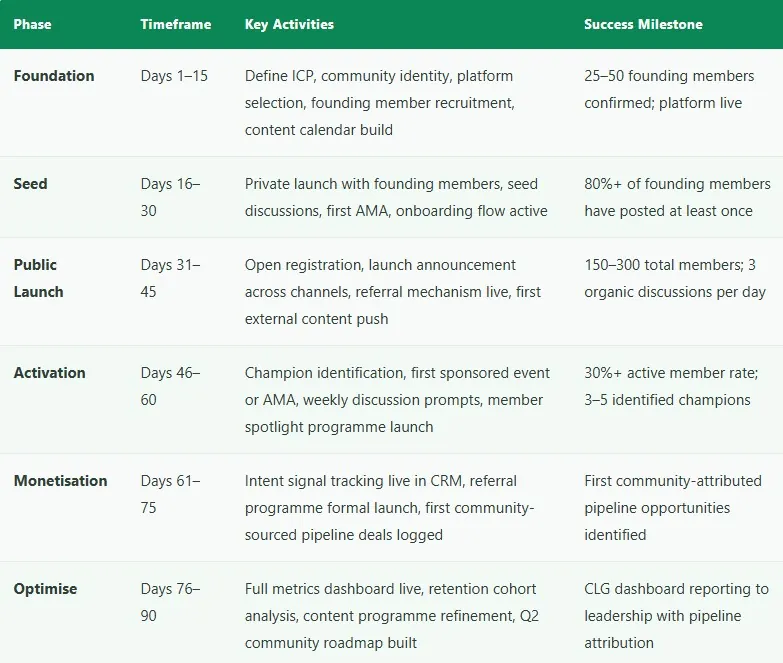
Your 90-Day CLG Launch Framework
A community-led growth strategy doesn't need a year of planning. Here's a proven 90-day framework to go from zero to a functioning, revenue-connected community:
Common Pitfalls and How to Avoid Them
1. Building a Community for Your Brand, Not Your Members
If your community is only used to share product updates, people will quickly lose interest and stop participating.
A successful community follows a simple balance of content:
About 80% should focus on members’ needs, such as discussions, learning, advice, and career growth
Around 20% can be about the brand, such as product updates, case studies, or company news
If you focus too much on self-promotion instead of helping members, the community will slowly become inactive and lose its value.
2. Underresourcing Community Management
A community needs a dedicated person to manage and guide it. Without a community manager, it often becomes inactive and loses direction.
Even a part-time, skilled community manager can do a much better job of building engagement and maintaining the right culture than depending only on automated or AI-based moderation.
When planning your budget, prioritise hiring or assigning a community manager before spending on tools or platforms. This is one of the most important investments because it directly affects how active, healthy, and valuable your community becomes.
3. Measuring Only Surface-Level Metrics
Just looking at the total member count can be misleading and doesn’t show the real value of a community. For example, a small community of 500 active and engaged professionals who contribute to $800K in business pipeline is far more valuable than a large community of 10,000 members who do not participate or generate any business impact.
Instead of only tracking sign-ups, focus on meaningful metrics like:
Active members who regularly engage
Revenue or pipeline generated from the community
Improvement in customer retention due to community involvement
These metrics give a clearer picture of how the community is actually contributing to business growth.
4. Treating Community as a Campaign, Not a Programme
Communities take time to grow and deliver results. A community started in the first quarter usually begins to show a strong business impact only by the third or fourth quarter.
If teams expect quick results within 90 days, they often give up too early—before the community has had enough time to build momentum.
Instead, it’s important to set the right expectations with leadership. Community growth should be viewed as a long-term investment over 12–18 months. However, you can still track early progress through monthly indicators like engagement, activity, and member participation.
5. Keeping the Community Separate from the Go-To-Market Strategy
One of the biggest mistakes in community-led growth is treating the community as a separate marketing activity, not connected to sales, product, or customer success teams.
In reality, a community provides very valuable insights, such as:
What customers are interested in (intent signals)
Who your most active and influential users are
What product features or improvements are people requesting
This information is useful for all parts of the business.
That’s why it’s important to connect community data with your CRM and make sure sales, product, and customer success teams work together with community insights from the beginning.
When this is done well, community-led growth becomes more than just a marketing effort — it turns into a powerful engine for overall business growth.
Conclusion
In 2026, the strongest advantage in B2B marketing is not better algorithms, bigger ad budgets, or a large content library. It has a strong and active community where people trust each other and also trust your brand because of the value it provides in their professional lives.
A well-executed community-led growth strategy keeps growing over time in a way that paid marketing channels cannot match. As more members join, the community becomes more valuable. More meaningful discussions attract even more people. And when members become customers, it proves the value of the community and helps fund further growth.
The 90-day plan, growth flywheel model, and revenue-focused approach in this guide give you a clear starting point. The key factor now is your commitment to building something that truly helps your community first, while allowing business growth to follow naturally.
If you want to build a strong community-led growth system, you can also explore other resources on SEO, content marketing, influencer marketing, and video marketing designed for B2B growth in 2026.
Explore easy-to-understand marketing guides on the Marketricka blogs that help you learn step-by-step strategies and use them in real projects.