
AI Influencer Marketing Strategy 2026 Guide
Explore AI influencer marketing in 2026—discovery, ROI tracking, automation, fraud detection, and data-driven campaign strategies.
 By Divyesh Savaliya
Influencer marketing has gone from an experimental budget line to a core revenue channel, and in 2026, it's undergoing its most significant structural shift yet. The era of manually browsing Instagram handles, negotiating over DMs, and guessing at ROI is over. What's replaced it is something far more precise, scalable, and data-driven: AI influencer marketing.
Artificial intelligence now handles the three most labour-intensive parts of the influencer workflow — finding the right creators, running campaigns efficiently, and proving return on investment with hard numbers. The result is a channel that can operate at enterprise scale without enterprise headcount.
This is your complete guide to influencer marketing strategy in 2026: the market context, the AI capabilities that matter, the tools to evaluate, and the strategic framework to build on. Whether you're running a lean in-house team or managing multiple brand accounts, this playbook will help you operate smarter.
Why Influencer Marketing Is Evolving Fast in 2026
Three forces are reshaping the influencer marketing landscape simultaneously, and understanding them is the foundation of any credible influencer marketing strategy for 2026.
1. Creator Economy Professionalization
The creator economy has professionalized. Influencers are no longer individual creators — many operate as media businesses with dedicated management, audience analytics, and multi-platform strategies. This means brands that approach influencer partnerships with outdated, transactional mindsets are left behind. Authentic, long-term brand-creator relationships now consistently outperform one-off sponsored posts in both reach and conversion. This aligns closely with the principles behind a strong content marketing strategy, where relationship depth drives content quality.
2. Audience Trust Challenges Are Increasing
Consumers in 2026 are acutely aware of paid promotions and quick to disengage from content that feels inauthentic. Platform transparency labels, disclosure requirements, and rising ad overload mean that creator-brand fit is no longer optional, it's the primary predictor of campaign performance. AI now plays a critical role in matching brands to creators whose organic content and audience values are genuinely aligned.
3. Attribution Pressure from the C-Suite
As influencer marketing budgets grow, brands are paying closer attention to results. Marketing teams now need to show how influencer campaigns directly help increase sales — not just likes, views, or engagement.
This has led to the rise of AI-powered influencer marketing tools that can track clicks, sales, and customer journeys more accurately. It also reflects a larger shift in digital marketing toward strategies that focus on real data and measurable results.
Market Data & Key Statistics
Before diving into tactics, here's the market context every strategist building an influencer marketing strategy in 2026 needs to know.
The influencer marketing platform market is forecast to grow at a CAGR of 33.4% through 2027, driven by demand for AI-powered creator discovery, analytics automation, and cross-platform campaign management. (Grand View Research)
Statista's benchmarking data shows the average ROI of influencer marketing across industries stands at $6.50 for every $1 invested, with beauty, fashion, and SaaS sectors reporting the highest returns — often exceeding $10 per dollar spent. (Statista)
AI-Driven Influencer Discovery & Selection
Manual influencer research — scrolling feeds, checking follower counts, guessing at audience fit is one of the most time-consuming and error-prone parts of influencer marketing. AI influencer marketing platforms have replaced this with systematic, data-driven discovery that surfaces better-fit creators in a fraction of the time.
Semantic Search & Audience Matching
Modern AI discovery engines go far beyond keyword searches. They use natural language processing to analyze thousands of posts and comments, building a semantic profile of each creator's content universe. Brands can describe their ideal creator in plain language — "female fitness creator, plant-based diet, 25–35 audience, UK-based" and the AI returns ranked matches scored on genuine content alignment, not just follower demographics.
Audience Quality Scoring
This is where AI separates genuine influence from inflated numbers. AI models analyze follower growth velocity, comment-to-like ratios, geographic follower distribution, and engagement authenticity to generate an audience quality score. Creators with artificially boosted follower counts are flagged automatically — protecting budgets from the influencer fraud that has historically cost brands billions.
Brand Safety & Sentiment Analysis
AI scans a creator's entire content history, not just recent posts, for brand safety signals. It flags potentially controversial past content, detects political or ideological positioning, and analyzes comment sentiment to identify creators whose communities may react negatively to commercial partnerships. This type of pre-screening is now a non-negotiable part of a responsible influencer marketing strategy, especially for regulated industries.
Lookalike Creator Discovery
Feed in your best-performing past collaborator, and AI tools identify dozens of structurally similar creators — same audience composition, content style, and engagement quality at various price points. This is especially powerful for brands scaling programmes across new markets or verticals, and it connects naturally to the audience expansion goals in a broader SEO and growth strategy.
Campaign Automation: Briefing to Publishing
Once creators are selected, the campaign execution workflow has traditionally been a manual, error-prone chain of emails, spreadsheets, and missed deadlines. AI campaign automation changes this end-to-end, and it's a key reason why AI influencer marketing platforms are growing at over 30% annually.
Automated Outreach & Contract Generation
AI-powered platforms handle initial creator outreach at scale — personalized messages based on the creator's content style, audience size, and category relevance. Accepted partnerships trigger automated contract generation with pre-populated rates, deliverable timelines, usage rights, and disclosure requirements. What used to take a week of back-and-forth now closes in 24–48 hours.
AI Brief Generation
Effective creative briefs are detailed, brand-specific, and customized to each creator's style. AI tools now generate these automatically by combining your campaign objectives, brand guidelines, product messaging, and the creator's content analysis. The output is a brief that gives creators everything they need without over-scripting their authentic voice — the balance that drives performance.
Content Review & Compliance Workflows
AI assists with content review by automatically checking submitted drafts against brand guidelines, disclosure requirements (FTC, ASA), and safety criteria before human approval. This dramatically reduces review cycles and ensures regulatory compliance at scale — critical for brands running simultaneous campaigns with dozens of creators across multiple markets.
Cross-Platform Scheduling & Publishing
Approved content is scheduled and published across platforms with AI-optimized timing — matching each creator's audience peak activity windows. This automation removes the coordination overhead from large-scale influencer programmes and integrates with the multi-platform distribution principles covered in our video marketing strategy guide.
ROI Tracking & Attribution in 2026
This is the section that wins over CFOs. The number one reason influencer budgets stalled in previous years was the inability to tie spend to revenue. That problem is now largely solved, and proving it is central to a credible influencer marketing strategy for 2026.
Multi-Touch Attribution Models
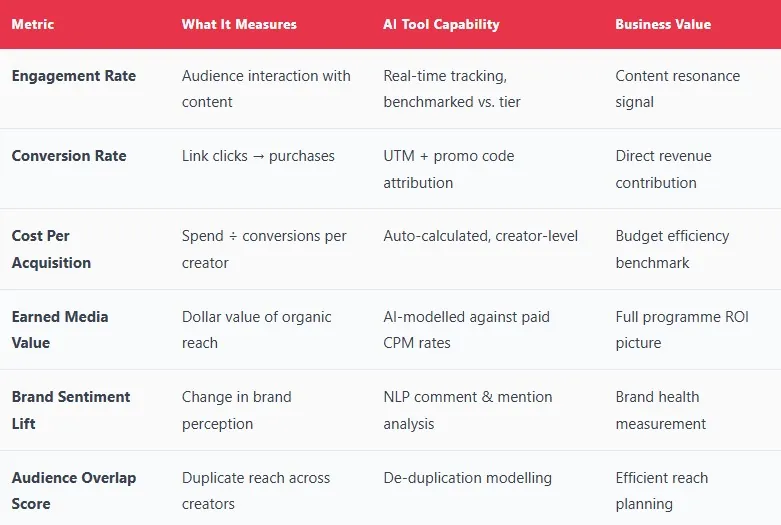
AI attribution platforms track the full customer journey from first influencer content exposure through multiple touchpoints to final conversion. Rather than crediting the last click, data-driven attribution distributes conversion credit proportionally across every influencer and channel that contributed. This gives marketers a far more accurate picture of which creators and content types are genuinely driving revenue.
Unique Tracking Links & Promo Codes
Every creator in your programme should have unique UTM-tagged links and personalized promo codes. AI platforms aggregate this data automatically, giving you creator-level revenue attribution in real time. This connects influencer performance directly to the sales metrics your leadership team tracks — critical for justifying and scaling budgets. It's a reporting capability that sits at the heart of any data-backed sales growth strategy.
Earned Media Value (EMV) Calculation
AI platforms now automatically calculate the earned media value of every piece of influencer content — assigning a dollar value to organic reach, shares, saves, and brand mentions that would otherwise be invisible in paid media terms. This makes it possible to report the full economic contribution of your influencer programme, beyond direct conversion.
Real-Time Performance Dashboards
Rather than waiting for campaign end-reports, AI dashboards surface performance signals in real time — flagging underperforming creators early enough to reallocate budget, identifying content formats that are over-indexing, and predicting final campaign outcomes based on early data trajectories.
Building Your Influencer Marketing Strategy for 2026
With the data, AI capabilities, and tools understood, here's the strategic framework for building a high-performance influencer marketing strategy in 2026:
Phase 1: Define Objectives and KPIs
Map each campaign objective to a specific, measurable KPI before engaging any creator. Awareness campaigns are measured by reach, impressions, and brand lift. Conversion campaigns live or die by CPA, ROAS, and revenue attribution. Without this clarity upfront, optimization is impossible, and budget justification becomes guesswork.
Phase 2: Build Your Creator Tier Portfolio
Use AI discovery tools to build a portfolio across tiers, not a single mega-deal. For most brands, the highest-ROI configuration is a micro-heavy portfolio (60–70% of creators) with selective macro activation for reach peaks. Use audience overlap scoring to ensure your portfolio reaches distinct audience clusters, not the same people repeatedly.
Phase 3: Establish a Consistent Brand-Creator Fit Scorecard
Define your non-negotiable fit criteria: content category alignment, audience demographics, engagement quality, brand safety score, and past campaign performance. Run every creator through this scorecard before outreach. This standardizes decision-making and removes selection bias from the programme.
Phase 4: Build the Automation Infrastructure
Set up your campaign management platform, outreach templates, brief generator, compliance workflow, tracking links, and performance dashboard before campaigns launch. Retrofitting attribution after the fact is one of the most common and costly mistakes in influencer marketing. Embedding this infrastructure connects your influencer programme to the full-funnel tracking architecture outlined in our digital marketing frameworks resource.
Phase 5: Run, Measure, and Iterate
Launch with a test cohort before scaling. Measure at the creator level, not just the campaign level, to identify your highest-performing creator profiles. Use those insights to inform your next discovery cycle. Over time, this builds a proprietary performance model for your brand, compounding returns with each campaign iteration.
Objectives and KPIs are defined before creator outreach begins.
AI-powered discovery and audience authenticity scoring are in place
Tiered creator portfolio (nano/micro/macro) mapped to campaign goals
Automated outreach, contracts, and briefing workflow configured
Unique tracking links and promo codes assigned to every creator
The real-time performance dashboard is live before the campaign goes live
Post-campaign creator performance is scored and fed back into the discovery model
Pitfalls to Avoid in 2026
1. Chasing Follower Counts Over Audience Quality
A creator with 500K followers and a 0.8% engagement rate will almost always underperform a creator with 80K followers and a 5.2% engagement rate. AI audience quality scoring exists precisely to surface this — use it consistently and resist the temptation of vanity metrics.
2. Over-Scripting Creator Content
Authenticity is your unfair advantage in influencer marketing. Over-scripted content reads as advertising, triggers skip behaviour, and destroys the trust relationship between creator and audience. Brief creators on outcomes and key messages, then trust their voice. AI brief tools are designed to walk this line — use their output as a starting point, not a final script.
3. Ignoring Disclosure and Compliance Requirements
Regulatory requirements for sponsored content disclosure are tightening globally — the FTC in the US, ASA in the UK, and equivalent bodies across the EU. Non-compliance creates legal and reputational risk. AI compliance tools can auto-check submitted content for proper disclosure language before it goes live. Make this a mandatory workflow step, not an afterthought.
4. Running Influencer as an Isolated Channel
Influencer content that reinforces your SEO keywords, mirrors your email campaign messaging, and is amplified via paid social performs dramatically better than standalone activations. Integrating influencers into your holistic content marketing ecosystem is what separates mature programmes from scattered spend.
Conclusion
Influencer marketing in 2026 is not the same channel it was three years ago. It is faster, more accountable, more data-driven, and when AI is embedded throughout the workflow, significantly more scalable. Brands that treat it as a performance channel, governed by the same data discipline as paid search or email, are seeing returns that justify aggressive investment.
The influencer marketing strategy for 2026 that wins is built on three AI-powered pillars: discovery that finds genuinely aligned creators at scale, automation that runs campaigns without the operational drag, and attribution that connects every post to measurable business outcomes.
Start with your objectives. Build your creator portfolio intelligently. Automate the execution. And measure everything. That is the AI influencer marketing playbook for 2026, and it's available to any team willing to build it.
Want More Strategy Guides Like This? Explore our full library of AI-powered marketing frameworks, tool comparisons, and channel playbooks — built for growth teams operating at speed in 2026.