
Video Marketing Strategy 2026: How AI Creates, Distributes, and Optimises Video at Scale
Discover how AI creates, distributes, and optimizes video marketing strategies at scale for better growth in 2026.
 By Divyesh Savaliya
Video has always been a powerful medium. But in 2026, video marketing strategy looks fundamentally different from even two years ago because artificial intelligence has quietly taken over three of its most time-intensive pillars: creation, distribution, and optimization.
AI video marketing tools can generate scripts, produce footage, personalize content for dozens of audience segments, push it to the right channels at the right time, and continuously test performance, all with minimal human intervention.
This guide is your comprehensive video marketing strategy 2026 playbook. Whether you're a brand manager, digital marketer, or growth lead, it covers how AI helps you produce content faster and how to build a video strategy that truly connects to revenue.
Why 2026 Is the Inflection Point for Video
The video marketing landscape didn't just evolve, it compounded. Every major platform doubled down on video, consumer attention shifted irrevocably toward short-form and interactive content, and the cost of AI-assisted production collapsed. The result? A window of competitive advantage for brands bold enough to build a proper video marketing strategy in 2026 and a slow death for those still depending on ad-hoc video production.
Three macro-forces are driving this shift:
AI democratization: Generative AI tools have made broadcast-quality video accessible to teams of any size, removing the cost barrier that once reserved video at scale for enterprise brands.
Platform algorithm pressure: Every major platform — from LinkedIn to Instagram to YouTube — now explicitly privileges video content in organic reach, making video a non-negotiable part of any digital marketing framework.
Consumer preference shift: Audiences in 2026 expect personalized, native-format video. Static ads and text-heavy content are experiencing measurable engagement decline across verticals.
Understanding these forces is the first step. The second is building a strategy that systematically leverages AI, and that's exactly what we'll break down.
Market Data & Insights You Need to Know
Before you build a strategy, ground it in numbers. Here are the key statistics shaping AI video marketing tools and the broader video marketing landscape.
The global video streaming market is projected to grow at a CAGR of 21.5% through 2030, driven primarily by AI-powered personalization and short-form content formats. (Grand View Research)
McKinsey's 2024 research found that companies embedding AI into marketing workflows — including video production — reported a 15–40% reduction in content creation costs and significantly faster time-to-market. (McKinsey & Company)
Global digital video ad spending is forecast to surpass $200 billion in 2026, with programmatic video — largely powered by AI — representing over 65% of total video ad spend. (Statista)
How AI Creates Marketing Videos Faster Without Losing Brand Quality
Wyzowl's 2026 report found that 63% of video marketers have already used AI tools to help create or edit marketing videos — up sharply from the previous year. The adoption reflects real operational change, not experimentation.
What AI video tools actually do well?
Script generation from a brief
AI takes a structured brief — audience, goal, key messages, CTA, and generates a video script in minutes. A human still needs to review and edit for brand voice, but the blank-page problem is eliminated. This is where most teams see the biggest time saving.
AI avatar and voiceover
For tutorial content, internal communications, and product walkthroughs, AI avatars and text-to-speech voiceovers allow teams to produce videos without camera time or studio booking. The output quality for informational content is now professional-grade for most use cases
Clip repurposing from long-form
AI tools analyze a long video — a webinar recording, a customer interview, a conference keynote, and automatically identify the most engaging moments, extract clips, add captions, and resize for each platform format. One piece of long-form video becomes 8–12 short-form assets without manual editing
Auto-captioning and translation
AI captions every video accurately in minutes and translates into multiple languages automatically. This is not just accessibility compliance — captions increase watch time by 12% and are required for social video to perform in silent-scroll environments
Dynamic video personalization
AI assembles personalized video versions for different audience segments — different opening hooks, different case study references, different CTAs automatically at scale. This is the video equivalent of what we cover in Hyper-Personalization at Scale
What AI doesn't replace: the creative brief, the strategic narrative, the brand judgment. AI compresses production. It does not replace the thinking that makes content worth producing.
How AI Distributes Video Smarter
Creating the video is half the battle. Getting it to the right audience, on the right platform, at the right moment, that's where distribution intelligence separates good campaigns from great ones. This is where AI video marketing tools deliver their second major advantage.
1. Predictive Audience Targeting
AI-powered ad platforms now predict which audience segments are most likely to convert before a campaign even launches by modelling historical engagement data, lookalike audiences, and intent signals. This means your video budget is front-loaded toward high-probability viewers rather than spread thin.
2. Cross-Platform Formatting Automation
A single source video can be automatically reformatted for 16:9 (YouTube), 9:16 (Reels, TikTok), 1:1 (Instagram feed), and 4:5 (LinkedIn) with intelligent reframing that keeps the focal subject centred. This removes a major limitation in multi-platform video publishing, and it integrates naturally into any SEO and content distribution strategy that spans organic and paid channels.
3. Optimal Timing & Frequency Modelling
AI analyses your audience's platform usage patterns and predicts the optimal publish windows for maximum organic reach and paid efficiency. It also calculates frequency caps to avoid creative fatigue — one of the most common and costly mistakes in video campaign management.
4. Programmatic Video Placement
Programmatic AI systems now handle real-time bidding for video ad placements with millisecond precision. They factor in contextual relevance, viewer intent signals, device type, and competitive auction dynamics to maximize view-through rates and minimize wasted spend. This should sit at the core of any performance-driven digital marketing framework.
AI distribution tools also handle channel-specific optimization: selecting optimal publish times per platform based on audience engagement data, generating platform-native captions and thumbnails, and auto-scheduling across your content calendar. What used to require a social media manager's full attention for a week runs automatically after the initial setup.
Video distribution as part of a paid media strategy is particularly powerful when connected to your programmatic advertising and AI retargeting infrastructure.
How to Optimize Video Performance with AI — Beyond Just View Count
Views are a vanity metric. They tell you how many people started watching. They tell you nothing about whether the video is working. Here is the measurement framework that actually connects video to marketing and sales outcomes.
The metrics that matter by video type
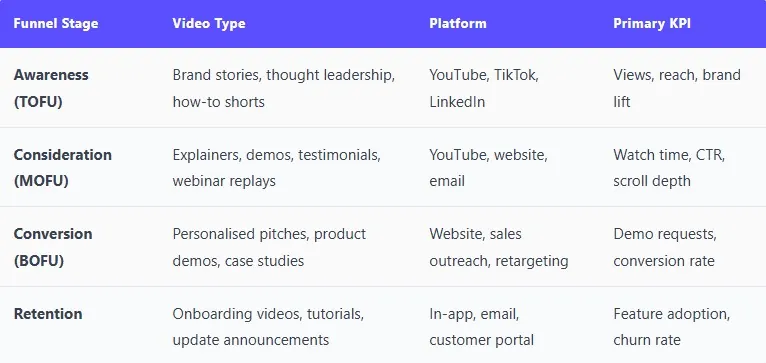
Awareness video: Watch rate (what % complete the video), brand recall lift (surveyed), follower/subscriber growth rate, and organic reach. Not total views.
Consideration video: Engagement rate, average watch percentage, click-through rate on CTA, demo, or contact page visits from video referrers
Decision video (demos, testimonials): Conversion rate on the page where the video lives, time-on-page with and without video, assisted pipeline from viewers who later became leads
Sales sequence video: Open rate of emails containing video, reply rate, meeting book rate — comparing video vs non-video versions of the same sequence
How AI optimizes video performance in real time
1. Real-Time A/B and Multivariate Testing
AI can simultaneously test dozens of video variants — different hooks, thumbnails, copy overlays, CTAs, and automatically shift budget toward the highest-performing combinations within hours of launch. Traditional A/B testing takes weeks. AI-driven multivariate testing is an ongoing, self-correcting loop.
2. Emotion & Attention Analytics
Advanced video intelligence tools now analyze viewer attention retention frame-by-frame, detecting exactly where engagement drops, where viewers replay, and which emotional moments correlate with downstream conversion. This data feeds directly back into the creative briefing for the next iteration.
3. SEO Optimization for Video
AI tools auto-generate transcriptions, closed captions, titles, descriptions, and tags optimized for both platform-native search (YouTube SEO) and Google's video search index. This closes the loop between your video marketing strategy and your overall SEO strategy, ensuring video content contributes to organic search visibility, not just paid reach.
4. Predictive Performance Scoring
Before you spend money on distribution, AI models can score a new video's predicted performance based on patterns from your historical campaigns and platform insights. This de-risks creative decisions and helps allocate production investment more intelligently — a key lever for driving sales growth through marketing.
Building Your Video Marketing Strategy for 2026
Data and tools are only useful if they're woven into a coherent strategy. Here's a step-by-step framework for building a robust video marketing strategy in 2026:
Step 1: Define Your Video Goals and KPIs
Before touching a tool, clarify what success looks like. Video can serve multiple objectives — awareness, engagement, lead generation, conversion, retention, and each demands different formats, platforms, and metrics. Tie your KPIs to business outcomes, not vanity metrics.
Step 2: Map Video to the Full Funnel
Step 3: Build an AI-Powered Production Workflow
Use AI to generate script drafts from your content briefs
Record a master version, then use AI to create platform-optimized variants
Auto-generate captions, SEO metadata, and thumbnails
Plug into a DAM (Digital Asset Management) system to maintain brand consistency
Step 4: Integrate Video into Your SEO and Content Strategy
Every video asset should connect to your written content marketing programme — embedded in blogs, linked from pillar pages, transcribed for indexability, and mapped to target keywords. This integration multiplies the organic reach of both channels and creates a stronger topical authority signal for search engines.
Step 5: Build a Continuous Testing Loop
Set up a systematic test-learn-optimize cycle: launch video variants, measure performance weekly, feed insights back into the next creative brief. AI tools handle the mechanical testing; your team focuses on interpreting the signals and making strategic calls.
Common Challenges & How to Overcome Them
1. Brand Consistency at Scale
When AI generates hundreds of video variants, maintaining visual and tonal brand consistency is non-trivial.
Solution: Invest in a locked brand kit within your AI tools (colour palette, font, logo placement, tone guidelines) before scaling production.
2. AI-Generated Content Feeling Generic
AI output is only as distinctive as your inputs. Generic prompts produce generic content
Solution: Train your AI tools with brand-specific examples, proprietary insights, and a clear point-of-view. Human creative direction remains essential.
3. Attribution Complexity
Measuring a video's true contribution to revenue across a multi-touch funnel is difficult.
Solution: Implement UTM tracking on all video assets, integrate video platforms with your CRM, and use data-driven attribution models rather than last-click. This is foundational to any serious sales growth strategy.
4. Tool Fragmentation
The AI video tool market is crowded and fragmented. Running five different platforms creates workflow inefficiency.
Solution:Build around 2–3 core platforms that cover creation, distribution, and analytics — and ensure they integrate with your existing martech stack.
Conclusion
The brands winning at video marketing in 2026 are not necessarily those with the biggest budgets or the largest teams. They're the ones who've built intelligent, AI-powered systems that create video faster, distribute it smarter, and optimize it relentlessly.
A well-executed video marketing strategy for 2026 is no longer optional, it's the central pillar of any competitive digital presence. And AI video marketing tools are the infrastructure that makes that strategy executable at scale, without sacrificing quality or consistency.
The framework is clear: start with your funnel goals, build an AI-assisted production workflow, integrate video with your SEO and content strategy, and run a continuous test-optimize loop.
The question isn't whether to invest in AI-driven video. The question is how fast you can build the capability before your competitors do.
