
Webinar Marketing Strategy for B2B Growth 2026
Learn how AI-powered webinar marketing in 2026 helps B2B brands increase attendance, engagement, and lead conversions.
 By Divyesh Savaliya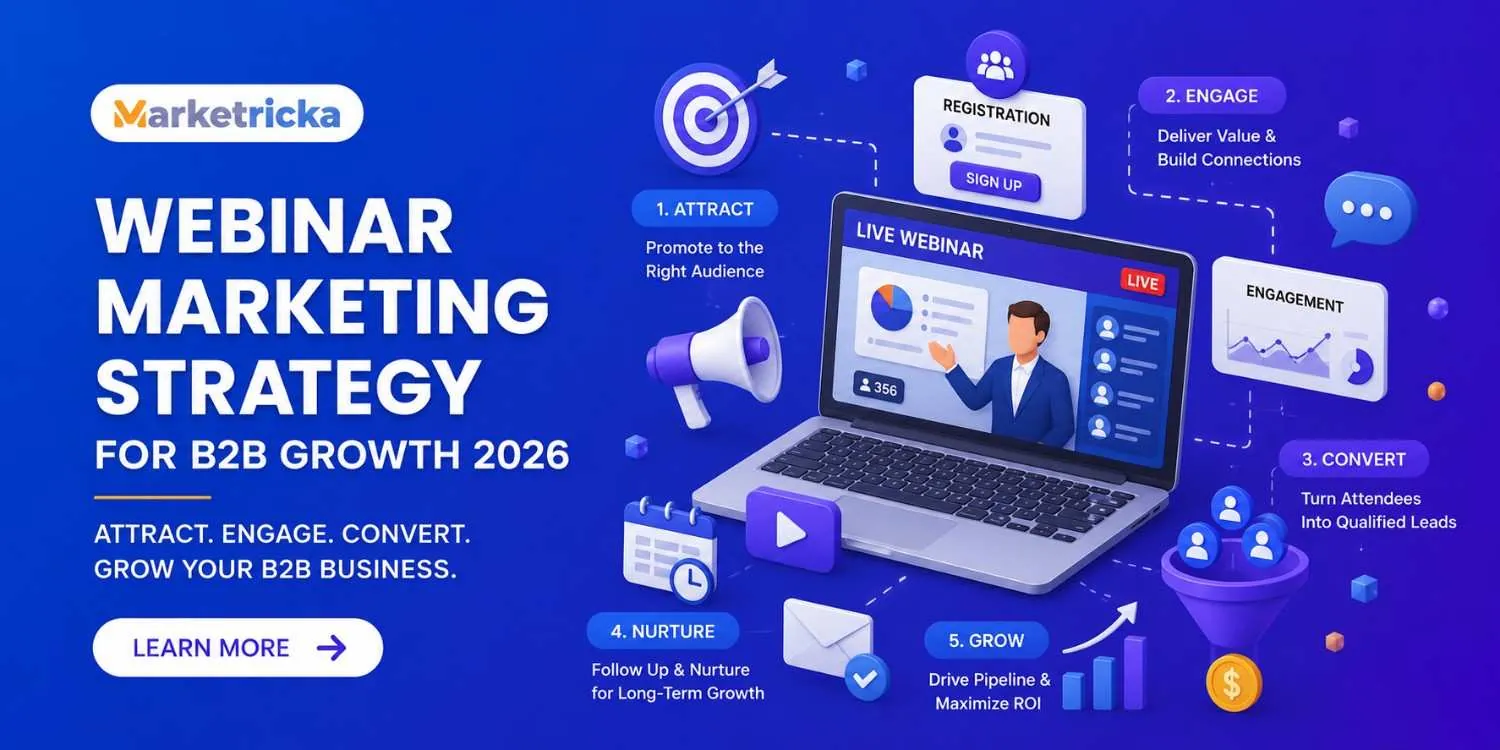
There is a content format that generates leads at $72 per lead — 2.7x cheaper than trade shows and nearly half the cost of LinkedIn Ads. It converts 20–40% of attendees into qualified pipeline opportunities. It keeps audiences engaged for an average of 51 minutes. And 97% of senior B2B marketers rate it as "critical" or "very important" to their pipeline generation strategy in 2026.
That format is the webinar, and if your team is not using it as a core B2B webinar lead generation engine, you are leaving one of the highest-ROI channels in B2B marketing ignored.
The numbers make the case clearly. Over 60 million webinars are expected to be hosted globally in 2026. The webinar and virtual event platform market has reached $4.4 billion in 2025 and is growing at a 12.68% CAGR, with the broader market projected to reach $134.2 billion by 2032 — driven by AI integration, hybrid event adoption, and the compounding content value that modern webinar programs generate. 91% of B2B professionals say webinars are their preferred type of content, and 52% of marketers rank webinars among their top three performing marketing channels.
But the gap between average webinar programs and elite ones is enormous and in 2026, AI is the primary differentiator. This guide gives you the complete webinar marketing strategy for 2026: how to fill seats, drive live attendance, convert attendees into pipeline, and use AI to automate the parts that most teams do manually.
Why Webinars Are B2B's Highest-Converting Lead Channel in 2026
Before building a strategy, the performance case deserves its own clear statement because most teams underestimate how decisive the webinar advantage is relative to other lead generation channels.
73% of B2B marketers and sales leaders believe webinars are the best way to generate high-quality leads, outperforming paid search, content syndication, social advertising, and most other channels. 52% of marketers say the quality of leads from webinars is "above average" or "excellent". And the conversion data confirms it: between 20% and 40% of webinar attendees convert into qualified pipeline opportunities, and 73% of B2B webinar attendees become leads, compared to 20–40% for B2C contexts (DemandSage Webinar Statistics 2026).
The structural reason webinars outperform is self-selection. A prospect who registers for a 60-minute educational session on a business problem, shows up live, and participates in Q&A has demonstrated a level of intent and engagement that no form fill or ad click can match. 54% of B2B professionals attend or engage with a webinar on a weekly or even daily basis — making it one of the most consistently consumed content formats in professional life.
The downstream conversion data is equally compelling. 62% of webinar attendees request a product demo post-event, and 89% visit the host's website after a webinar, with 83% sharing the content with colleagues (Amra and Elma Webinar Marketing Statistics 2026). That last statistic is particularly significant for B2B pipeline building: webinar content regularly reaches buying committee members beyond your original registrant list, expanding your account-level influence without any additional marketing spend.
Webinar-generated leads also move through the funnel 22% faster than leads from other channels — directly improving the Sales Pipeline Velocity that your revenue team depends on for predictable forecasting. Faster-moving leads at lower CPL with higher conversion rates: that is the webinar advantage, and in 2026, AI is making it compound even further.
The AI Transformation of Webinar Marketing
The most significant shift in webinar marketing strategy 2026 is not a new platform feature or a content format change. It is the integration of AI across every stage of the webinar lifecycle, from promotion and registration to in-event engagement and post-event conversion.
Here is what AI is actually changing at each stage of the webinar funnel:
1. Pre-event (Promotion and Registration)
AI-powered pre-event reminder sequences that combine personalized email and SMS touchpoints are pushing registrant-to-attendee conversion rates from the industry-average 56% to as high as 71% — a 27% lift over baseline, according to a Demand Gen Report benchmark study of 1,400+ B2B webinar programs. AI also identifies which registrant segments are most likely to attend live based on historical behavioral data, allowing teams to concentrate their pre-event nurture on the accounts that matter most.
2. During the event
AI real-time transcription, Q&A clustering, and sentiment analysis reduce the cognitive load on hosts and give live moderators structured visibility into what topics are generating the most engagement. Instead of scanning a chaotic chat feed, AI surfaces the questions that most deserve a response — improving the live experience for every attendee.
3. Post-event (Conversion and Nurture)
This is where AI delivers the most dramatic performance lift. Webinar attendees who received a personalized post-event email sequence of 4+ touchpoints within 14 days converted to paying customers at 17.4% — nearly double the 9.1% conversion rate seen when only a single follow-up was sent, per Gartner's 2026 B2B Digital Buying Behavior Survey of 3,100 respondents. AI-powered post-event systems auto-generate these sequences, segment attendees by engagement depth (who asked questions, who attended the full session, who dropped off before the CTA), and route high-intent accounts directly to sales with context that makes the conversation immediately relevant.
This AI-powered nurture layer is the direct connection between your webinar program and your Marketing Automation ROI strategy. The automation that triggers personalized sequences based on attendee behavior and routes high-engagement accounts to your CRM with enriched engagement data is the engine that turns a live event into a multi-week pipeline driver.
The 5-Part Webinar Marketing Playbook for 2026
Webinars are no longer just virtual events. In 2026, they are one of the highest-performing channels for generating qualified B2B leads, improving engagement, and building a long-term pipeline.
To get consistent results, businesses need a structured webinar marketing strategy — from registration to post-event nurturing.
1. Optimize Registration to Fill Your Funnel
A successful webinar starts long before the live session begins. Your registration page and promotion strategy directly impact attendance and lead quality.
What Works Best
Choose Specific Topics: Narrow, outcome-focused webinar titles attract more qualified attendees.
Example: Instead of: “Customer Success Best Practices”
Use: “How to Reduce B2B SaaS Churn by 30% in 90 Days.”
Specificity creates stronger intent and improves conversion rates.
Promote Across Multiple Channels
The highest-performing webinar campaigns use:
Email marketing
Social media promotion
Event landing pages
Community groups
Retargeting campaigns
Start promotion at least 3–4 weeks before the event and continue reminders until the webinar starts.
Schedule at the Right Time
The best-performing webinar slots are:
Tuesday to Thursday
10 AM – 11 AM (local attendee time)
Morning webinars consistently achieve higher attendance rates compared to evening sessions.
Use a 60-Minute Format
A 60-minute webinar generally attracts more registrations because it signals depth and value.
Recommended structure:
40 minutes of educational content
15 minutes Q&A
5 minutes CTA or closing
2. Increase Live Attendance with Reminder Sequences
Many registrants fail to attend simply because they forget.
A strong reminder sequence can significantly improve attendance rates.
Recommended Reminder Flow
Send:
Confirmation email immediately after registration
Reminder 1 day before the webinar
Reminder 1 hour before
Final reminder 5–10 minutes before going live
Include Calendar Invites
Always add:
Google Calendar link
Outlook calendar link
ICS file
This keeps your webinar visible in the attendees’ schedules.
Personalize Reminder Messaging
Modern webinar campaigns use AI-driven personalization based on:
Industry
Job title
User interests
Pain points
Instead of generic reminders, reference the exact problem the attendee wants to solve.
3. Design for Engagement, Not Just Attendance
Attendance alone does not generate a pipeline. Engagement does.
Attendees who interact during webinars are significantly more likely to become qualified leads.
High-Engagement Webinar Elements
Live Polls
Use polls throughout the webinar to:
Maintain attention
Gather audience insights
Segment leads for follow-up campaigns
Interactive Q&A
Encourage questions during the session.
Modern webinar platforms now use AI to:
Group similar questions
Prioritize common topics
Help presenters answer the most relevant concerns
Educational-First Content Structure
Avoid turning the webinar into a sales pitch.
Use this structure:
70% education
20% case studies and proof
10% CTA or product mention
Educational webinars build trust and improve long-term conversion rates.
4. Convert Webinar Attendees into Pipeline
The webinar itself is only the beginning. Most conversion opportunities happen after the event.
Build a Strong Post-Webinar Follow-Up System
Segment Attendees by Engagement
High-Intent Attendees
People who:
Attended most of the sessions
Asked questions
Participated in polls
These leads should receive direct sales outreach within 24 hours.
Medium-Intent Attendees
People who:
Watched part of the webinar
Showed moderate engagement
Add them to nurture campaigns with additional educational content.
No-Shows
Send:
Webinar replay
Key takeaways
Additional resources
Many users prefer watching recordings later.
Use Multi-Touch Follow-Up Campaigns
Instead of one email, create a 4+ touchpoint sequence over 14 days.
Include:
Replay links
Case studies
Related blog posts
CTA offers
Personalized recommendations
Gate the Webinar Replay
A gated replay page helps generate additional leads from people who missed the live session but still want the content.
5. Repurpose Webinar Content for Long-Term ROI
A webinar should not be treated as a one-time event.
One webinar can generate weeks of marketing content.
Content Repurposing Strategy
Convert Transcripts into Blog Posts
Turn webinar discussions into SEO-focused articles to increase organic traffic.
Create Social Media Clips
Use short 60–90 second clips for:
LinkedIn
Instagram
YouTube Shorts
X (Twitter)
These clips extend webinar reach and drive replay traffic.
Turn Q&A into Future Content
Audience questions reveal real market demand.
Use them to create:
New webinars
Guides
Blog posts
Email campaigns
Use Webinar Clips for Retargeting Ads
Retarget:
Registration page visitors
Partial attendees
Replay viewers
Video snippets and key insights work well as ad creatives.
Connecting Webinars to Your Full Revenue Engine
Webinars generate the most pipeline when they are connected to the rest of your revenue infrastructure, not operated as standalone events managed by a single team member with a Zoom link.
When your demand generation programs promote webinars to intent-identified accounts, registrant quality improves. When your B2B intent data platforms surface that a target account registered for your webinar AND is showing active research signals, your sales team can engage that account with real-time relevance before the event even happens. When your Revenue Intelligence Tools flag that a webinar-sourced lead has been engaged across 4+ touchpoints and is stalling in the pipeline, your RevOps team has the signal to intervene before the deal goes cold.
This is the system that turns webinar marketing from a content tactic into a predictable revenue engine, and in 2026, AI is the layer that makes every part of that system smarter, faster, and more personalized than any manual process can match.
Final Thought
Webinar marketing strategy in 2026 is a shift from periodic live events to a systematic pipeline-building program that runs continuously, compounds with every session, and improves with every attendee data point your AI systems learn from.
Instead of hosting a webinar every quarter and manually following up with a generic email to everyone who registered, you build a system where:
AI fills seats by targeting high-intent accounts and personalizing every registration touchpoint
Live engagement is structured to generate behavioral signals that score and segment attendees automatically
Post-event sequences convert attendees at nearly 2x the rate of single follow-ups
Replay content generates more pipeline than the live event and fuels your organic, syndication, and retargeting channels simultaneously
The format delivers $72 CPL, 20–40% attendee-to-lead conversion, and 22% faster funnel velocity than any other B2B channel. In a market where 97% of senior marketers rate webinars as critical to pipeline generation and where AI has removed most of the operational complexity that made high-quality webinar programs hard to scale, the competitive advantage is straightforward: build the system before your competitors do.
If your current webinar program is a one-off event with a generic follow-up email, you are using your highest-converting channel at a fraction of its potential.
Explore simple marketing guides on the Marketricka blogs that help you understand strategies and use them in real projects.