
B2B Podcast Marketing 2026: AI & Demand Gen Guide
Learn B2B podcast marketing in 2026 using AI, distribution, and demand gen strategies to drive leads, pipeline, and revenue.
 By Divyesh Savaliya
In 2026, there’s one marketing format that gives B2B brands something very few channels can offer: 30 to 60 minutes of focused attention from decision-makers who actually choose to listen. No banner ads being ignored, no endless scrolling, and no fighting for a few seconds of attention on social media. Just real engagement from the exact audience your business wants to reach.
That format is podcasting.
And B2B podcast marketing has grown far beyond simply creating branded audio content. Today, podcasts are a powerful demand generation channel. With the help of AI tools, businesses can create episodes faster, distribute them to the right audience at scale, and track performance all the way from listener engagement to actual revenue.
This guide will help you understand everything you need to know about B2B podcast marketing in 2026, including why companies are investing in it, strategies to grow the right audience, and ways to measure how podcasts contribute to your sales pipeline.
Why B2B Podcasting Has Become a Demand Gen Engine
In the early days, most B2B companies used podcasts mainly for brand awareness. They were seen as a way to share ideas, build credibility, and show industry expertise without expecting direct business results.
But that has changed in 2026.
Today, smart B2B marketers treat podcasts like any other serious demand generation channel, similar to webinars or email campaigns. Modern podcasts are built with clear goals from the start, attracting the right audience, tracking listener interest, capturing leads, and connecting podcast engagement directly to revenue.
What Makes B2B Podcasts So Effective?
1. People Give Podcasts Real Attention
One of the biggest advantages of podcasts is the amount of time people spend listening. A typical B2B podcast episode keeps listeners engaged for 25 to 45 minutes. That’s far more attention than most digital content gets today.
This longer engagement helps businesses build trust faster and creates a stronger interest in their products or services.
2. The Right Audience Finds You Naturally
Podcast audiences are highly targeted because people choose shows based on their professional interests and challenges.
For example:
A podcast about revenue operations attracts RevOps professionals.
A podcast about cloud infrastructure attracts CTOs and engineering leaders.
Instead of relying heavily on ads or algorithms, the content itself attracts the right audience.
3. Every Episode Becomes a Long-Term Content Asset
Unlike many marketing campaigns that lose value quickly, podcast episodes continue working over time.
Each episode can:
Generate downloads for years
Bring backlinks and website traffic
Be repurposed into blogs, clips, newsletters, and social posts
Reach new audiences through AI-powered distribution
This means your podcast library keeps building authority and creating opportunities long after an episode is published.
Because of these advantages, B2B podcasting now works as both:
A top-of-funnel channel that builds awareness
A mid-funnel channel that builds trust and buying intent
That combination makes podcasting an important part of a strong, long-term content marketing strategy.
Market Data & Key Statistics
Before building your strategy, ground it in the numbers that define the B2B podcast marketing landscape in 2026.
The global podcasting market is projected to reach $131 billion by 2030, growing at a CAGR of 27.6%, driven by B2B adoption, AI-powered production tools, and the rise of programmatic podcast advertising infrastructure that makes measurement and attribution viable at scale. (Grand View Research)
Statista's advertising effectiveness benchmarks show podcast advertising generates 3× higher brand recall than display advertising and 2.2× higher purchase intent than pre-roll video ads, with B2B software and professional services categories reporting the highest podcast-to-trial conversion rates across all industries. (Statista)
B2B Podcast Formats: Choosing the Right Model
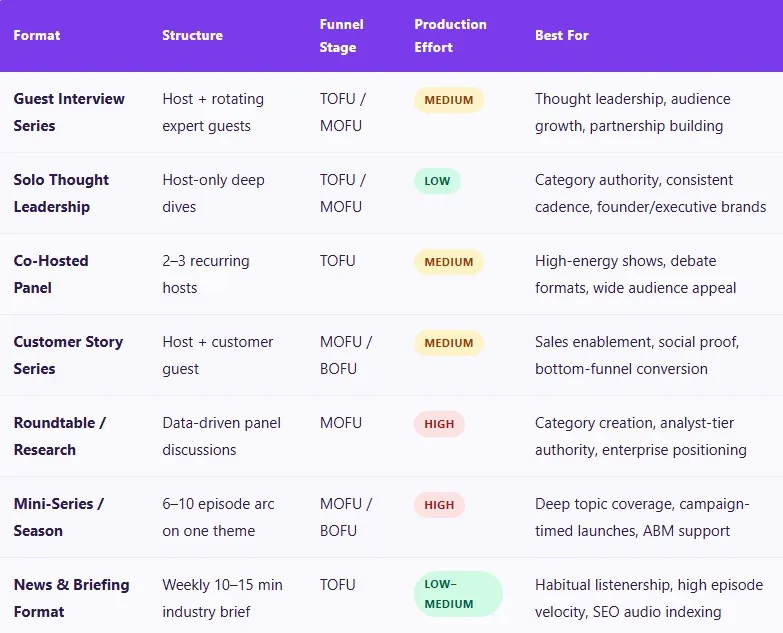
The format of your podcast is not a production decision; it’s a strategic one. Different formats attract different audiences, serve different funnel stages, and require different resource commitments. Choosing the wrong format is one of the most common reasons B2B podcasts lose momentum and stop growing.
AI Distribution: Reaching the Right Audience at Scale
Creating a great podcast episode is important, but getting it in front of the right audience is what truly makes podcasting a powerful demand generation channel.
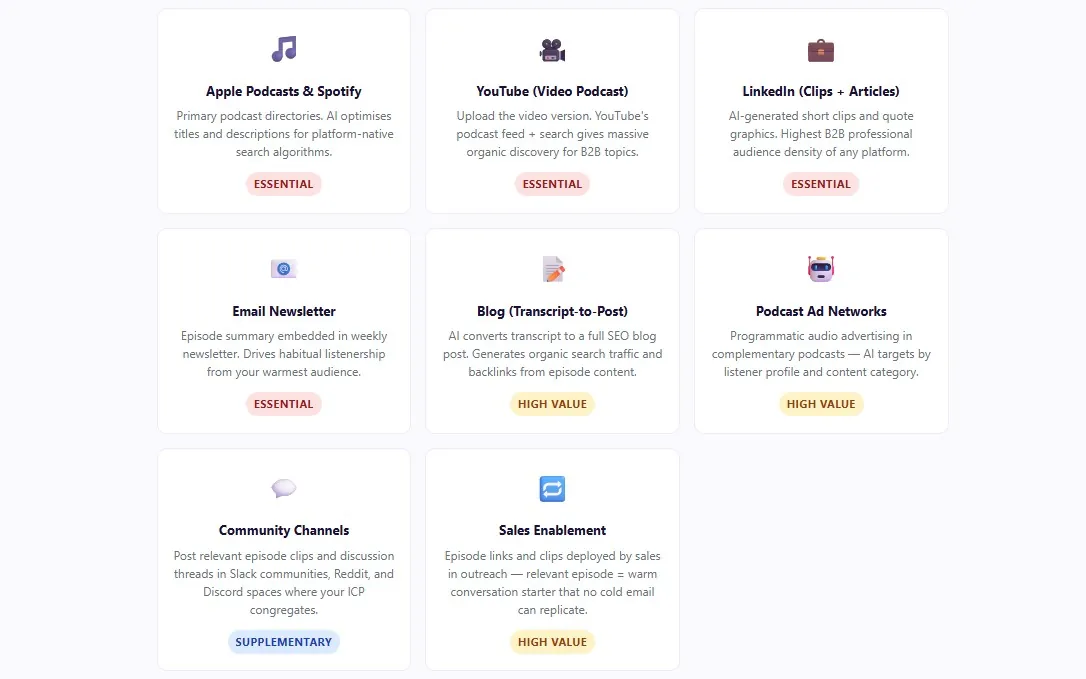
In 2026, AI has completely changed how podcasts are distributed. Instead of manually sharing episodes across different platforms one by one, businesses now use AI-powered systems that automatically match podcast content with the right listeners.
This makes it easier for companies to reach the people most likely to be interested in their content, whether they are decision-makers, industry leaders, or potential buyers.
The Multi-Channel Distribution Stack
AI Audience Intelligence for Smarter Podcast Distribution
AI is not only helping businesses publish podcasts across multiple channels, but it is also making podcast distribution much smarter and more targeted.
In 2026, platforms like Spotify and Apple offer advanced tools that help businesses reach very specific audiences based on factors like:
Job titles
Industry
Company size
Listening habits and interests
This gives podcast marketing the same level of targeting precision that paid search and PPC advertising brought to digital marketing years ago.
Because of this, podcast advertising is no longer just about reaching a large audience for brand awareness. Businesses can now use podcasts as a focused demand generation channel and optimise campaigns based on actual lead quality and cost per acquisition (CPA).
Companies are also combining podcast marketing with retargeting strategies. For example, someone who listens to a podcast episode may later see related ads on social media or other websites. This creates a connected marketing journey that moves potential buyers from awareness to conversion more effectively.
By combining audio content with digital marketing strategies, businesses can build a stronger and more measurable customer acquisition system.
Turning Your Podcast Into a Demand Generation Engine
A podcast only becomes a true demand generation channel when it is designed with clear business goals in mind. The difference between a podcast that simply gets downloads and one that actually drives revenue comes down to the systems behind it.
Here are four effective ways businesses turn podcast listeners into real sales opportunities and pipeline growth.
Mechanism 1: Invite Your Ideal Customers as Guests
One of the smartest B2B podcast strategies is inviting your target buyers onto the show.
For example, if your ideal customers are CFOs or marketing leaders, having them as podcast guests creates a valuable relationship naturally. During a 30–45 minute conversation, they spend meaningful time engaging with your brand and discussing their challenges.
It also gives your sales team a warm and natural way to continue the conversation later, making every guest a potential sales opportunity.
Mechanism 2: Offer Downloadable Resources With Each Episode
A great way to generate leads from your podcast is by offering helpful downloadable content connected to the episode.
This could include:
Checklists
Frameworks
Research reports
Templates
Guides mentioned during the conversation
Listeners who spend time listening to an episode are often interested in learning more, making them more likely to download these resources through a simple lead form.
This helps businesses collect high-quality leads connected directly to specific topics and buyer interests.
Mechanism 3: Retarget Engaged Podcast Listeners
Not every listener becomes a customer immediately, but many are interested enough to continue engaging with your brand.
By tracking visits to podcast episode pages and using retargeting tools, businesses can later show relevant ads, content offers, or demo invitations to those listeners on social media and other platforms.
For example, someone who listened to an episode about RevOps might later see a related case study or product demo ad.
This helps move listeners from passive interest to active buying consideration.
Mechanism 4: Connect Podcast Data With Your Sales Team
The most advanced B2B companies connect podcast activity directly to their CRM and sales systems.
For example, if a prospect downloads a resource from an episode about scaling revenue operations while already speaking with your sales team, the account executive can automatically receive that information.
This gives sales teams valuable context about what the prospect is interested in, helping them have more relevant and personalised conversations.
It also builds trust because the sales discussion is based on topics the listener already cares about.
When done correctly, podcasting becomes much more than content marketing — it becomes a measurable system for building relationships, generating leads, and accelerating sales growth.
The Podcast Content Repurposing Machine
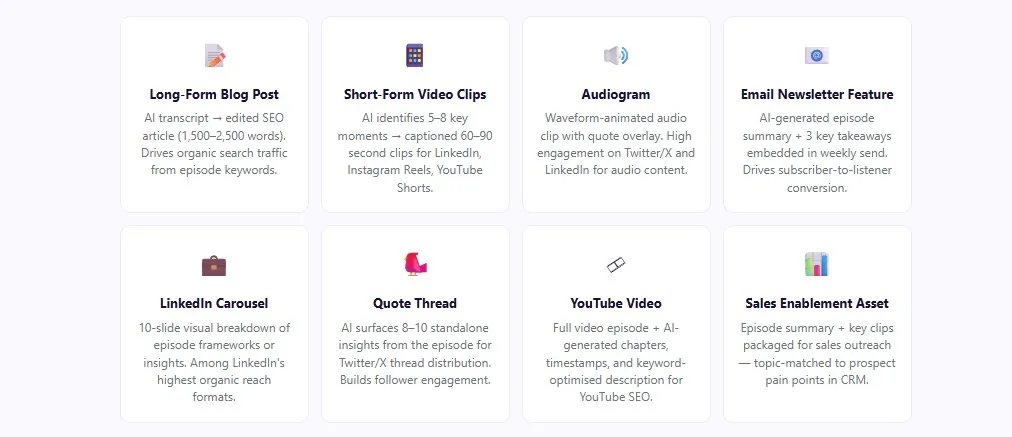
One of the most underutilized aspects of podcast investment is the breadth of content that a single recording session produces. With AI repurposing tools, one 45-minute episode generates a full week of multi-channel content, making podcasting one of the most efficient content production models available to a B2B marketing team.
Measuring Podcast ROI and Pipeline Attribution
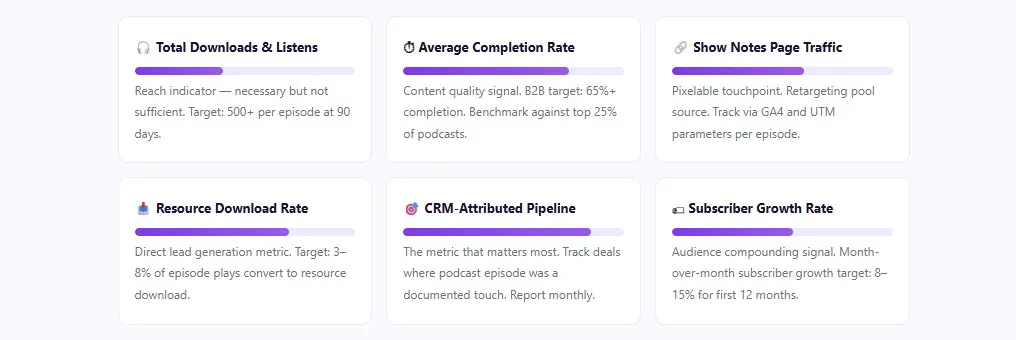
The most common objection to podcast investment is the measurement challenge. In 2026, that objection has largely been answered, but only for teams that build the right attribution infrastructure before they publish Episode 1.
The Podcast ROI Measurement Framework
The Attribution Stack
Implement UTM parameters on every distribution link. Pixel your show notes page and episode landing pages. Gate your companion resources to capture lead data with podcast-specific source tracking. Integrate your hosting platform's listener data with your CRM. Build a dedicated podcast attribution view in your revenue dashboard — reported alongside other demand generation channels with the same level of accuracy and detail. This is how podcast demand generation earns and keeps its budget.
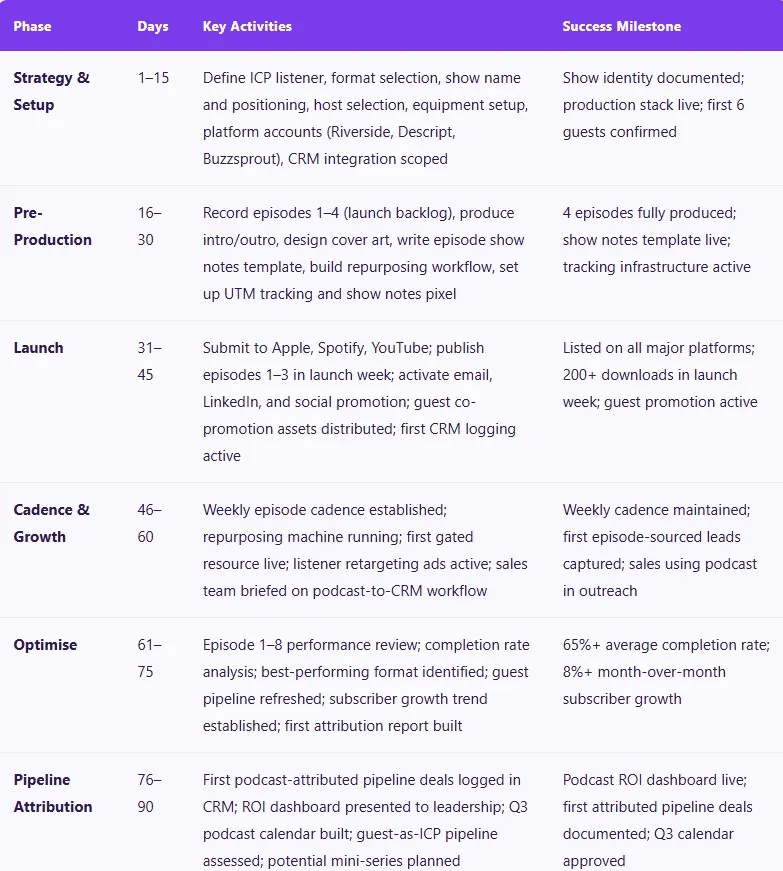
Your 90-Day B2B Podcast Launch Framework
Pitfalls That Kill B2B Podcasts and How to Avoid Them
1. Building a Podcast About Your Product
One of the biggest mistakes in B2B podcasting is focusing too much on your own company, product updates, or internal views.
When a podcast feels like a marketing pitch, people don’t have a strong reason to keep listening, especially when they can already get that information from your website, blog, or newsletter.
Instead, your podcast should focus on your audience: their challenges, goals, and industry conversations. Your brand should play the role of a helpful host, not the main subject.
2. Launching Without a Backlog
Starting a podcast with just one episode and promising regular uploads often leads to a poor first impression.
New listeners usually want to explore more episodes before deciding to subscribe. If they only find one, there’s a high chance they won’t come back.
A better approach is to launch with at least three episodes already published, and have a few more ready in advance before promoting the show.
3. Relying Only on Download Numbers
Download counts can be misleading. They don’t show how engaged your audience is or whether the podcast is actually driving business results.
For example, a podcast with 300 highly relevant listeners who fully engage and turn into pipeline is far more valuable than one with 3,000 random listeners who don’t convert.
Instead of focusing only on downloads, track more meaningful metrics like:
How long do people listen
How many convert into leads
How much revenue does the podcast influence
4. No Distribution Strategy After Publishing
Simply uploading episodes to platforms like Spotify or Apple Podcasts is not enough. Without active promotion, most podcasts struggle to grow.
Successful podcasts use a clear distribution plan, which can include:
Sharing clips on LinkedIn and other social platforms
Emailing new episodes to subscribers
Collaborating with guests for cross-promotion
Running retargeting ads
Promotion should be planned before the first episode is even recorded.
5. Posting Irregularly
Inconsistent publishing is one of the fastest ways to lose an audience.
Listeners get used to a schedule, and if episodes stop showing up regularly, many of them stop coming back.
It’s better to choose a realistic schedule, whether weekly or bi-weekly, and stick to it consistently. Modern AI tools can help with production, but the goal should always be maintaining a steady and reliable rhythm rather than overloading your team.
Conclusion
B2B podcasting in 2026 offers something most marketing channels can’t focused, voluntary attention from decision-makers who actually choose to listen. It’s a rare opportunity in a world where attention is short and competition is high.
But results don’t come from publishing episodes alone. The real impact happens when podcasts are built as a complete system with consistent production, smart distribution, AI support, and clear links to leads and revenue.
The opportunity is still strong today, but it won’t stay this open forever. Brands that start early and stay consistent will build lasting authority and a compounding growth engine over time.
In short, the earlier you build it, the stronger it works for you later.
Check out Marketricka blogs for easy-to-understand tips, practical insights, and useful ideas you can apply right away.