
Salesforce vs HubSpot CRM in 2026: Which Is Right for Your Revenue Team?
Salesforce vs HubSpot CRM in 2026: Compare pricing, features, and AI to choose the best CRM for your sales team.
 By Divyesh Savaliya
At some point, every sales team reaches a point where the simple tools they have been using, like spreadsheets, are not working well enough. Things get messy and harder to track.
That’s when they have to decide:
Should they move to a CRM, a system to manage customers and sales, or if they already have one, should they switch to a better option?
In short, their current setup is not keeping up anymore. They need to choose what to do next.
The Salesforce vs HubSpot CRM debate is one of the most searched decisions in B2B sales and marketing. Both platforms dominate the global CRM market, both have invested heavily in AI, and both can genuinely transform how a revenue team operates. But they are built for fundamentally different buyers.
Choose the wrong one, and you'll spend the next three years either paying for complexity you don't need or outgrowing a platform you love. This guide cuts through the marketing fluff and gives you an honest, data-backed answer to the HubSpot vs Salesforce question in 2026.
The 2026 CRM Landscape: Where Both Platforms Stand
Before diving into features and pricing, it helps to understand where each platform sits in the market today.
Salesforce is the undisputed category leader. According to IDC's Worldwide Semiannual Software Tracker (April 2025), Salesforce led all CRM vendors with a 20.7% market share more than its four nearest competitors combined, and it has held the #1 CRM position for 12 consecutive years.
In fiscal year 2025, Salesforce reported $37.9 billion in total revenue, representing approximately 9% year-over-year growth. Founded in 1999, Salesforce essentially invented cloud CRM and has since evolved into a full enterprise platform spanning sales, service, marketing, commerce, analytics, and industry-specific solutions.
HubSpot is the fastest-growing major CRM platform. Its full-year 2024 revenue reached $2.63 billion, up 21% from the prior year, according to HubSpot's official SEC filing. As of December 2024, HubSpot had 247,939 customers in more than 135 countries, per HubSpot's 10-K annual report. Founded in 2006 as an inbound marketing tool, HubSpot has expanded into a full CRM suite that's closing the enterprise feature gap fast.
The global CRM market itself is projected to reach $87.96 billion in 2026 and $128.86 billion by 2031, driven by AI integration and the continued shift from legacy tools to modern, connected platforms.
HubSpot vs Salesforce Pricing: The Real Cost in 2026
On paper, the per-seat pricing looks similar at the high end. In practice, the total cost of ownership (TCO) tells a very different story, and it's the number that actually matters when you're signing a multi-year contract.
HubSpot Pricing (2026)
HubSpot's biggest differentiator is the genuinely free CRM tier — unlimited users, contact management, deal tracking, email tracking, and meeting scheduling at zero cost. Paid tiers unlock progressively more powerful tools:
Free: $0 — contact management, basic pipelines, email tracking (unlimited users)
Starter: From $20/month — removes HubSpot branding, basic automation
Professional: From $800–$1,600/month (flat base + per-seat fees) — full automation, custom reporting, sequences
Enterprise: From $3,200+/month — advanced permissions, custom objects, sandboxes
Salesforce Pricing (2026)
Salesforce charges per seat with annual billing, and most businesses discover quickly that the sticker price is just the beginning:
Professional: $80/user/month
Enterprise: $165/user/month
Unlimited: $330/user/month
Marketing Cloud: Separate product, from $1,250/month — not included in Sales Cloud
Salesforce Admin: $80,000–$120,000/year in salary for a dedicated admin
Implementation: $58,000–$143,000 for enterprise deployments
The TCO Reality Check
For a 20-person team, the numbers look like this:
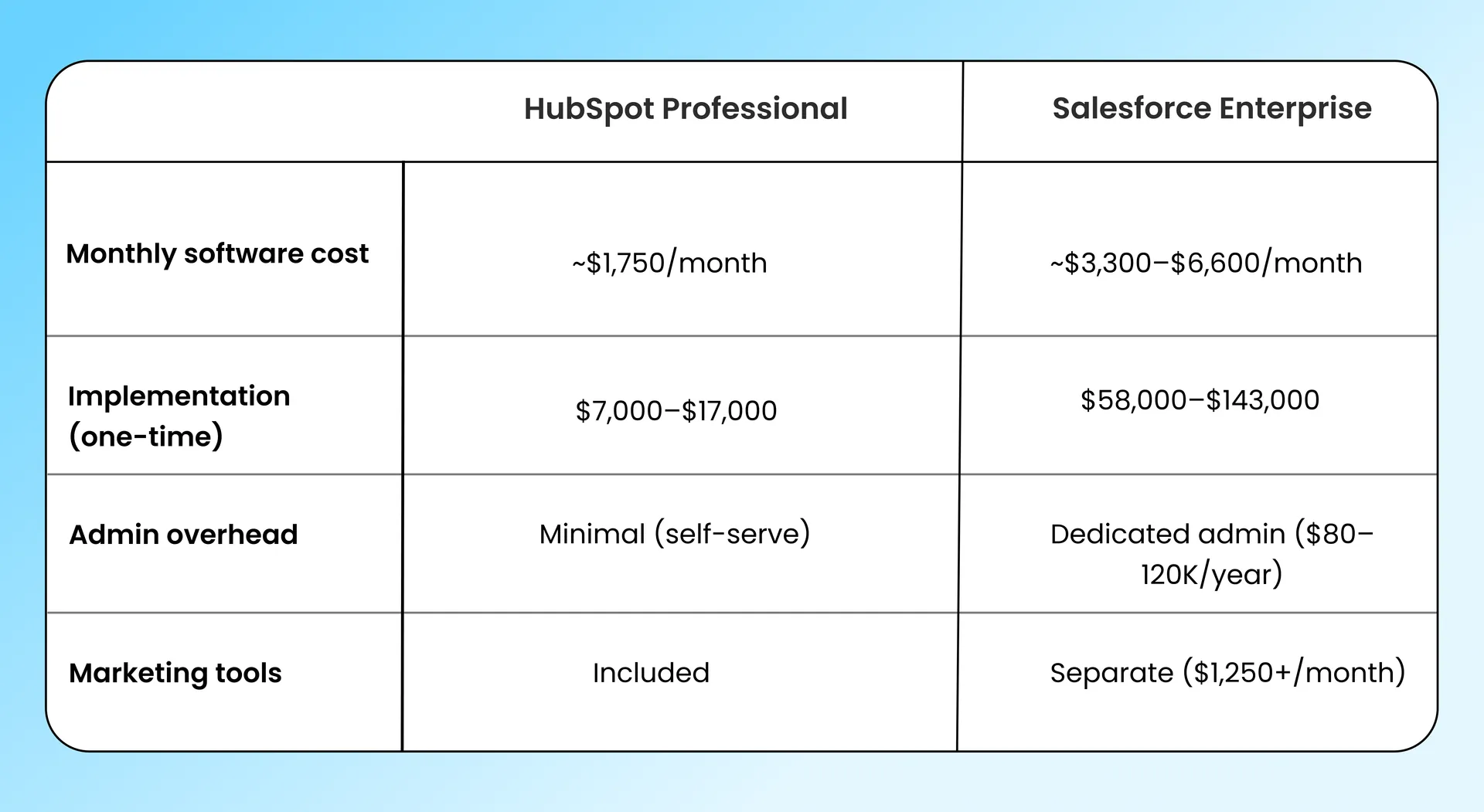
For companies under 200 employees with marketing-driven sales processes, HubSpot's total cost of ownership is typically 20–30% lower than a comparable Salesforce stack (Avidly Agency, 2026). HubSpot also saves $5,000–$200,000 for teams of 5–50 users over three years when you factor in implementation and admin costs.
CRM Comparison: HubSpot vs Salesforce
1. Sales Features
HubSpot Sales Hub
Easy to use, quick setup
Sales reps can start in 1–2 days
Visual pipelines, simple tools
No heavy admin needed
Salesforce Sales Cloud
Very powerful and customizable
Handles complex sales processes
Takes 2–4 weeks (or more) to learn/set up
Needs an experienced admin
2. Marketing Integration (Big Difference)
HubSpot
Marketing + CRM in one system
Data updates instantly (no syncing issues)
Easy to track the full customer journey
Sales sees all marketing activity in one place
Salesforce
Needs separate tools like Marketing Cloud / Pardot
Requires data syncing between systems
More setup + chances of data mismatch
3. AI Capabilities (2026)
HubSpot (Breeze AI)
Built-in, easy to use
Helps with emails, summaries, and lead scoring
Works right away without setup
Salesforce (Agentforce AI)
More advanced and powerful
Can automate complex workflows
Needs clean data + setup + ongoing management
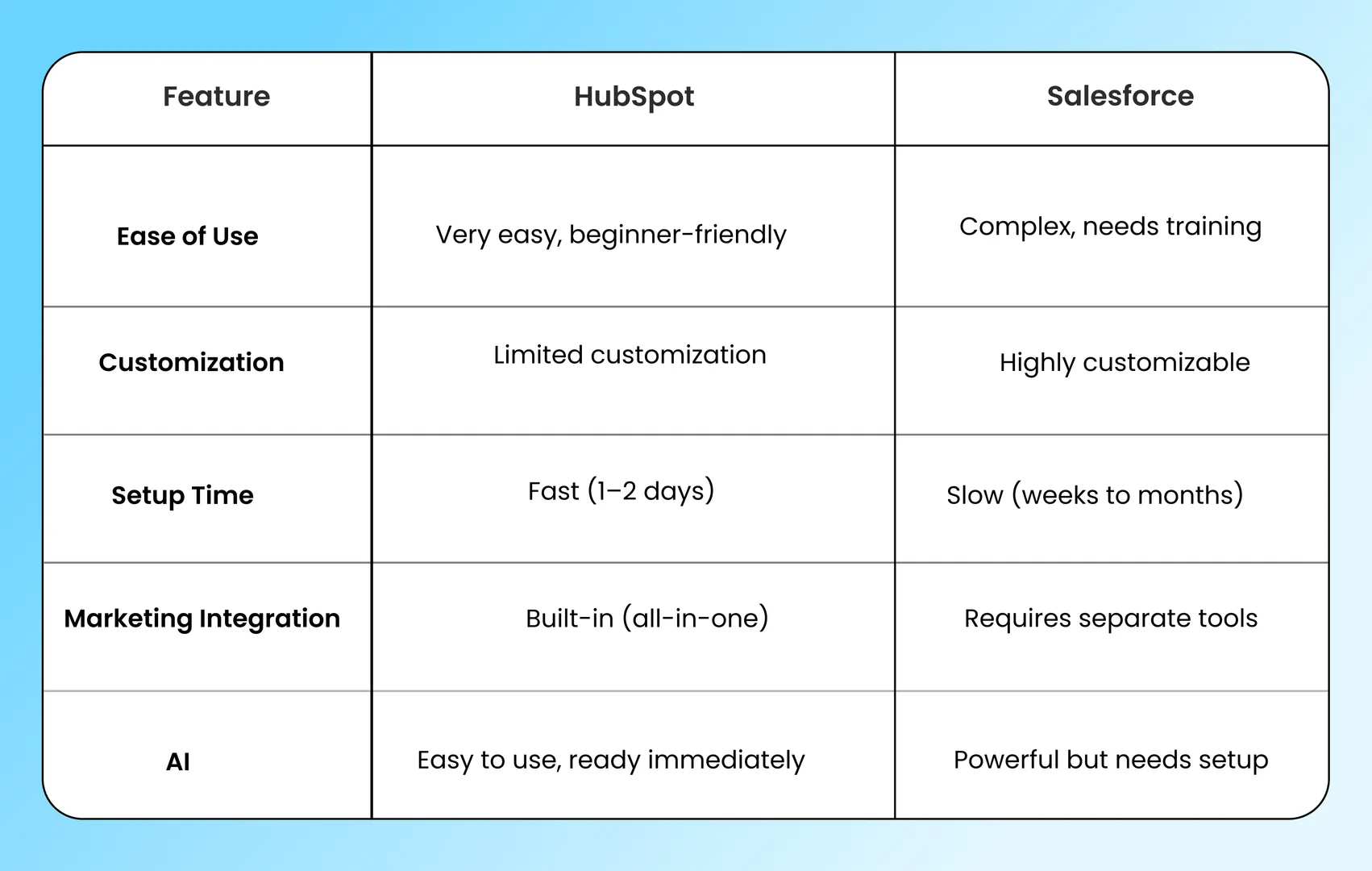
Quick Comparison Table Hubspot vs Salesforce
CRM for Startups vs Enterprises: The Decision Framework
The CRM for startups vs enterprises question has a cleaner answer in 2026 than it did two or three years ago.
Choose HubSpot if:
Your team is under 200 employees and growing
Marketing and sales need to share one data layer without integration overhead
You don't have a dedicated CRM admin (and don't want to hire one)
You want to move from spreadsheets to a real CRM in days, not months
Inbound marketing, content, and lead generation are central to your growth model
Budget matters, and you want to avoid a six-figure implementation bill
You're a startup that needs a free CRM that scales into paid tiers without re-platforming
Choose Salesforce if:
Your organization has 500+ employees with complex, multi-team sales structures
You need custom objects, granular permission hierarchies, and advanced territory management
Your sales motion involves CPQ (Configure, Price, Quote), complex approval workflows, or industry-specific compliance requirements
You already have a dedicated Salesforce admin team and an established ecosystem
You need AppExchange depth — Salesforce offers 5,000+ pre-built integrations for virtually any use case
Your organization operates across multiple business units with distinct data governance requirements
A Third Option: Running Both
One of the fastest-growing CRM strategies in 2026 is the dual-platform approach using HubSpot for top-of-funnel marketing and lead generation while running Salesforce as the system of record for sales, service, and compliance (Vantage Point, 2026). This lets each platform do what it does best, connected via native Salesforce-HubSpot sync through HubSpot's Operations Hub.
It's worth evaluating seriously if you're in a regulated industry or have a large enterprise sales motion, but also want best-in-class inbound marketing.
Which One Wins? HubSpot vs Salesforce in 2026
There's no universal winner in the Salesforce vs HubSpot CRM debate, but there is a right answer for your specific situation.
For most B2B teams under 500 employees, HubSpot is the stronger choice in 2026. It's faster to implement, easier to adopt, cheaper to own, and better integrated for marketing-led revenue teams. The platform has closed the enterprise feature gap significantly and now handles everything most mid-market companies need without the complexity tax that comes with Salesforce.
For large enterprises with complex requirements, Salesforce justifies its cost. The depth of customization, the ecosystem of AppExchange integrations, the autonomous AI capabilities of Agentforce, and the industry-specific cloud solutions are genuinely unmatched. If you need detailed control at scale, Salesforce is worth the investment.
Both decisions connect directly to how well your CRM Automation Strategies perform, how tightly your Sales Funnel Automation operates, and whether your Revenue Operations function has the data it needs to make confident forecasts.
Final Thought: The Right CRM Is the One Your Team Actually Uses
The best CRM in the world is worthless if your team works around it.
Choosing between Salesforce and HubSpot isn't just a technology decision; it's a revenue strategy decision. The platform you choose shapes how marketing and sales collaborate, how quickly you can forecast, how easily you can onboard new reps, and how confidently you can tell the board what next quarter looks like.
This is not just a comparison between two software products. It's a choice between two philosophies: depth and configurability on one side, speed and alignment on the other.
Brands that choose the right CRM for their current stage and configure it properly from day one are building a revenue foundation their competitors will struggle to replicate:
Faster sales cycles because reps aren't fighting their tools
Better marketing ROI because campaign data feeds directly into the pipeline
Cleaner forecasts because the data is actually trustworthy
In a market where B2B buyers are harder to reach, and every deal takes longer to close, your CRM is not a cost center. It's the operating system your revenue team runs on.
If your current system feels like it’s slowing you down instead of helping you, or if you’re choosing a CRM for the first time, it’s important to pick the right one.
Want simple tips to improve your revenue? Check out the Marketricka blogs for easy, practical ideas to help you grow faster.