
GTM Strategy 2026: How to Build a Go-To-Market Plan That Actually Scales
Learn how to build a scalable GTM strategy in 2026 with ICP, channels, AI, and alignment to drive predictable revenue growth.
 By Divyesh Savaliya
If your go-to-market strategy still looks like a product launch checklist, you're already behind. In 2026, the companies pulling ahead are treating GTM as a living, cross-functional revenue engine, not a one-time campaign. This guide breaks down exactly how to build a go-to-market plan that doesn't just launch products, but scales revenue quarter after quarter.
What Is a Go-To-Market Strategy and Why Does It Matter More in 2026?
A go-to-market (GTM) strategy is your company's coordinated plan for reaching target customers, driving product adoption, and generating sustainable revenue. It aligns your sales, marketing, product, and customer success teams around a unified execution plan.
The stakes? Higher than ever.
According to Salesmate's 2025 research, companies with a structured GTM strategy see 3× greater revenue growth and 10% higher launch success rates. Yet a significant share of businesses still operate without a clearly defined GTM plan, paying for it in wasted pipeline and missed targets. In fact, InsightMark Research reports that approximately 70% of GTM strategies fail outright due to weak cross-functional coordination, and 90% of businesses struggle to execute their strategies effectively.
In 2026, three forces are reshaping how GTM strategies must be built: AI-powered execution, shifting B2B buyer behavior, and the rise of ecosystem-led growth. If your plan doesn't account for all three, it won't scale.
The 5 Pillars of a Scalable GTM Strategy in 2026
Building a go-to-market plan that actually scales comes down to five interconnected pillars. Miss one, and the entire revenue motion breaks down.
Pillar 1: Ideal Customer Profile (ICP) + Buyer Intelligence
Your GTM strategy lives or dies on how precisely you define who you're selling to. In 2026, B2B buyers spend 83% of their purchase journey researching independently before engaging a sales rep (InsightMark Research). That means your ICP must go beyond firmographics — it needs to capture behavioral signals, intent data, and buying committee dynamics.
Modern buyers don't decide alone. The average B2B deal now involves 6.3 stakeholders, and your messaging must resonate across multiple decision-maker roles simultaneously. A weak or outdated ICP means your team is burning budget chasing the wrong accounts.
To build intent-driven ICPs, the best GTM teams in 2026 are using B2B intent data platforms that surface active in-market signals before prospects ever raise their hand.
Related Read: B2B Intent Data Platforms: Top Tools to Find In-Market Buyers
Pillar 2: Positioning and Messaging That Conditions the Market
Most GTM messaging focuses on product features. Winning GTM messaging focuses on market conditioning — educating buyers, differentiating your category, and building pre-funnel awareness before prospects have entered a sales cycle.
According to Gartner's 2026 Marketing Practice research, the most successful CMOs are repositioning brand investment as a strategic lever for customer acquisition and competitive advantage — not just awareness-building. Brand and product marketing teams must collaborate tightly to ensure messaging is grounded in real product differentiation.
Think about how companies like Drift reframed chatbots as "conversational marketing." That's category creation through positioning, and it's one of the most durable GTM advantages a company can build.
Strong positioning also directly supports your content marketing strategy. White papers, thought-leadership reports, and in-depth guides are powerful market-conditioning tools that build trust before the sales conversation begins.
Related Read: Beyond Blog Posts: The Role of White Papers in Content Marketing
Pillar 3: Channel Strategy and Sales Motion
Choosing the right GTM channels is where most teams overspend. The average software company now runs five core GTM channels alongside 5.5 experimental initiatives simultaneously (InsightMark Research). More channels don't mean more growth; aligned channels do.
In 2026, the dominant GTM motions are:
Product-Led Growth (PLG): Gartner predicts 95% of SaaS providers will employ self-service PLG for new customer acquisition, citing reduced CAC and shorter sales cycles.
Sales-Led Growth (SLG): Still dominant for mid-market and enterprise segments where deal complexity and stakeholder count are high.
Partner/Ecosystem-Led Growth: Increasingly critical as direct launch strategies give way to GTM orchestration across platforms, marketplaces, and influencer channels.
Related Read: Sales Pipeline Velocity: The Key Revenue Metric
Pillar 4: Sales and Marketing Alignment
This is the single most destructive failure point in GTM execution and the most common. InsightMark Research reports that 53% of organizations experience handoff misalignment between marketing and sales, and in those organizations, less than 35% of engaged contacts ever reach a sales rep. For SaaS companies, this misalignment can drain 30–50% of the pipeline.
Companies with strong sales-marketing alignment achieve 20% annual revenue growth on average, versus a 4% decline for poorly aligned teams. When alignment is strong, marketing influences up to 29% of the pipeline compared to just 10% when it's weak.
High-performing GTM teams in 2026 are organizing into cross-functional pods that combine marketing, BDRs, account executives, and customer success under shared OKRs and real-time dashboards.
Related Read: MQL to SQL: How to Fix Your Lead Handoff Process with Automation
Pillar 5: Measurement, Analytics, and Iteration
A GTM strategy without a measurement framework is just a hypothesis. In 2026, the metrics that separate scaling companies from stagnating ones are: pipeline velocity, CAC payback period, marketing-influenced ARR, win rate by segment, and Net Dollar Retention (NDR).
ZoomInfo's research shows 95% of sales, marketing, and RevOps leaders say poor quality data has harmed their GTM efforts. Most teams are still measuring activity rather than outcomes. The fastest-growing companies are using AI-powered sales forecasting to predict pipeline health with 90%+ accuracy.
AI's Role in Your 2026 GTM Plan
The generative AI market for GTM applications is valued at $62.75 billion in 2025, with projected growth to $356 billion by 2030 (SuperAGI/DevriX). AI usage in GTM has surged 893% since 2023 (ZoomInfo), and 93% of GTM teams now use AI-powered tools in some capacity. Gartner's 2026 technology trends confirm that AI-native platforms are among the top enterprise investment priorities.
What does this mean practically for your GTM plan?
AI-powered outbound personalization: Teams using intent-signal personalization have moved reply rates from 0.6% to 9.4% — roughly a 15× improvement.
AI-driven conversion: Salesforce research shows real-time AI personalization increases conversion by up to 22% over static messaging.
AI-assisted pipeline management: Reduces manual GTM operational work by an estimated 30–40% (Grand Research Store).
The catch: AI amplifies both good and broken GTM motions. If your ICP is fuzzy or your teams are misaligned, AI will accelerate the wrong activities faster. Fix the fundamentals first, then apply AI to scale what works.
Related Read: Win Rate Optimization: How AI Fixes Lost Deals
Your GTM Plan Template: The PACET Framework
If you need a practical structure for building or auditing your go-to-market strategy, the PACET framework is one of the most widely applied models used by high-growth B2B teams:
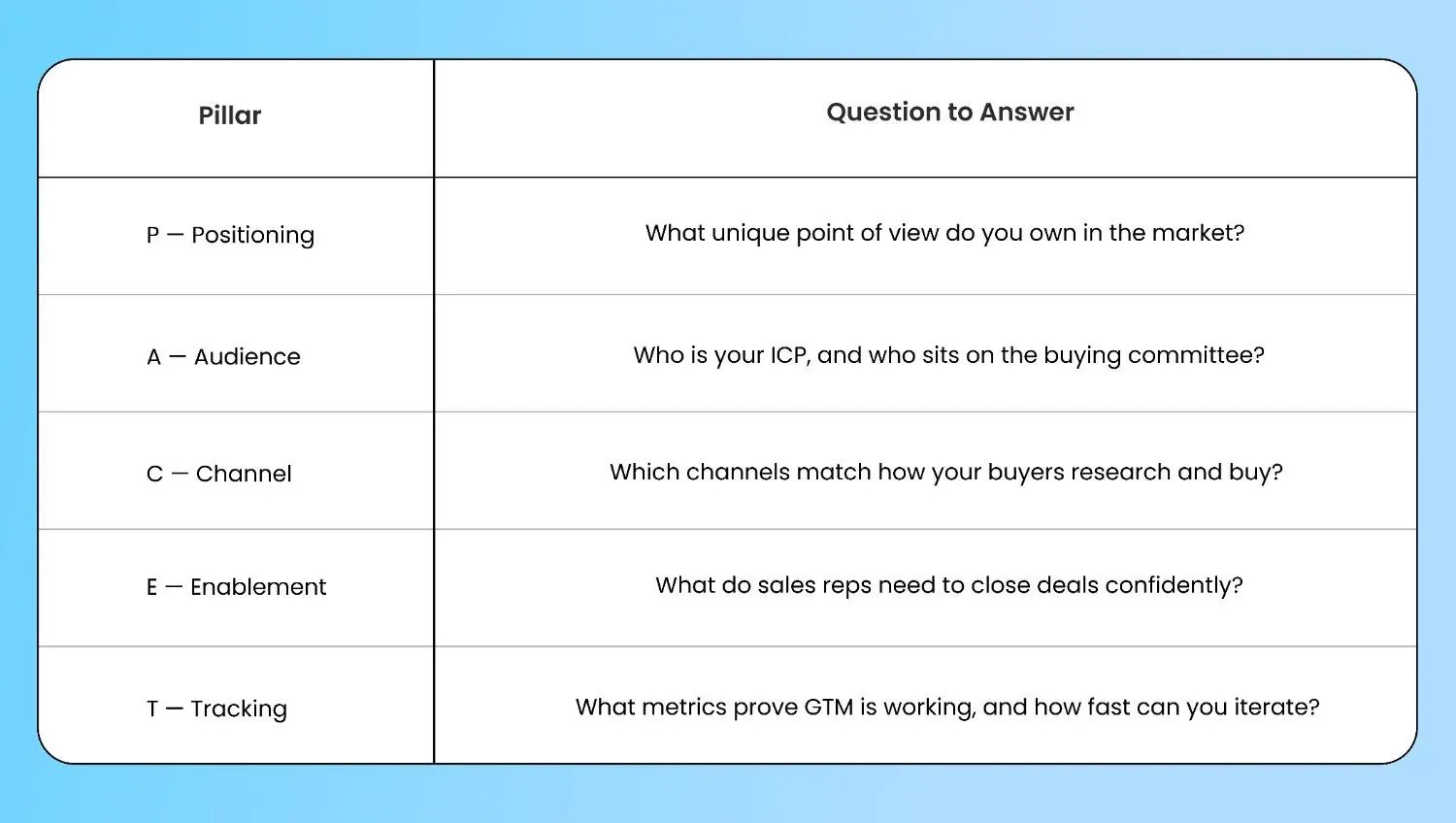
Run every product launch, market expansion, or new segment play through this framework before execution. It forces alignment, surfaces gaps early, and creates a repeatable playbook. For tracking and attribution, a well-chosen CRM is foundational.
Related Read: Salesforce vs HubSpot CRM in 2026: Which Is Right for Your Revenue Team?
Common GTM Failures and How to Avoid Them
Weak demand validation: 40% of products fail shortly after launch due to insufficient market need assessment (InsightMark Research). Talking to 20 customers before launch is not optional; it's minimum viable validation.
Fragmented execution: 70% of GTM strategies fail due to weak cross-functional coordination. The org chart isn't the customer's problem; misaligned execution is.
Underinvestment in GTM: 59% of companies underinvest in launches, missing vital testing, enablement, and acquisition infrastructure. Market leaders allocate 15–35% of launch budget specifically to GTM planning and operations (DevriX).
One-and-done thinking: Your GTM strategy should be reviewed quarterly and overhauled annually. Companies that treat GTM as a continuous operating system, not a launch event, are the ones that compound growth.
Ignoring post-sale GTM: Customer success is increasingly a GTM function. Reducing churn and driving expansion revenue through automation directly impacts your net revenue retention.
Related Read: Customer Success Automation
The Bottom Line: GTM Strategy Is Your Growth Infrastructure
In 2026, a go-to-market strategy isn't a document you file away after launch. It's the infrastructure that determines whether your sales and marketing investment converts to predictable revenue or bleeds out in misalignment and wasted pipeline.
The companies winning right now have cracked three things: crystal-clear ICPs backed by real buyer intelligence, tight sales-marketing alignment organized around shared revenue metrics, and AI-powered execution that scales personalization without sacrificing precision.
At Marketricka, we help marketing and sales professionals build, audit, and scale GTM strategies that drive real growth with practical frameworks, data-backed insights, and AI-driven tools you can apply immediately.
Ready to build a GTM plan that scales? Start with a GTM audit of your current ICP, channel mix, and sales-marketing alignment, and identify the one gap costing you the most pipeline right now.