
GEO vs SEO: Complete Guide to Generative Engine Optimization
GEO vs SEO explained: Learn how generative engine optimization builds authority and AI visibility beyond rankings.
 By Divyesh Savaliya
Search is evolving quickly. Traditional SEO helped brands rank higher, drive traffic, and compete for visibility on search engines. That model still matters, but user behavior is shifting. More people are asking AI platforms direct questions and expecting clear, summarized answers instead of browsing multiple links. This is where Generative Engine Optimization (GEO) starts becoming relevant.
If you’ve been following the rise of AI in marketing, you already know that AI is changing how brands create content and connect with audiences. Now it’s also influencing how users discover businesses. AI-driven search systems pull structured, authoritative insights from across the web, which means brands need to think beyond rankings and focus on how their expertise is interpreted and presented.
At Marketricka, we see GEO as the next layer of modern search strategy. It doesn’t replace SEO, but it strengthens it. In this guide, we’ll break down how SEO and GEO differ, how generative search works, and how businesses can adapt early to stay visible in an AI-first search environment.
Quick Definitions: SEO and GEO
SEO (Search Engine Optimization):
SEO is the practice of optimizing web pages, blogs, and any other form of content to rank higher on traditional search engine results pages (SERPs) like Google. It focuses on keyword relevance, backlinks, technical performance, and authority signals to increase organic traffic and visibility.GEO (Generative Engine Optimization):
GEO is the process of optimizing content so that AI-driven search engines and generative platforms (like AI answer engines) reference, cite, or synthesize your content in their responses. It focuses on semantic clarity, structured knowledge, entity authority, and contextual depth rather than just keyword ranking.
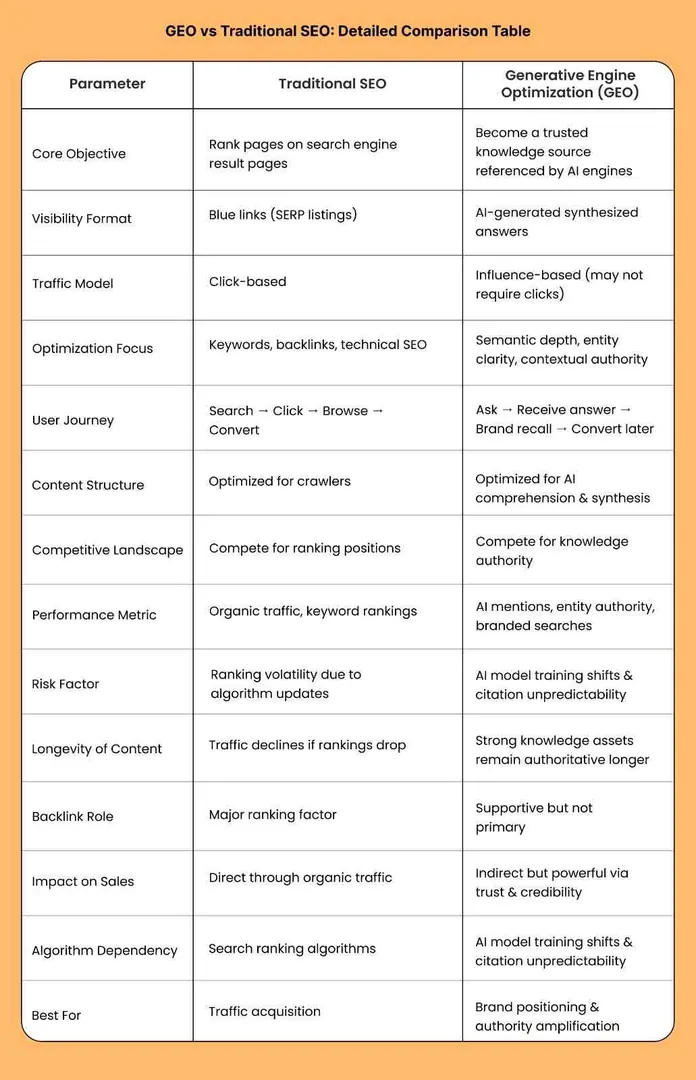
GEO vs Traditional SEO: Detailed Comparison Table
SEO vs GEO: What Actually Changes?
Traditional SEO was built around ranking. You optimize pages for specific keywords, improve technical structure, build backlinks, and aim to appear higher on Google.
Generative Engine Optimization shifts the focus slightly. AI-driven search engines don’t just display links; they generate answers. When someone asks a question inside an AI platform or tools, the system summarizes information instead of listing websites. So the real difference is this: SEO competes for position, while GEO competes for authority.
Discoverability vs Authority
SEO ensures people can find you. If someone searches for “best SEO agency for SaaS,” your goal is to rank in the top results and earn the click. That visibility directly impacts traffic numbers.
GEO works at a different stage of the decision journey. When a user asks, “Is GEO better than SEO for SaaS companies?” The AI provides an explanation. If your content is structured clearly and covers the topic in depth, your thinking can influence that explanation. Even without a direct click, your brand starts building credibility in the user’s mind.
For service businesses, this matters. Traffic brings visitors, but authority builds trust. And trust often decides who gets shortlisted.
Keyword Targeting vs Topic Ownership
In SEO, success often starts with selecting the right keywords. You identify what people are searching for and create optimized pages around those terms. Ranking for “Generative Engine Optimization strategy” becomes a measurable goal.
With GEO, the focus moves beyond ranking for a single phrase. AI systems evaluate whether your brand consistently demonstrates expertise around a subject. That means covering related angles like comparisons, strategy frameworks, implementation guides, and real-world use cases in a structured and meaningful way.
Instead of asking, “Are we ranking for this keyword?” the smarter question becomes, “Are we known for this topic?”
Traffic Metrics vs Perception Impact
Traditional SEO performance is easy to measure. You track impressions, clicks, and conversions. Growth is visible inside analytics dashboards.
GEO influences perception. When your ideas consistently appear in AI-driven explanations, brand familiarity increases. Users are more likely to search your name directly or trust your expertise when evaluating options.
SEO drives measurable traffic growth. GEO strengthens brand positioning before the first interaction happens. When combined, they create both visibility and credibility, which is where real growth happens.
Steps to Build a Strong GEO Strategy
If you’re thinking about Generative Engine Optimization as just another SEO tactic, you’ll miss the opportunity. GEO is not about stuffing “AI” keywords into your content. It’s about reshaping how your brand communicates knowledge so that AI systems recognize you as a reliable source.
Let’s break this down in a way that actually makes sense.
1. Start With Topic Depth, Not Just Keywords
Most businesses begin with keyword research, and that’s fine for traditional SEO. But GEO starts with topic clarity. Before you create content, ask yourself: Do we truly understand this subject deeply enough to explain it from multiple angles?
If you’re targeting “Generative Engine Optimization,” your content shouldn’t stop at a definition. You should also cover how AI search engines work, how GEO differs from traditional SEO, how to measure success, common mistakes, real implementation steps, and industry-specific applications.
AI systems look for patterns of authority. When your website covers a subject comprehensively instead of publishing one isolated article, you increase the chances of your content being interpreted as a trusted reference.
Instead of creating scattered blog posts, build structured content clusters around core themes. Think in terms of ownership, not ranking.
2. Write for Clarity, Not Just Optimization
AI models process language differently than search engine crawlers. They prioritize clarity, structure, and context over keyword density. That means vague, promotional, or surface-level writing simply won’t perform well in generative environments.
Your content should clearly define concepts before expanding on them. Use logical structure. Make comparisons easy to understand. Explain processes step by step instead of assuming the reader already knows.
For example, if you’re explaining GEO strategy, don’t just say it improves AI visibility. Explain how AI engines retrieve information, why structured explanations matter, and how topic authority influences inclusion in generated answers.
When your writing makes complex ideas simple without oversimplifying them, you increase both user trust and AI interpretability.
3. Build Entity Authority Around Your Brand
Generative systems depend heavily on conceptual recognition. They connect brands, topics, industries, and expertise areas. If your brand is consistently associated with a specific domain, AI engines are more likely to recognize that connection.
This means your GEO strategy should include:
Publishing consistent content around your core expertise
Earning mentions in industry publications
Contributing insights on authoritative platforms
Aligning your messaging across channels
It’s not just about your website. It’s about how your brand exists across the web.
If your agency wants to be known for AI search optimization, that positioning needs to show up in your blog content, guest articles, LinkedIn insights, and case studies. Over time, that repetition strengthens entity recognition.
4. Structure Content So AI Can Interpret It Easily
Structure matters more than most businesses realize. AI engines favor content that is logically organized and easy to understand.
That means:
Clear section headings
Defined subtopics
Comparative tables were helpful
Context before conclusions
Practical examples
Instead of writing one long promotional page, break down information into meaningful sections. If you’re explaining a strategy, guide the reader through the process rather than presenting abstract theory.
Well-structured content doesn’t just help AI systems. It improves user experience and reduces confusion, which indirectly strengthens engagement signals.
5. Focus on Use Cases and Real Scenarios
Generative engines prioritize content that answers real questions. One way to strengthen your GEO presence is to address practical use cases.
Instead of writing generic content about GEO, answer questions like:
How does GEO impact SaaS companies?
Should local businesses invest in GEO?
How does AI visibility affect B2B lead generation?
When your content anticipates specific scenarios, it becomes more relevant for conversational AI queries.
Real-world examples also make your expertise feel grounded rather than theoretical. If you can demonstrate how GEO improved brand positioning or reduced sales friction, your authority increases.
6. Align With Conversational Search Behavior
AI-driven search queries are often longer and more natural than traditional keyword searches. People don’t just type “GEO strategy.” They ask, “How do I build a Generative Engine Optimization strategy for my SaaS company?”
Your content should reflect this shift. Include natural language explanations. Answer questions directly within your content. Think about how a real decision-maker would phrase their query inside an AI tool. This alignment improves the chances that your content matches the intent behind generative prompts.
Key Ways to Measure GEO Success
Measuring GEO success is not as direct as checking keyword rankings. You won’t always see a dramatic spike in traffic and think, “Yes, this is GEO working.” The impact is usually more subtle, but if you know where to look, it becomes very clear.
Increase in branded searches
When your content starts shaping AI conversations, people become curious about your brand. They search your company name directly. If branded queries start rising steadily, it’s a strong sign your authority is growing.Better quality traffic, not just more traffic
GEO often improves who is coming to your site rather than how many. You might notice visitors spending more time, reading more pages, and exploring service sections seriously. That usually means they already trust what they’ve seen.Higher conversion rate from organic
If your organic traffic begins converting better without a major jump in sessions, that’s meaningful. It suggests people are arriving with a stronger intent and less hesitation.Wider visibility across related queries
When your content truly covers a topic well, you start appearing for more connected search phrases. That expansion shows your authority is being recognized.Stronger engagement signals
Scroll depth, repeat visits, and time spent on key pages often improve when your content feels structured and credible. People stay longer when they find clarity.
Looking to Strengthen Your GEO Strategy and Online Presence?
Our experts are here to help! You can drop us a quick mail at hello.marketricka@gmail.com