
How to Optimize Content for ChatGPT Search in 2026
Learn how to optimize content for ChatGPT Search in 2026 with GEO, AI visibility, and structured, authoritative content.
 By Divyesh Savaliya
For more than two decades, digital visibility revolved around one fundamental objective: ranking higher on traditional search engine results pages. Businesses competed for position one on Google, optimized for keywords, acquired backlinks, and tracked click-through rates obsessively because ranking meant visibility, and visibility meant revenue.
However, in 2026, the rules have fundamentally shifted.
Search behavior is no longer confined to blue links and keyword-based retrieval. Users now engage with AI-powered conversational engines such as ChatGPT Search, Google’s AI Overviews, Perplexity, and Microsoft Copilot, where answers are synthesized, contextualized, and presented directly within the interface. Instead of asking “best CRM software,” users now ask, “What is the best CRM software for a growing B2B startup under $50 per user per month?”
This evolution introduces a new competitive battlefield.
Brands are no longer competing just to rank. They are competing to be selected, trusted, and cited by AI systems.
At Marketricka, where SEO, content strategy, and revenue growth intersect, this shift represents more than a tactical adjustment. It demands a strategic transformation. Optimizing for ChatGPT Search in 2026 is not about replacing SEO; it is about evolving it into something more intelligent, more structured, and more authoritative.
Welcome to Generative Engine Optimization.
Understanding ChatGPT Search and Generative Engine Optimization (GEO)
ChatGPT Search operates differently from traditional search engines because it uses Retrieval-Augmented Generation (RAG). In simple terms, this means the AI retrieves relevant information from the web in real time and then generates a comprehensive response using that information combined with its trained knowledge.
Unlike traditional ranking systems, where visibility depends on link position, AI search engines prioritize:
Clarity of explanation
Structural integrity of content
Factual credibility
Contextual completeness
Source reliability
This shift has given rise to what industry leaders now call Generative Engine Optimization (GEO) — the discipline of optimizing digital content so that AI systems can easily interpret, extract, and reference it within generated answers.
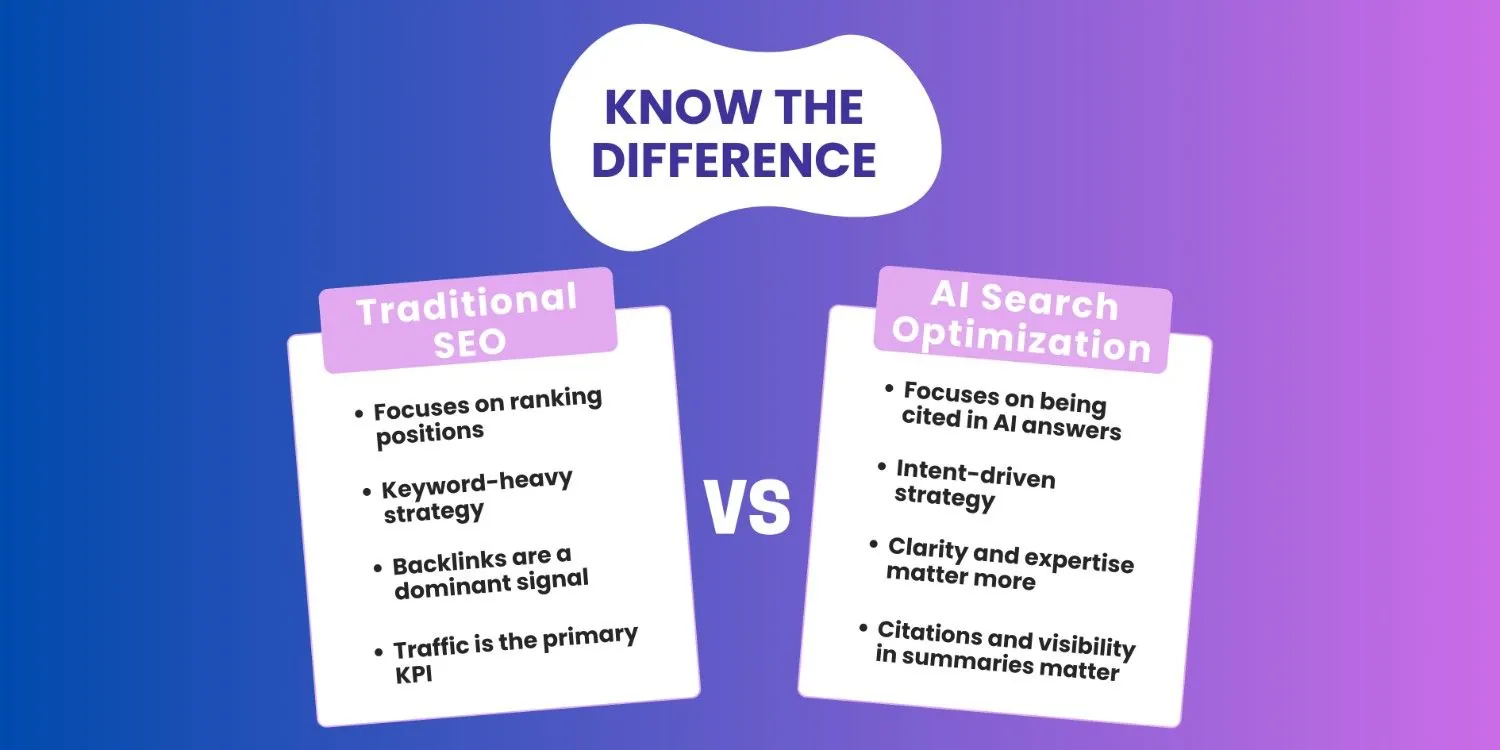
While traditional SEO focuses heavily on keyword density, backlink authority, and metadata, GEO focuses on content structure, semantic richness, expertise signals, and machine readability. Both disciplines are interconnected, but the emphasis has changed dramatically.
This presents a unique opportunity because businesses that align content strategy with AI systems early will dominate conversational visibility before their competitors understand what happened.
Why Optimizing for ChatGPT Search Matters in 2026
Several market indicators reinforce the urgency of this shift. Industry research across major SEO platforms indicates that:
A growing percentage of informational queries now trigger AI-generated answers before traditional links.
Users increasingly trust AI summaries for research, comparison, and purchase decisions.
Conversational queries are longer, more specific, and intent-driven.
The implications are significant.
If your brand is not included in AI-generated responses, your visibility declines even if your website technically ranks well in traditional search results. Being absent from AI citations means you lose both authority perception and potential traffic.
More importantly, AI search surfaces brands as trusted sources within contextual answers. This changes the psychological dynamic. Instead of users discovering you through exploration, they encounter you as a recommended authority.
For a growth-focused agency like Marketricka, this shift directly influences how we approach SEO, content creation, and sales funnel architecture for clients.
How AI Systems Select Content
To optimize effectively, we must understand how AI systems evaluate and retrieve information. AI-powered search engines generally prioritize content that demonstrates:
Logical structure with hierarchical headings
Clear question-and-answer formatting
Concise yet comprehensive explanations
Authoritative tone backed by data
Schema markup for contextual clarity
Transparent authorship and expertise signals
The AI does not “read” content the way humans do. It segments content into chunks, evaluates relevance at the paragraph level, and extracts the most contextually complete answer block. Therefore, the structure of your content is no longer cosmetic. It is functional.
Ways to Optimize Content for AI Search Engines
Search doesn’t behave the way it used to. People aren’t scanning ten links anymore. They’re asking full questions inside ChatGPT, Google AI Overviews, and similar AI systems and expecting one clear, confident answer.
That changes everything. You’re no longer optimizing only to rank on a results page. You’re optimizing so an AI model can read your content, understand it instantly, and decide it’s strong enough to quote. That requires clarity, structure, and real authority. Let’s walk through what actually works.
1. Start with How People Actually Ask
AI search engines are built around conversational queries. They interpret natural language. So if your content still revolves around stiff, two-word keywords, you’re already behind.
Instead of writing only around “AI SEO strategy,” think about real user questions:
How do I optimize content for ChatGPT search?
Why isn’t my website showing in AI-generated answers?
What is Generative Engine Optimization?
When you structure headings around real questions and answer them directly, your content aligns naturally with how AI retrieves information. It becomes easier for the model to match your page to the user’s intent.
You’re not guessing what people search for. You’re reflecting it.
2. Answer Immediately Don’t Delay
If a heading asks a question, the very next sentence should answer it clearly.
AI systems scan sections and extract clear explanations. If your definition or key point appears five paragraphs later, it may never get picked up.
For example:
What is Generative Engine Optimization?
Generative Engine Optimization (GEO) is the process of structuring content so AI systems can retrieve, interpret, and cite it in generated answers.
That’s direct. That’s usable. After that, you can expand with examples and depth.
Think of each section as something that could stand alone. If AI pulls just that paragraph, does it still make sense? If yes, you’re doing it right.
3. Structure Is Practical, Not Decorative
AI models break content into logical chunks. Headings, paragraphs, and formatting guide how they interpret meaning.
A messy article with long, dense paragraphs makes extraction harder. A clean structure makes it easier.
Here’s what improves AI readability:
Clear H1, H2, and H3 hierarchy
Short paragraphs focused on one idea
Occasional bullet points for clarity
Tables for comparisons
FAQ sections with direct answers
For example, when explaining differences between traditional SEO and AI search optimization, a table communicates faster and cleaner than paragraphs alone:
4. Write Like a Human, Not a Keyword Machine
AI models understand meaning. They don’t reward repetition.
If you force the same keyword into every sentence, your writing feels unnatural, cv b and AI systems detect that too. Instead, focus on covering the topic fully and naturally.
If you’re writing about AI search optimization, related ideas will naturally appear:
Conversational queries
Retrieval-Augmented Generation
Schema markup
E-E-A-T
AI citations
That semantic depth shows you understand the subject. You don’t need to repeat one phrase twenty times. You need to explain the topic clearly and completely.
5. Strengthen E-E-A-T Signals
AI systems tend to reference content that appears trustworthy and authoritative. That’s where E-E-A-T — Experience, Expertise, Authoritativeness, and Trustworthiness — becomes important.
If your article sounds generic, it blends into thousands of similar pages.
To strengthen credibility:
Add a real author bio
Include examples or case studies
Reference data where relevant
Share practical observations
For instance, instead of saying “AI search is growing fast,” explain how you’ve seen AI summaries replace traditional clicks for informational queries. Specific details build confidence. AI systems prefer content that feels grounded in knowledge, not surface-level commentary.
6. Use Schema Markup to Add Clarity
Schema markup doesn’t change how your article looks to readers, but it changes how machines interpret it.
Adding structured data like:
FAQPage
Article
HowTo
Product
helps search engines understand exactly what type of content they’re reading.
If you have a well-written FAQ section, marking it up correctly increases the chances that AI systems interpret it accurately. Think of a schema as labeling your content clearly so nothing gets misread.
7. Focus on Intent, Not Exact Match
AI search engines care about intent. They aim to solve the user’s problem. If someone asks, “How do I get my website cited by ChatGPT?”, your article should address:
How AI retrieval works
What makes content extractable
How structure affects citation
Why authority matters
Cover the real problem completely. Don’t obsess over repeating the exact phrase. When your content addresses the full intent behind a query, it becomes relevant to multiple related searches, which increases visibility.
8. Make Sure AI Can Actually Access Your Content
This sounds basic, but it’s overlooked often. If your content is blocked by robots.txt, hidden behind JavaScript tabs, or poorly rendered, AI systems may struggle to retrieve it.
Check:
Your important content is crawlable
Key answers aren’t hidden inside expandable sections
HTML is clean and structured
If AI cannot access the content, it cannot cite it. Optimization starts with accessibility.
9. Keep Content Updated
AI systems favor fresh information, especially for topics that change quickly. If your article says “Best tools in 2023,” it immediately looks outdated. Updating statistics, examples, and references keeps your content relevant. Even small updates signal that the page is maintained. That matters.
10. Track AI Visibility Separately
Traditional SEO metrics still matter: rankings, traffic, engagement.
But now you also need to monitor:
Whether your brand appears in AI summaries
Queries that trigger AI-generated answers
Referral traffic from AI tools
User behavior after AI-driven visits
AI visibility is becoming its own channel. If users discover you through generated answers, that’s part of your acquisition strategy now.
One Shift You Can’t Ignore is Content Optimization for ChatGPT
You’re no longer optimizing just to appear in search results. You’re optimizing to be quoted.
That means every section of your article should be clear enough to stand on its own. Every explanation should be precise. Every claim should feel confident and grounded. AI systems reward clarity, structure, and credibility. They ignore fluff.
Write for people. Organize machines. When both align, your content becomes easy to retrieve, easy to understand, and easy to cite. That’s what visibility looks like in the AI search era.